
THE EFFECT OF AERATION ON THE BIOCONVERSION OF CLITORIA TERNATEA L. TEA BY THE CULTURE OF MICROORGANISMS MEDUSOMYCES GISEVII DP-21
DOI:
https://doi.org/10.15421/jchemtech.v33i4.320639Keywords:
fermented beverages; kombucha; aeration; fermentation; physicochemical indicators; organoleptic indicators.Abstract
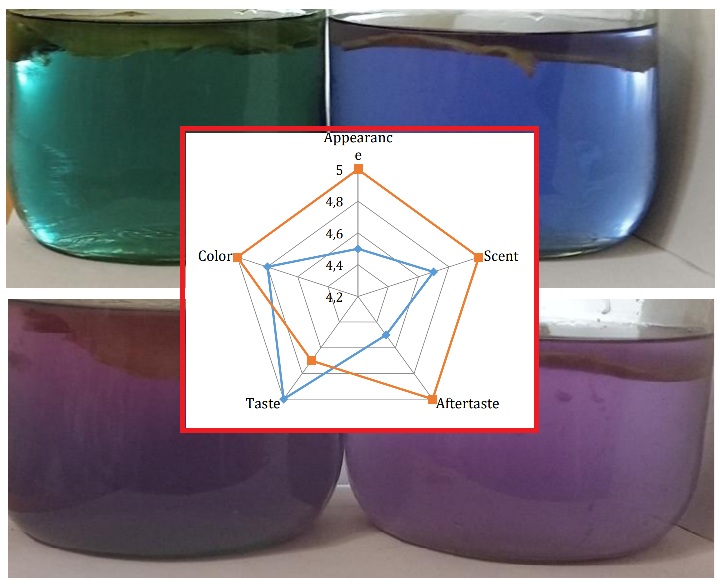
Traditional kombucha is produced by fermenting an infusion of black or green tea using a symbiotic culture of bacteria and yeast (SCOBY). According to the classification of microorganisms, this culture is called Medusomyces gisevii. It ferments sucrose and other components of the wort, which can serve as the basis for creating new products with original sensory properties beneficial to human health. The article determines the optimal temperature for extracting Clitoria ternatea L. tea leaves for the preparation of kombucha fermented beverage. It was established that the change in the color of the wort during fermentation is caused by an increase in its acidity and a corresponding change in the coloration of the fermented wort. The influence of aeration during fermentation on the appearance of the drinks was analyzed. The effect of dry matter content, particularly sucrose, on the fermentation process was studied. Changes in titratable acidity during the fermentation of wort under different cultivation conditions were determined. The content of acetic, gluconic, glucuronic, pyruvic, malic, citric, and succinic acids in the fermented wort was identified. The organoleptic profile of the drinks was examined, which confirms the feasibility of aerating the wort during fermentation.
References
Imathiu, S. (2020). Benefits and food safety concerns associated with consumption of edible insects. NFS journal, 18, 1–11. https://doi.org/10.1016/j.nfs.2019.11.002
Dulka, О., Prybylskyi, V., Fedosov, O., Olijnyk, S., Кuts, A., Sharan, L, Koretska, I., Tiurikova, I. (2023). [Іnnovative water preparation technology for production of kombucha fermented beverage]. Journal of Chemistry and Technologies, 31(1), 82–91. (In Ukrainian) https://doi.org/10.15421/jchemtech.v31i1.240014
Vartanian, L. R., Schwartz, M. B., Brownell, K. D. (2007). Effects of soft drink consumption on nutrition and health: a systematic review and meta-analysis. American journal of public health, 97(4), 667–675. doi: 10.2105/AJPH.2005.083782
Dulka, О., Prybylskyi, V., Oliinyk, S. Kuts, A., Kovalenko, O. (2019). [The improvement of the technology of water treatment for the production of kvass]. Food Science and Technology, 13(2), 111–117. (In Ukrainian)
Kim, J., Adhikari, K. (2020). Current trends in kombucha: Marketing perspectives and the need for improved sensory research. Beverages, 6(1), 15. https://doi.org/10.3390/beverages6010015
Dulka, O., Prybylskyi, V. (2021). [Kombucha – an innovative functional beverage in hospitality establishments]. Mizhnarodna naukovo-praktychna konferentsiia, 78. (In Ukrainian)
Dulka, O. (2025). [Prospects for craft production of the innovative fermented beverage kombucha for hospitality industry establishments]. Restorannyi i hotelnyi konsaltynh. Innovatsii, 7(2), 232–244. (In Ukrainian) https://doi.org/10.31866/2616-7468.7.2.2024.335181
Amarasinghe, H., Weerakkody, N. S., Waisundara, V. Y. (2018). Evaluation of physicochemical properties and antioxidant activities of kombucha “Tea Fungus” during extended periods of fermentation. Food science & nutrition, 6(3), 659–665. https://doi.org/10.1002/fsn3.605
Villarreal-Soto, S. A., Beaufort, S., Bouajila, J., Souchard, J. P., Renard, T., Rollan, S., Taillandier, P. (2019). Impact of fermentation conditions on the production of bioactive compounds with anticancer, anti-inflammatory and antioxidant properties in kombucha tea extracts. Process Biochemistry, 83, 44–54 https://doi.org/10.1016/j.procbio.2019.05.004
Vázquez-Cabral, B. D., Larrosa-Pérez, M., Gallegos-Infante, J. A., Moreno-Jiménez, M. R., González-Laredo, R.F., Rutiaga-Quiñones, J.G., Rocha-Guzmán, N.E. (2017). Oak kombucha protects against oxidative stress and inflammatory processes. Chemico-Biological Interactions, 272, 1–9. https://doi.org/10.1016/j.cbi.2017.05.001
Vitas, J. S., Cvetanović, A. D., Mašković, P. Z., Švarc-Gajić, J. V., Malbaša, R. V. (2018). Chemical composition and biological activity of novel types of kombucha beverages with yarrow. Journal of functional foods, 44, 95–102 doi:10.1016/j.jff.2018.02.019
de Miranda, J. F., Ruiz, L. F., Silva, C. B., Uekane, T. M., Silva, K. A., Gonzalez, A. G. M., Lima, A. R. (2022). Kombucha: A review of substrates, regulations, composition, and biological properties. Journal of Food Science, 87(2), 503–527. https://doi.org/10.1111/1750-3841.16029
de Melo, L. M., Soares, M. G., Bevilaqua, G. C., Schmidt, V. C. R., de Lima, M. (2024). Historical overview and current perspectives on kombucha and scoby: a literature review and bibliometrics. Food Bioscience, 104081 https://doi.org/10.1016/j.fbio.2024.104081
Aksornsri, T., Chaturapornchai, N., Jitsayen, N., Rojjanapaitoontip, P., Peanparkdee, M. (2023). Development of kombucha-like beverage using butterfly pea flower extract with the addition of tender coconut water. International Journal of Gastronomy and Food Science, 34, 100825 https://doi.org/10.1016/j.ijgfs.2023.100825
Wang, X., Wang, D., Wang, H., Jiao, S., Wu, J., Hou, Y., Yuan, J. (2022). Chemical profile and antioxidant capacity of kombucha tea by the pure cultured kombucha. LWT, 168, 113931. https://doi.org/10.1016/j.lwt.2022.113931
Escher, G. B., Wen, M., Zhang, L., Rosso, N.D., Granato, D. (2020). Phenolic composition by UHPLC-Q-TOF-MS/MS and stability of anthocyanins from Clitoria ternatea L.(butterfly pea) blue petals. Food chemistry, 331, 127341. https://doi.org/10.1016/j.foodchem.2020.127341
Giusti,M. M., Wrolstad, R. E. (2003). Acylated anthocyanins from edible sources and their applications in food systems. Biochemical engineering journal, 14(3), 217–225. https://doi.org/10.1016/S1369-703X(02)00221-8
Wang, B., Rutherfurd-Markwick, K., Zhang, X. X., Mutukumira, A. N. (2022). Kombucha: Production and microbiological research. Foods, 11(21), 3456. https://doi.org/10.3390/foods11213456
Dulka, О. S., Prybylskyi, V. L., Tyshchenko, O. M., Kovbych, V. О. (2025). Use of kombucha as a basis for the preparation of smoothies for restaurant establishments. Journal of Chemistry and Technologies, 33(1), 168–176. https://doi.org/10.15421/jchemtech.v33i1.293429
Batista, P., Penas, M. R., Pintado, M., Oliveira-Silva, P. (2022). Kombucha: perceptions and future prospects. Foods, 11(13), 1977. https://doi.org/10.3390/foods11131977
Downloads
Published
Issue
Section
License
Copyright (c) 2025 Oles Honchar Dnipro National University

This work is licensed under a Creative Commons Attribution 4.0 International License.
- Authors reserve the right of attribution for the submitted manuscript, while transferring to the Journal the right to publish the article under the Creative Commons Attribution License. This license allows free distribution of the published work under the condition of proper attribution of the original authors and the initial publication source (i.e. the Journal)
- Authors have the right to enter into separate agreements for additional non-exclusive distribution of the work in the form it was published in the Journal (such as publishing the article on the institutional website or as a part of a monograph), provided the original publication in this Journal is properly referenced
- The Journal allows and encourages online publication of the manuscripts (such as on personal web pages), even when such a manuscript is still under editorial consideration, since it allows for a productive scientific discussion and better citation dynamics (see The Effect of Open Access).