
INTEGRATED MULTICRITERIA ANALYSIS OF HYDROGEN AND AMMONIA AS ALTERNATIVE MARINE FUELS IN THE MARITIME TRANSPORT DECARBONIZATION PROCESS
DOI:
https://doi.org/10.15421/jchemtech.v33i4.335825Keywords:
maritime transport, ship operation, environmental safety, pollution prevention, NOₓ emissions, technical systems, power plants, ammonia toxicity, fuel economy, energy efficiency, port infrastructure, marine environment protection, marine decarbonization, alternative fuels, energy efficiency, port infrastructure, safety risk management.Abstract
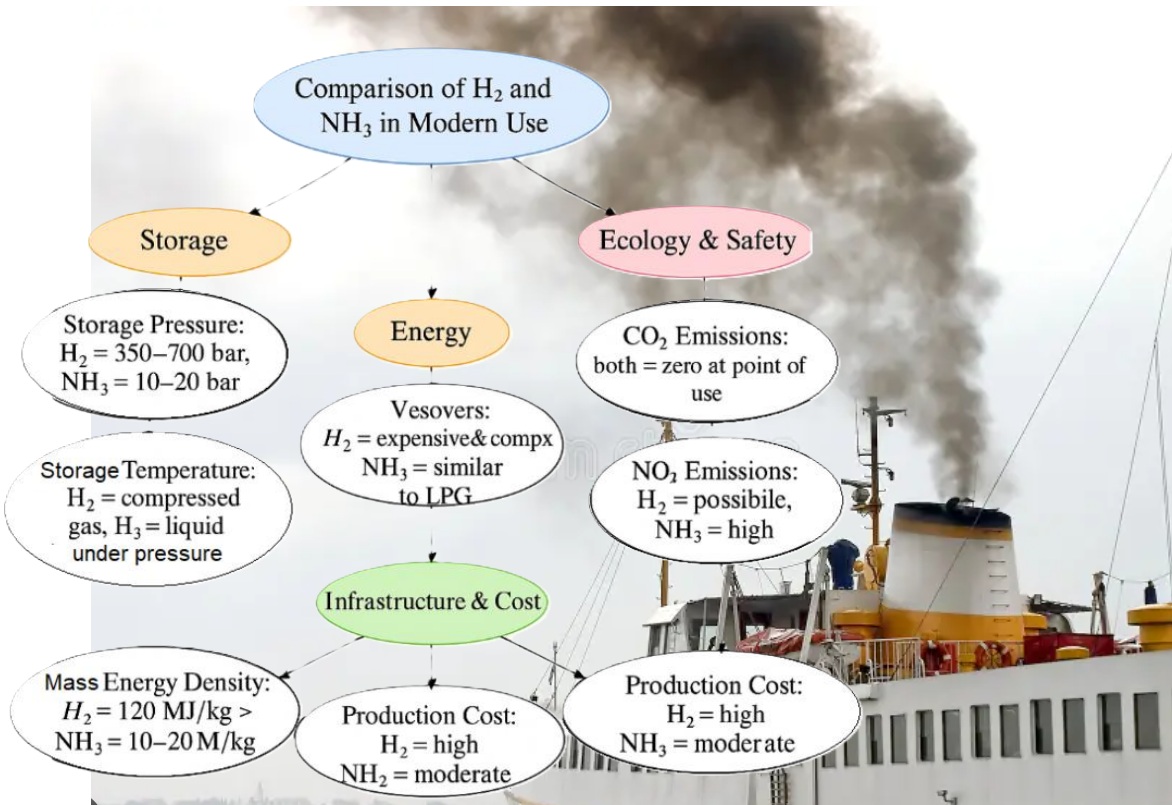
In this work, a new method of fuel selection for ships is proposed, taking into account indicators of efficiency, environmental friendliness and safety. First, the characteristics of hydrogen and ammonia as potential substitutes for traditional fuels are analyzed in detail with an emphasis on cost, energy efficiency and technical features of their storage and transportation. Next, with the help of statistical models, the risks of emergency situations were assessed, taking into account random factors for the quantitative determination of the probability of failures under different operating conditions. The next step is to formulate the task of optimal choice of route and type of fuel, combining economic costs and safety requirements. A separate section is devoted to the analysis of the full life cycle of fuel, from production to final consumption, which makes it possible to compare the environmental impact of different options. Based on the obtained results, a generalized index was developed that allows shipowners and operators to make informed decisions during the transition to «green» technologies. Examples of real projects illustrate the practical suitability of the approach and its prospects for fleet modernization in the face of global emissions reduction requirements.
References
Levikhin, A., Boryaev, A. (2025). Low-carbon ammonia-based fuel for maritime transport. Results in Engineering, 25, 104175. https://doi.org/10.1016/j.rineng.2025.104175
Schreuder, W., Slootweg, J. C., Van der Zwaan, B. (2025). Techno-economic assessment of low-carbon ammonia as fuel for the maritime sector. Applications in Energy and Combustion Science, 22, 100330. https://doi.org/10.1016/j.jaecs.2025.100330
Machaj, K., Kupecki, J., Malecha, Z., Morawski, A., Skrzypkiewicz, M., Stanclik, M., Chorowski, M. (2022). Ammonia as a potential marine fuel: A review. Energy Strategy Reviews, 44, 100926. https://doi.org/10.1016/j.esr.2022.100926
Li, Z., Wang, K., Liang, H., Wang, Y., Ma, R., Cao, J., Huang, L. (2025). Marine alternative fuels for shipping decarbonization: Technologies, applications and challenges. Energy Conversion and Management, 329, 119641. https://doi.org/10.1016/j.enconman.2025.119641
Dickson, U. J., Huang, C. (2025). 2050 UK shipping emissions of NOx, SOx, PM10, and PM2.5: What are the determining factors, is the zero pollution by 2050 feasible, and will the reduction rate for these pollutants be at the same pace? Marine Pollution Bulletin, 220, 118371. https://doi.org/10.1016/j.marpolbul.2025.118371
Jörissen, L. (2024). Fuels – Introduction | Hydrogen Industrial Use. Encyclopedia of Electrochemical Power Sources (Second Edition), 161–170. https://doi.org/10.1016/B978-0-323-96022-9.00267-X
Wang, Z., Li, M., Zhao, F., Ji, Y., Han, F. (2024). Status and prospects in technical standards of hydrogen-powered ships for advancing maritime zero-carbon transformation. International Journal of Hydrogen Energy, 62, 925–946. https://doi.org/10.1016/j.ijhydene.2024.03.083
Li, J., Xu, H., Zhou, K., Li, J. (2024). A review on the research progress and application of compressed hydrogen in the marine hydrogen fuel cell power system. Heliyon, 10(3), e25304. https://doi.org/10.1016/j.heliyon.2024.e25304
Islam Rony, Z., Mofijur, M., Hasan, M., Rasul, M., Jahirul, M., Forruque Ahmed, S., Kalam, M., Anjum Badruddin, I., Yunus Khan, T., Show, P. (2023). Alternative fuels to reduce greenhouse gas emissions from marine transport and promote UN sustainable development goals. Fuel, 338, 127220. https://doi.org/10.1016/j.fuel.2022.127220
Alrashid, R., Mahmoud, M., Alami, A. H. (2024). Introduction to Green Hydrogen and Green Ammonia. Comprehensive Green Materials, 256–271. https://doi.org/10.1016/B978-0-443-15738-7.00038-6
Van Sickle, E., Ralli, P., Pratt, J., Klebanoff, L. (2025). MV Sea Change: The first commercial 100% hydrogen fuel cell passenger ferry in the world. International Journal of Hydrogen Energy, 105, 389–404. https://doi.org/10.1016/j.ijhydene.2025.01.040
Jesus, B., Ferreira, I. A., Carreira, A., Ove Erikstad, S., Godina, R. (2024). Economic framework for green shipping corridors: Evaluating cost-effective transition from fossil fuels towards hydrogen. International Journal of Hydrogen Energy, 83, 1429–1447. https://doi.org/10.1016/j.ijhydene.2024.08.147
Xing, H., Stuart, C., Spence, S., Chen, H. (2021). Alternative fuel options for low carbon maritime transportation: Pathways to 2050. Journal of Cleaner Production, 297, 126651. https://doi.org/10.1016/j.jclepro.2021.126651
Tasleem, S., Bongu, C. S., Krishnan, M. R., Alsharaeh, E. H. (2024). Navigating the hydrogen prospect: A comprehensive review of sustainable source-based production technologies, transport solutions, advanced storage mechanisms, and CCUS integration. Journal of Energy Chemistry, 97, 166–215. https://doi.org/10.1016/j.jechem.2024.05.022
Harahap, F., Nurdiawati, A., Conti, D., Leduc, S., Urban, F. (2023). Renewable marine fuel production for decarbonised maritime shipping: Pathways, policy measures and transition dynamics. Journal of Cleaner Production, 415, 137906. https://doi.org/10.1016/j.jclepro.2023.137906
Abbas, M., Abbas, Q., Khan, A., Tayyab, S. M., Mehdi Rizvi, S. H., Raza, A., Haider Zaidi, S. S., Razzaqi, A. A., Haider, S., Sarfraz, S. A. (2024). Energy management in marine transportation sector. Reference Module in Earth Systems and Environmental Sciences. https://doi.org/10.1016/B978-0-44-313219-3.00151-9
Arias, A., Nika, C., Vasilaki, V., Feijoo, G., Moreira, M. T., & Katsou, E. (2024). Assessing the future prospects of emerging technologies for shipping and aviation biofuels: A critical review. Renewable and Sustainable Energy Reviews, 197, 114427. https://doi.org/10.1016/j.rser.2024.114427
Lee, G. N., Kim, J. M., Jung, K. H., Park, H. (2024). Comparative life cycle assessment of various hydrogen supply methods from Australia to the Republic of Korea in environmental and economic aspects. Science of The Total Environment, 947, 174669. https://doi.org/10.1016/j.scitotenv.2024.174669
Wang, Y., Cao, Q., Liu, L., Wu, Y., Liu, H., Gu, Z., Zhu, C. (2022). A review of low and zero carbon fuel technologies: Achieving ship carbon reduction targets. Sustainable Energy Technologies and Assessments, 54, 102762. https://doi.org/10.1016/j.seta.2022.102762
Fan, H., Abdussamie, N., Chen, P. S. L., Harris, A., Gray, E. M., Arzaghi, E., Bhaskar, P., Mehr, J. A., Penesis, I. (2025). Two decades of hydrogen-powered ships (2000–2024): Evolution, challenges, and future perspectives. Renewable and Sustainable Energy Reviews, 219, 115878. https://doi.org/10.1016/j.rser.2025.115878
Wang, Z., Dong, B., Li, M., Ji, Y., Han, F. (2024). Configuration of Low-Carbon fuels green marine power systems in diverse ship types and Applications. Energy Conversion and Management, 302, 118139. https://doi.org/10.1016/j.enconman.2024.118139
Hoang, A. T., Pandey, A., Martinez De Osés, F. J., Chen, W., Said, Z., Ng, K. H., Ağbulut, Ü., Tarełko, W., Ölçer, A. I., Nguyen, X. P. (2023). Technological solutions for boosting hydrogen role in decarbonization strategies and net-zero goals of world shipping: Challenges and perspectives. Renewable and Sustainable Energy Reviews, 188, 113790. https://doi.org/10.1016/j.rser.2023.113790
Melnyk, O., Onyshchenko, S., Onishchenko, O., Shumylo, O., Voloshyn, A., Ocheretna, V., & Fedorenko, O. (2024). Implementation Research of Alternative Fuels and Technologies in Maritime Transport. Studies in Systems, Decision and Control, 510, 13-31. https://doi.org/10.1007/978-3-031-44351-0_2
Melnyk, O., Onishchenko, O., Onyshchenko, S. (2023). Renewable Energy Concept Development and Application in Shipping Industry. Lex Portus, 9(6), 15–24. https://doi.org/10.26886/2524-101X.9.6.2023.2
Melnyk, O., Bulgakov, M., Fomin, O., Onyshchenko, S., Onishchenko, O., Pulyaev, I. (2025). Sustainable development of renewable energy in shipping: technological and environmental prospects. Scientific Journal of Silesian University of Technology. Series Transport, 127, 165–188. https://doi.org/10.20858/sjsutst.2025.127.10
International Energy Agency. (2024). World Energy Outlook 2024. https://www.iea.org/reports/world-energy-outlook-2024
Det Norske Veritas. (2025). Energy Transition Outlook 2025. https://www.dnv.com/energy-transition-outlook/
International Renewable Energy Agency. (2024a). World Energy Transitions Outlook 2024: 1.5 °C pathway. Available at: https://www.irena.org/-/media/Files/IRENA/Agency/Publication/2024/Nov/IRENA_World_energy_transitions_outlook_2024.pdf
International Renewable Energy Agency. (2024b). Renewable Energy Statistics 2024. https://www.irena.org/-media/Files/IRENA/Agency/Publication/2024/Jul/IRENA_Renewable_Energy_Statistics_2024.pdf
International Maritime Organization. (2023). 2023 IMO strategy on reduction of GHG emissions from ships. Доступно: https://www.imo.org/en/OurWork/Environment/Pages/2023-IMO-Strategy-on-Reduction-of-GHG-Emissions-from-Ships.aspx
International Maritime Organization. (2020). Fourth IMO GHG study 2020. Доступно: https://www.imo.org/en/Publications/Pages/Fourth-IMO-GHG-Study-2020.aspx
Brynolf, S., Taljegard, M., Grahn, M., Hansson, J. (2017). Electrofuels for the transport sector: A review of production costs. Renewable and Sustainable Energy Reviews, 81, 1887–1905. https://doi.org/10.1016/j.rser.2017.05.288
Valera-Medina, A., Xiao, H., Owen-Jones, M., David, W., Bowen, P. (2018). Ammonia for power. Progress in Energy and Combustion Science, 69, 63–102. https://doi.org/10.1016/j.pecs.2018.07.001
Ishak, M. I., Masri, A. N., Rasol, A. A. A., Ibrahim, I. M., & Hasbullah, H. (2025). Amino acid deep eutectic solvents (AADES) in oil purification: An overview of properties, applications, and future directions. Journal of Ionic Liquids, 5(1), 100143. https://doi.org/10.1016/j.jil.2025.100143
Shumylo, O., Yarovenko, V., Malaksiano, M., & Melnyk, O. (2023). Comprehensive assessment of hull geometry influence of a modernized ship on maneuvering performance and propulsion system parameters. Pomorstvo, 37(2), 314–325. https://doi.org/10.31217/p.37.2.13
Anantharaman, M., Sardar, A., Islam, R. (2025). Decarbonization of shipping and progressing towards reducing greenhouse gas emissions to net zero: A bibliometric analysis. Sustainability, 17(7), 2936. https://doi.org/10.3390/su17072936
Sagin, S., Haichenia, O., Karianskyi, S., Kuropyatnyk, O., Razinkin, R., Sagin, A., Volkov, O. (2025). Improving green shipping by using alternative fuels in ship diesel engines. Journal of Marine Science and Engineering, 13(3), 589. https://doi.org/10.3390/jmse13030589
Petrychenko, O., Levinskyi, M., Goolak, S., Lukoševičius, V. (2025). Prospects of solar energy in the context of greening maritime transport. Sustainability, 17(5), 2141. https://doi.org/10.3390/su17052141
Christopher Selvam, D., Raja, T., Nagappan, B., Upadhye, V. J., Guntaj, J., Devarajan, Y., & Mishra, R. (2025). The role of biodiesel in marine decarbonization: Technological innovations and ocean engineering challenges. Results in Engineering, 25, Article 103974. https://doi.org/10.1016/j.rineng.2025.103974
Kalafatelis, A. S., Nomikos, N., Giannopoulos, A., Alexandridis, G., Karditsa, A., & Trakadas, P. (2025). Towards predictive maintenance in the maritime industry: A component-based overview. Journal of Marine Science and Engineering, 13(3), 425. https://doi.org/10.3390/jmse13030425
Melnyk, O. M., Onishchenko, O. A., Shyshkin, O. V., Volkov, O. M., Volyanskyy, S. M., Maulevych, V. O., Kreitser, K. O. (2024). Enhancing shipboard technical facility performance through the utilization of low-sulfur marine fuel grades. Journal of Chemistry and Technologies, 32(1), 233–245. https://doi.org/10.15421/jchemtech.v32i1.297916
Onishchenko, O., Bukaros, A., Melnyk, O., Yarovenko, V., Voloshyn, A., Lohinov, O. (2023). Ship refrigeration system operating cycle efficiency assessment and identification of ways to reduce energy consumption of maritime transport. In Studies in Systems, Decision and Control, 481, 641–652). Springer. https://doi.org/10.1007/978-3-031-35088-7_36
Korban, D., Melnyk, O., Onishchenko, O., Kurdiuk, S., Shevchenko, V., Obniavko, T. (2024). Radar-based detection and recognition methodology of autonomous surface vehicles in challenging marine environment. Scientific Journal of Silesian University of Technology. Series Transport, 122, 111–127. https://doi.org/10.20858/sjsutst.2024.122.7
Melnyk, O., Onishchenko, O., Onyshchenko, S., Yaremenko, N., Maliuha, E., Honcharuk, I., Shamov, O. (2024). Innovative technologies for the maritime industry: Hydrogen fuel as a promising direction. In Studies in Systems, Decision and Control, 510, 23–34). Springer. https://doi.org/10.1007/978-3-031-44351-0_3
Melnyk, O., Onyshchenko, S., Onishchenko, O., Shibaev, O., Volyanskaya, Y. (2024). A comprehensive approach to structural integrity analysis and maintenance strategy for ship’s hull. Journal of Maritime Research, 21(1), 36–44.
Melnyk, O., Onyshchenko, S., Onishchenko, O., Shumylo, O., Voloshyn, A., Ocheretna, V., Fedorenko, O. (2024). Implementation research of alternative fuels and technologies in maritime transport. In Studies in Systems, Decision and Control, 510, 13–21. Springer. https://doi.org/10.1007/978-3-031-44351-0_2
Onishchenko, O. A., Melnyk, O. M., Yarovenko, V. A., Aleksandrovska, N. I., Kurdiuk, S. V., Parmenova, D. G., Storchak, O. O. (2023). Study of efficiency and advancement of marine engine oil purification and filtration technologies. Journal of Chemistry and Technologies, 31(4), 762–774. https://doi.org/10.15421/jchemtech.v31i4.285643
Onyshchenko, S., Bychkovsky, Y., Melnyk, O., Onishchenko, O., Jurkovič, M., Rubskyi, V., Liashenko, K. (2024). A model for assessing shipping safety within project-orientated risk management based on human element. Scientific Journal of Silesian University of Technology. Series Transport, 123, 319–334. https://doi.org/10.20858/sjsutst.2024.123.16
Melnyk, O., Onishchenko, O., Onyshchenko, S., Voloshyn, A., Ocheretna, V. (2023). Comprehensive study and evaluation of ship energy efficiency and environmental safety management measures. In Studies in Systems, Decision and Control, 481, 665–679. Springer. https://doi.org/10.1007/978-3-031-35088-7_38
Sagin, S., Chymshyr, V., Karianskyi, S., Kuropyatnyk, O., Madey, V., Rusnak, D. (2025). Using ultrasonic fuel treatment technology to reduce sulfur oxide emissions from marine diesel exhaust gases. Energies, 18(17), 4756. https://doi.org/10.3390/en18174756
Minchev, D. S., Varbanets, R. A., Alexandrovskaya, N. I., Pisintsaly, L. V. (2021). Marine diesel engines operating cycle simulation for diagnostics issues. Acta Polytechnica, 61(3), 428–440. https://doi.org/10.14311/ap.2021.61.0435
Varbanets, R., Minchev, D., Kucherenko, Y., Zalozh, V., Kyrylash, O., Tarasenko, T. (2024). Methods of real-time parametric diagnostics for marine diesel engines. Polish Maritime Research, 31(3), 71–84. https://doi.org/10.2478/pomr-2024-0037
Onyshchenko, S., Bondar, A., Andrievska, V., Sudnyk, N., Lohinov, O. (2019). Constructing and exploring the model to form the road map of enterprise development. Eastern-European Journal of Enterprise Technologies, 5(3-101), 33–42. https://doi.org/10.15587/1729-4061.2019.179185
Downloads
Published
Issue
Section
License
Copyright (c) 2025 Oles Honchar Dnipro National University

This work is licensed under a Creative Commons Attribution 4.0 International License.
- Authors reserve the right of attribution for the submitted manuscript, while transferring to the Journal the right to publish the article under the Creative Commons Attribution License. This license allows free distribution of the published work under the condition of proper attribution of the original authors and the initial publication source (i.e. the Journal)
- Authors have the right to enter into separate agreements for additional non-exclusive distribution of the work in the form it was published in the Journal (such as publishing the article on the institutional website or as a part of a monograph), provided the original publication in this Journal is properly referenced
- The Journal allows and encourages online publication of the manuscripts (such as on personal web pages), even when such a manuscript is still under editorial consideration, since it allows for a productive scientific discussion and better citation dynamics (see The Effect of Open Access).