COMPARATIVE STUDIES OF THE PROPERTIES OF BOILED SAUSAGES OF FUNCTIONAL PURPOSE WITH TOMATO POMACE OR THEIR SUBCRITICAL EXTRACTS
DOI:
https://doi.org/10.15421/jchemtech.v33i4.336084Keywords:
boiled sausages;, tomato pomace;, subcritical extracts;, functional properties;, nutritional value;, consumer properties;, antioxidant properties.Abstract
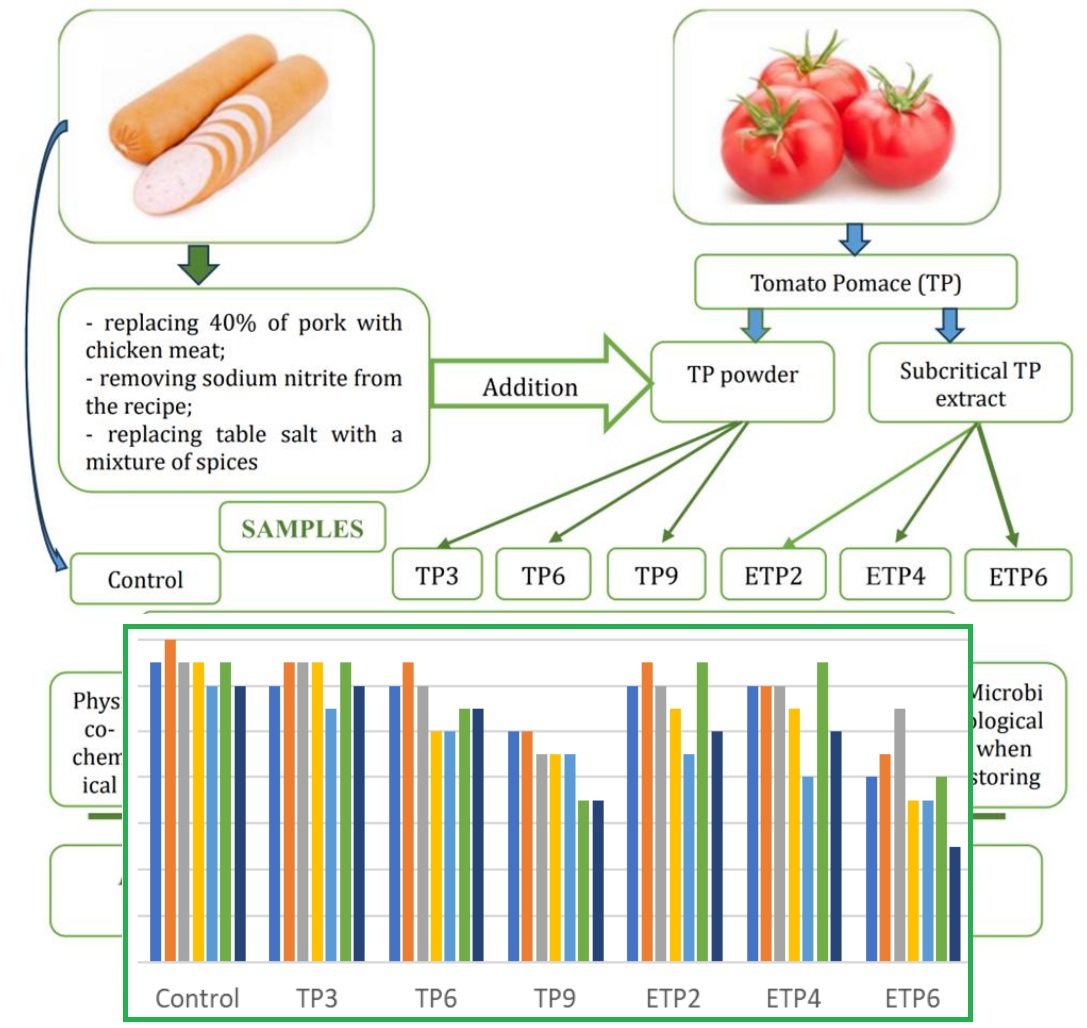
The development of technologies for functional cooked sausages (CS) involves reducing fat and salt content, eliminating sodium nitrite, and enriching their composition with tomato purée (TP) or their subcritical extracts. The purpose of the work is to investigate the properties of CS made using TP or their subcritical extracts. Methods: subcritical extracts of TP were obtained in a high-pressure reactor RVD-2-500; study of the properties of objects – using generally accepted methods. Results. Replacing 40 % of pork with chicken meat; removing sodium nitrite from the composition of CS, replacing 60–62 % of table salt with a mixture of spices and adding to the recipe composition of TP (in the form of powder – 3 %, 6 %, 9 %) or their subcritical extract (2 %, 4 %, 6 %), with their subsequent organoleptic evaluation allowed us to select samples with the addition of 6 % TP and 4 % TP extract. The improvement of the technology led to the enrichment of CS with dietary fibers, carotenoids (mainly lycopene), made it possible to reduce the hardness of VK by 2.1–8.1 %; improve chewing properties by 1.02–1.07 times; reduce fat content, increase the content of crude fiber, cooking yield and emulsion stability. There was a slight increase in the brightness of CS samples with TР and an increase in red color. The presence of lycopene led to an increase in the antioxidant properties of the samples: after 10 days of storage, the TBARS index for samples with 6 % TР and 4 % TР extract had values of 1.7 and 1.8, and the control sample had 2.3 mg of malondehydrate/kg. Microbiological indicators of all samples met the current requirements. Conclusions: samples with 6% TB and 4 % TР extract were positively perceived by experts and increased the nutritional value and consumer properties of CS.
References
Meat Market Review. Overview of global market developments in 2024. https://openknowledge.fao.org/handle/20.500.14283/cd5077en.
Davydova, O. B., Zozuljov, O. V. (2021). [Current state of the Ukrainian sausage market: key trends and development drivers]. Aktualjni problemy ekonomiky ta upravlinnja. 15. 11. (in Ukrainian).
Bal-Prylypko, L., Nikolayenko, M., Cherednichenko, O., Danylenko, S., Stepasyuk, L. (2022). Current problems of the meat processing industry and practical approaches to enhancing the formulations of sausage products. Food resources, 10(19), 26–37. https://doi.org/10.31073/foodresources2022-19-03.
Zaky, A, A., Witrowa‐Rajchert, D., Nowacka, M. (2025). Revolution of Bioactive Compound Extraction: Impacts on Food Safety, Health, and Sustainability, Food Safety and Health. 2835–1096, https://www.doi.org/10.1002/fsh3.70012.
Skwarek, P., Karwowska, M. (2025). The Effect of Tomato Pomace on the Oxidative and Microbiological Stability of Raw Fermented Sausages with Reduced Addition of Nitrites. International Journal of Food Science. Article ID 6146090, 12. . https://doi.org/10.1155/ijfo/6146090.
Naik, H.R.; Amin, T. (2021). Processing and Preservation оf Meat and Meat Products. In Food Processing and Preservation; CRC Press: Boca Raton, FL, USA. https://doi.org/10.1201/9781003243250-7.
Li, Y., Sukmanov, V., Hanjun, M., Kang, Z.L. (2021). High pressure applications in low salt gel meat technologies. A review. Ukrainian Journal of Food Science. 9(2), 181–197. https://doi.org/10.24263/2310-1008-2021-9-2-6.
Bistola, V., Arfaras-Melainis, A., Trogkanis, E., Bakosis, G., Polyzogopoulou, E., Karavidas, I. N., Ikonomidis I., Parissis, J., Karavidas, A. (2020). Safety and efficacy of salt substitution with a low sodium-potassium enriched dietary salt in patients with heart failure with reduced ejection fraction: A pilot study. Clinical Nutrition ESPEN. 35, 90–94. https://doi.org/10.1016/j.clnesp.2019.11.004
Li, Y., Valerii А., Sukmanov, V., Hanjun, M., Kang, Z. L. (2021). High Pressure Applications in Low Salt Gel Meat Technologies. A review. Ukrainian Journal of Food Science. 9(2), 321–327. https://doi.org/10.24263/2310-1008-2021-9-2-6.
Li, Y., Kang, Z. L., Sukmanov, V., Ma, H.J. (2021). Effects of soy protein isolate on gel properties and water holding capacity of low-salt pork myofibrillar protein under high pressure processing. Meat Sci. 20(176), 108471. https://doi.org/10.1016/j.meatsci.2021.108471.
Šojića, B., Pavlića, B., Tomovića, V., Sunčica Kocić-Tanackova, S., Đurovićb, S., Zekovića, Z., Belovićc, M., Torbicac, A., Jokanovića, M., Uromovićd, N., Vujadinoviće, D., Ivića, M., Škaljaca, S. (2020). Tomato pomace extract and organic peppermint essential oil as effective sodium nitrite replacement in cooked pork sausages. Food Chemistry 330, 127202. https://doi.org/10.1016/j.foodchem.2020.127202.
Šojić, B., Tomović, V., Džinić, N., Jokanović, M., Ikonić, P., Škaljac, S., Pavlić, B. (2019). Plant extracts as natural antioxidants in meat processing. Bulgarian Journal of Agricultural Science, Agricultural Academy. 25 (Suppl. 1), 27–30.
Tokysheva, G., Tultabayeva, T., Mukhtarkhanova, R., Zhakupova, G., Gorbulya, V., Kakimov, M., Makangali, K. (2023). The study of physicochemical and technological properties of boiled sausage recommended for the older adults. Potravinarstvo Slovak Journal of Food Sciences, 17, 16–29. https://doi.org/10.5219/1806.
Szabo, K., Rodica-Anita, V., Ciont, C., Macri, A.M., Vodnar, D.C. (2025). An updated overview on the revalorization of bioactive compounds derived from tomato production and processing by-products. Review. Journal of Cleaner Production. 497(15), 145151. https://doi.org/10.1016/j.jclepro.2025.145151.
Olvera-Aguirre, G., Piñeiro-Vázquez, Á.T., Sanginés-García, J.R., Sánchez Zárate, A., Ochoa-Flores, A.A., Segura-Campos, M.R., Vargas-Bello-Pérez, E., Chay-Canul, A.J. (2023). Using plant-based compounds as preservatives for meat products: A review. Heliyon. 9(6), e17071. https://doi.org/10.1016/j.heliyon.2023.e17071.
Chabi, I. B., Oscar Zannou, Z., Emmanuelle, S.C., Dedehou, A., Ayegnon, D.P., Oloude, B., Odouaro, O., Maqsood, S., Galanakis, C.M., Kayode, A.P.P. (2024). Tomato pomace as a source of valuable functional ingredients for improving physicochemical and sensory properties and extending the shelf life of foods: A review. Heliyon, 10(3), e25261. https://doi.org/10.1016/j.heliyon.2024.e25261.
Navarro-González, I. García-Valverde, V. García-Alonso, J. (2021). Chemical profile, functional and antioxidant properties of tomato peel fiber Food Res. Int. 44, 1528–1535. http://dx.doi.org/10.1016/j.foodres.2011.04.005.
Zuorro, A. Fidaleo, M. Lavecchia, R. (2011). Enzyme-assisted extraction of lycopene from tomato processing waste Enzym. Microb. Technol. 49, 567–573. https://doi.org/10.1016/j.enzmictec.2011.04.020.
Lu, Z. Wang, J. Gao, R. (2019). Sustainable valorisation of tomato pomace: a comprehensive review. Trends Food Sci. Technol. 86, 172-187. https://doi.org/10.1016/j.tifs.2019.02.020.
Saini, R.K., Moon, S.H., Keum, Y.S. (2018). An updated review on use of tomato pomace and crustacean processing waste to recover commercially vital carotenoids. Food Res. Int. 108, 516–529. 10.1016/j.foodres.2018.04.003.
Liadakis, G., Kekes, T., Frakolaki, G., Giannou V. (2022). Ingredients for Food Products. In book: Tomato Processing By-Products (pp.117-148) Elsevier Inc., 2022. https://doi.org/10.1016/B978-0-12-822866-1.00007-7.
Domínguez, R., Gullón, P., Pateiro, M., Munekata, P.E.S., Zhang, W., Lorenzo, J.M. (2020). Tomato as Potential Source of Natural Additives for Meat Industry. A Review. Antioxidants. 15, 9(1), 73. https://doi.org/10.3390/antiox9010073.
Zaky, A.A., Akram, M.U., Rybak, K., Witrowa-Rajchert, D., Nowacka, M. (2024). Bioactive compounds from plants and by-products: Novel extraction methods, applications, and limitations. AIMS Molecular Science. 11(2), 150–188. https://www.doi.org/10.3934/molsci.2024010.
Pandya, D., Akbari, S., Bhatt, H., Joshi, D.C. (2017). Standardization of solvent extraction process for Lycopene extraction from tomato pomace. J Appl Biotechnol Bioeng. 2(1), 12–16. https://www.doi.org/10.15406/jabb.2017.02.00019.
Jamaleddine, A., de Caro, P., Bouajila, J., Evon, P., Haddad, J. G., El-Kalamouni, C., Hijazi, A., Merah, O. (2022). In Vitro Bioactivities of Extracts from Tomato Pomace. Front. Biosci. (Landmark Ed), 27(9), 259. https://doi.org/10.31083/j.fbl2709259.
Cheng, Y., Xue, F., Yu, S., Du, S., Yang, Y. (2021). Subcritical Water Extraction of Natural Products. Molecules, 26(13), 4004; https://doi.org/10.3390/molecules26134004.
Sukmanov, V., Suprun, А. (2021). Extraction of biologically active substances from onion peel with the subcritical water in a static mode. Journal of Chemistry and Technologies. 29(2), 265–278. https://doi.org/10.15421/jchemtech.v29i2.225749.
Rozzi, N. L., Singh, R. K., Vierling, R. A., Watkins, B. A. (2002). Supercritical Fluid Extraction of Lycopene from Tomato Processing Byproducts. J. Agric. Food Chem., Vol. 50, No. 9 2638−2643. https://doi.org/10.1021/jf011001t.
J.Y. Méndez-Carmona, B. A., Ascacio-Valdes, J.A.. Alvarez-Perez, O.B., Hernández-Almanza, A. Y., Ramírez-Guzman, N., Sepúlveda, L., Aguilar-González, M. A., Ventura-Sobrevilla, J. M., Aguilar, C.N. (2022). Tomato waste as a bioresource for lycopene extraction using emerging technologies. Food Bioscience. 49, 101966. https://doi.org/10.1016/j.fbio.2022.101966.
Li, N., Xia, Q., Hou, Y., Xu, G. (2018). Comparisons of three modifications on structural, rheological and functional properties of soluble dietary fibers from tomato peels. LWT. 88, 56–63. https://doi.org/10.1016/j.lwt.2017.10.003.
Karoui, I. J., Chaabani, E., Dali, I., Aydi, A., Hammami, M., Abderrabba, M. (2023). Optimization of antioxidant and lycopene extraction from tomato pomace using Hansen solubility parameters and its application in chicken meat preservation. Journal of Food Science. 88(9), 3714–3724. https://doi.org/10.1111/1750-3841.16722.
Islamova, G., Utebaeva, A., Yevlash, V., Shingisov, A., Kanseitova, E. (2025). Development of technology for functional combined meat cutlets “Turkestan” enriched with tomato pomace powder. Eastern-European Journal of Enterprise Technologies, 1 (11 (133)), 71–81. https://doi.org/10.15587/1729-4061.2025.323381.
Rаtsuк, M., Sаribекоvа, D., Vodyanitska, Z. (2022). Preparation of cooked sausage products with food fibers. Herald of Khmelnytskyi National University Technical sciences 307(2), 169–172. https://www.doi.org/10.31891/2307-5732-2022-307-2-169-172.
Shevchenko, I., Tunik, O. (2024). Cryoprotective properties of functional mixtures in cooked sausage products. Ukrainian Journal of Food Science. 12(1), 33–44. https://www.doi.org/10.24263/2310-1008-2024-12-1-5.
Wenjiao, F., Yongkui, Z., Yunchuan, C., Junxiu, S., Yuwen, Y. (2024). TBARS predictive models of pork sausages stored at different temperatures. Meat Science. 96(1), 1–4. https://doi.org/10.1016/j.meatsci.2013.06.025.
Bal-Prylypko, L., Nikolayenko, M.S., Danylenko, S.H., Ustymenko, I.M., Ryabovol, M.V., Zhurenko D. V. (2024). Justification of technology of sausages for herodietic purpose. Journal of Chemistry and Technologies 32(3), 759–765. https://doi.org/10.15421/jchemtech.v32i3.306991.
Ahmed, M., Akter, M.S., Lee, J-C., Eun, J-B. (2010). Encapsulation by spray drying of bioactive components, physicochemical and morphological properties from purple sweet potato. LWT-Food Science and Technology, 43, 1307–1312. http://dx.doi.org/10.1016/j.lwt.2010.05.014.
Raghavendra, S.N., Ramachandra Swamy, S.R., Rastogi, N.K.; Raghavarao, K.S.; Kumar, S.; Tharanathan, R.N. (2006). Grinding characteristics and hydration properties of coconut residue: A source of dietary fiber. J. Food Eng. 72, 281–286. https://doi.org/10.1016/j.jfoodeng.2004.12.008.
Garau, M.C.; Simal, S.; Rosselló, C.; Femenia, A. (2007). Effect of air-drying temperature on physico-chemical properties of dietary fibre and antioxidant capacity of orange (Citrus aurantium v. Canoneta) by-products. Food Chem. 104, 1014–1024. https://doi.org/10.1016/j.foodchem.2007.01.009.
Operating instructions texture analyzer TA-XT plus. Stable Micro Systems Ltd., UK.
Sukmanov, V. O., Mulko, I. S. (2023). [Study of the rheological and organoleptic properties of chicken nuggets with low sodium chloride content and added apple]. Scientific Bulletin of Tavria State Agrotechnological University, 13(1). (In Ukrainian).
Mäkinen, S., Hellström, J., Mäki, M., Korpinen, R., Mattila, P H. (2020). Bilberry and Sea Buckthorn Leaves and Their Subcritical Water Extracts Prevent Lipid Oxidation in Meat Products. Foods, 9(3), 265. https://doi.org/10.3390/foods9030265,
Colucci Cante, R., Gallo, M., Varriale, L., Garella, I., Nigro, R. (2022). Recovery of Carotenoids from Tomato Pomace Using a Hydrofluorocarbon Solvent in Sub-Critical Conditions. Applied Sciences, 12(6), 2822. https://doi.org/10.3390/app12062822.
Cheng, Y., Xue, F., Yu, S., Du, S., Yang, Y. (2021). Subcritical Water Extraction of Natural Products. Molecules, 26(13), 4004; https://doi.org/10.3390/molecules26134004.
Sukmanov, V., Suprun, А. (2021). Extraction of biologically active substances from onion peel with the subcritical water in a static mode. Journal of Chemistry and Technologies. 29(2), 265–278. https://doi.org/10.15421/jchemtech.v29i2.225749.
Sukmanov, V., Kovalchuk, О. (2023). Influence of extraction parameters on the properties of subcritical water extracts of soybean meal. Journal of Chemistry and Technologies. 31(1), 72–81. https://doi.org/10.15421/jchemtech.v31i1.274376.
Garcia M.L, Dominguez R., Garlvez M.D., Casas S., Sergas M.D. (2002). Utilization of cereal and fruit fibers in low-fat fermented sausage. Meat Science. 60(3), 227–236. https://doi.org/10.1016/S0309-1740(01)00125-5.
Yasarlar, E.E., Daglioglu, O., Yilmaz, I. (2007). Effect cereal bran addition on chemical composition, cooking characteristics and sensory properties of Turkish meat balls. Asian Journal of Chemistry. 19(3), 2353–2361.
Calvo, M.M., Garcia, M.L., Selgas, M.D. (2008). Dry fermented sausages enriched with lycopene from tomato peel. Meat Science. Vol.80, pp 167-172. https://doi.org/10.1016/j.meatsci.2007.11.016.
Sukhenko, Yu. G., Sukhenko, V. Yu., Koretsk, L. I., Dudchenko, V. V. (2019). [Biological value of cooked sausages with added wheat fiber and pumpkin pectin]. Latest technologies. 2(9), 98–103. (In Ukrainian).
Cofrades, S., Guerra, M.A., Carballo, F. Fernández-Martín, J. (2000). Plasma Protein and Soy Fiber Content Effect on Bologna Sausage Properties as Influenced by Fat Level. Journal of Food Science. 65(2), 281–287. https://doi.org/10.1111/j.1365-2621.2000.tb15994.x.
Kezban Candoga. (2002). The effect of tomato paste on some quality characteristics of beef patties during refrigerated store. European Food Research and Technology, 215(4), 305–309. https://doi.org/10.1007/s00217-002-0567-1.
Qiang, W., Hongbin, W., Yuejie, X., Haijun, C., Xue, L., Chengjiang, L., Zhengwei, X. (2017). Effects of tomato peel as fat replacement on the texture, moisture migration, and sensory quality of sausages with varied fat levels. CYTA – Journal of food. 15(4), 582–591. https://doi.org/10.1080/19476337.2017.1321586.
Chevance, F.F.V., Farmer, L.J., Desmond, E.M., Novelli, E., Troy, D.J., Chizzolini, R. (2000). Effect of some fat replacers on the release of volatile aroma compound from low-fat meat products. J Agric Food Chem. 48, 3476–3484. https://doi.org/10.1021/jf991211u.
Downloads
Published
Issue
Section
License
Copyright (c) 2025 Oles Honchar Dnipro National University

This work is licensed under a Creative Commons Attribution 4.0 International License.
- Authors reserve the right of attribution for the submitted manuscript, while transferring to the Journal the right to publish the article under the Creative Commons Attribution License. This license allows free distribution of the published work under the condition of proper attribution of the original authors and the initial publication source (i.e. the Journal)
- Authors have the right to enter into separate agreements for additional non-exclusive distribution of the work in the form it was published in the Journal (such as publishing the article on the institutional website or as a part of a monograph), provided the original publication in this Journal is properly referenced
- The Journal allows and encourages online publication of the manuscripts (such as on personal web pages), even when such a manuscript is still under editorial consideration, since it allows for a productive scientific discussion and better citation dynamics (see The Effect of Open Access).