THE USE OF BIOMODIFIED COLLAGEN-CONTAINING RAW MATERIALS IN THE DESIGN OF TECHNOLOGICAL ADDITIVES FOR THE PRODUCTION OF FOOD PRODUCTS
DOI:
https://doi.org/10.15421/jchemtech.v34i1.336412Keywords:
biomodified collagen-containing raw materials; biophysical properties of collagen hydrolysate., колагенAbstract
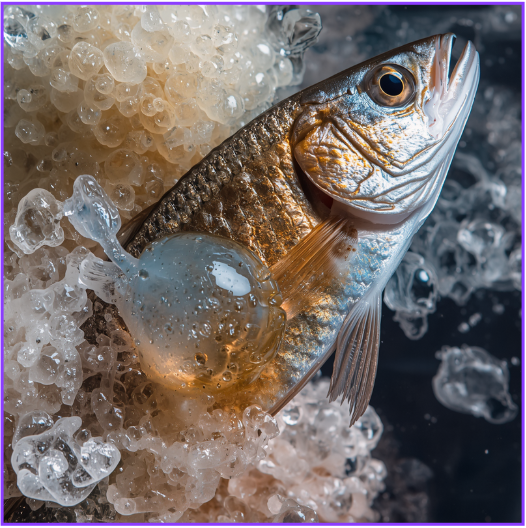
Resources of collagen-containing raw materials are quite significant. These include products of secondary fish processing that are not used and not recycled. Therefore, it is necessary to apply special methods of processing collagen-containing raw materials, in particular scales, fins, heads and bones, to obtain a protein product with proper functional and technological characteristics. Today, there are many ways to influence collagen-containing raw materials and obtain collagen preparations for use in the food industry, cosmetology, medicine, etc. The purpose of the work is to scientifically substantiate and experimentally confirm the possibility of obtaining high-quality protein products from collagen-containing raw materials (in particular from fish) by using various methods of its processing. The study used modern standard and generally recognized methods for determining physicochemical and structural and mechanical properties. Studies of the chemical composition of the starting raw materials (fish waste of various species of fish) were conducted. The results of the study indicate the possibility of using this raw material as a component of additive formulations. A study of collagen-containing fish scales was conducted, confirming the possibility of using collagen-containing products as stabilizers. Collagen hydrolysate in the composition of the supplement affects the quality characteristics of finished products. It can be concluded that the use of fish scales to obtain collagen hydrolysate for the production of supplements is possible only if they are pre-processed, namely separated from the fish carcass. The method of obtaining these products determines the directions of their further use. It is possible to use a supplement with collagen hydrolysate obtained from secondary fish raw materials in food production.
References
Dzyuba, N. A., Oliinyk, M. I., Telezhenko, L. M., & Kolesnichenko, S. L. (2021). [The effect of biomodification on the change in the morphological structure of collagen-containing fish raw materials]. Naukovi pratsi NUKhT, 27(2), 198–206. (In Ukrainian).
Gaikwad, S., & Kim, M. J. (2024). Fish by-product collagen extraction using different methods and their application. Marine Drugs, 22(2), 60. https://doi.org/10.3390/md22020060
Koliada, M. K., & Plavan, V. P. (2019). [Rational use of secondary products of animal origin in accordance with the environmental legislation of Ukraine and the European Union]. Ekolohichni nauky, 3(26), 25–30. (In Ukrainian). https://doi.org/10.32846/2306-9716-2019-3-26-5
Kushnir, N. A. (2014). [Determination of the balance of the amino acid composition of the collagen preparation]. Prohresyvni tekhnika ta tekhnolohii kharchovykh vyrobnytstv restorannoho hospodarstva i torhivli, 1(19), 107–116. (In Ukrainian).
Nykyforov, R. P., Simakova, O. O., Slashcheva, A. V., Nazarenko, I. A., Horiainova, Y. A., & Popova, S. Y. (2019). [Scientific justification of the technology of the latest food products based on protein-carbohydrate milk and vegetable raw materials: a monograph]. DonNUET. (In Ukrainian).
Lastukhin, Y. O. (2009). Kharchovi dobavky. E-kody. Budova. Oderzhannia. Vlastyvosti [Food additives. E-codes. Structure. Production. Properties] (Y. O. Lastukhin, Ed.). Tsentr Yevropy.
Kushnir, N. A. (2009). [Technology of dietary supplements containing amylolytic enzyme inhibitors] [Doctoral dissertation abstract, ONAKhT].
Kuprina, E. E., Kiprushkina, E. I., Abramzon, V. V., Rogozina, E. A., Romanenko, N. Y., Mezenova, O. Y., Mörsel, T. (2023). Obtaining and study of peptide compositions based on hydrolysates of collagen-containing fish raw materials. Fermentation, 9(5), 458. https://doi.org/10.3390/fermentation9050458
Heffernan, S., Giblin, L., & O’Brien, N. (2021). Assessment of the biological activity of fish muscle protein hydrolysates using in vitro model systems. Food Chemistry, 359, 129852. https://doi.org/10.1016/j.foodchem.2021.129852
Al-Nimry, S., Dayah, A. A., Hasan, I., & Daghmash, R. (2021). Cosmetic, biomedical and pharmaceutical applications of fish gelatin/hydrolysates. Marine Drugs, 19(3), 145. https://doi.org/10.3390/md19030145
Nitsuwat, S., Zhang, P., Ng, K., & Fang, Z. (2021). Fish gelatin as an alternative to mammalian gelatin for food industry: A meta-analysis. LWT - Food Science and Technology, 141, 110899. https://doi.org/10.1016/j.lwt.2021.110899
Gaikwad, S. B., More, P. R., Sonawane, S. K., & Arya, S. S. (2021). Antioxidant and anti-hypertensive bioactive peptides from Indian mackerel fish waste. International Journal of Peptide Research and Therapeutics, 27(4), 2671–2684. https://doi.org/10.1007/s10989-021-10282-0
Rajabimashhadi, Z., Gallo, N., Salvatore, L., & Lionetto, F. (2023). Collagen derived from fish industry waste: Progresses and challenges. Polymers, 15(3), 544. https://doi.org/10.3390/polym15030544
Meng, D., Tanaka, H., Kobayashi, T., Hatayama, H., Zhang, X., Ura, K., Takagi, Y. (2019). The effect of alkaline pretreatment on the biochemical characteristics and fibril-forming abilities of types I and II collagen extracted from bester sturgeon by-products. International Journal of Biological Macromolecules, 131, 572–580. https://doi.org/10.1016/j.ijbiomac.2019.03.091
Dong, Y., & Dai, Z. (2022). Physicochemical, structural and antioxidant properties of collagens from the swim bladder of four fish species. Marine Drugs, 20(9), 550. https://doi.org/10.3390/md20090550
González-Serrano, D. J., Hadidi, M., Varcheh, M., Jelyani, A. Z., Moreno, A., & Lorenzo, J. M. (2022). Bioactive peptide fractions from collagen hydrolysate of common carp fish byproduct: Antioxidant and functional properties. Antioxidants, 11(3), 509. https://doi.org/10.3390/antiox11030509
Jafari, H., Lista, A., Siekapen, M. M., Ghaffari-Bohlouli, P., Nie, L., Alimoradi, H., & Shavandi, A. (2020). Fish collagen: Extraction, characterization, and applications for biomaterials engineering. Polymers, 12(10), 2230. https://doi.org/10.3390/polym12102230
Van De Water, L., Varney, S., & Tomasek, J. J. (2023). Mechanoregulation of the myofibroblast in wound contraction, scarring, and fibrosis: Opportunities for new therapeutic intervention. Advances in Wound Care, 2(3), 122–141. https://doi.org/10.1089/wound.2012.03
Jeevithan, E., Bao, B., Bu, Y., Zhou, Y., Zhao, Q., & Wu, W. (2014). Type II collagen and gelatin from silvertip shark (Carcharhinus albimarginatus) cartilage: Isolation, purification, physicochemical and antioxidant properties. Marine Drugs, 12(7), 3852–3873. https://doi.org/10.3390/md12073852
Xu, S., Zhao, Y., Song, W., Zhang, C., Wang, Q., Li, R., ... Sun, L. (2023). Improving the sustainability of processing by-products: Extraction and recent biological activities of collagen peptides. Foods, 12(10), 965. https://doi.org/10.3390/foods12101965
Tawalbeh, D., Kha’sim, M. I., Sarbon, N. M., & Sarbon, N. M. (2025). Techno-functional and bioactivity properties of collagen hydrolysate and peptide: A review. Food Reviews International. https://doi.org/10.1080/87559129.2025.2450052
Abd Rashid, N. Y., Abdul Manan, M., Pa'ee, K. F., Saari, N., & Wong, F. W. F. (2022). Evaluation of antioxidant and antibacterial activities of fish protein hydrolysate produced from Malaysian fish sausage (Keropok Lekor) by-products by indigenous Lactobacillus casei fermentation. Journal of Cleaner Production, 347, 131303. https://doi.org/10.1016/j.jclepro.2022.131303
Espinales, C., Romero-Peña, M., Calderon, G., Vergara, K., & Caceres, P. C. (2023). Collagen, protein hydrolysates and chitin from by-products of fish and shellfish: An overview. Heliyon, 9(4), e14937. https://doi.org/10.1016/j.heliyon.2023.e14937
Jeyachandran, S., & Aman, M. (2025). Valorisation of fish scales and bones: A sustainable source of bioactive proteins and collagen for nutraceuticals. Bioresources and Bioprocessing, 12, 141. https://doi.org/10.1186/s40643-025-00970-w
Zaky, A. A., Simal-Gandara, J., Eun, J.-B., Shim, J.-H., & Abd El-Aty, A. M. (2022). Bioactivities, applications, safety, and health benefits of bioactive peptides from food and by-products: A review. Frontiers in Nutrition, 8, 815640. https://doi.org/10.3389/fnut.2021.815640
Downloads
Published
Issue
Section
License
Copyright (c) 2025 Oles Honchar Dnipro National University

This work is licensed under a Creative Commons Attribution 4.0 International License.
- Authors reserve the right of attribution for the submitted manuscript, while transferring to the Journal the right to publish the article under the Creative Commons Attribution License. This license allows free distribution of the published work under the condition of proper attribution of the original authors and the initial publication source (i.e. the Journal)
- Authors have the right to enter into separate agreements for additional non-exclusive distribution of the work in the form it was published in the Journal (such as publishing the article on the institutional website or as a part of a monograph), provided the original publication in this Journal is properly referenced
- The Journal allows and encourages online publication of the manuscripts (such as on personal web pages), even when such a manuscript is still under editorial consideration, since it allows for a productive scientific discussion and better citation dynamics (see The Effect of Open Access).