ATOMIC ABSORPTION AND ATOMIC EMISSION WITH INDUCTIVELY COUPLED PLASMA DETERMINATION OF COPPER, ZINC, NICKEL IN PHARMACEUTICAL SUBSTANCES
DOI:
https://doi.org/10.15421/jchemtech.v34i1.336904Keywords:
atomic absorption and atomic emission spectrometry with inductively coupled plasma, copper, zinc, nickel, Triton X-100 solutions, ultrasonic treatment, acetylacetone, metal acetylacetonates, pharmaceutical substances, metrological characteristicsAbstract
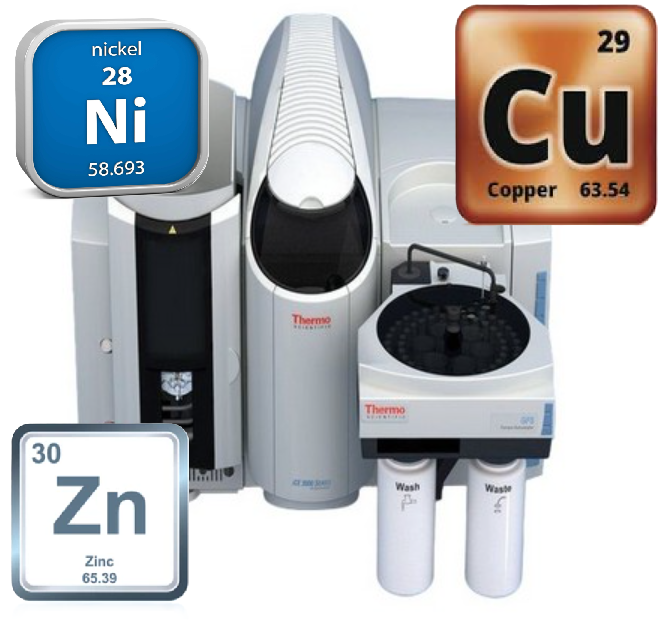
The influence of nonionic surfactant Triton X-100 on the analytical signal in atomic absorption determination of copper, zinc, and nickel in pharmaceutical substances was investigated. The sensitivity and precision of analyte determination were increased by using Triton X-100 (w = 4 %) solutions, calibration solutions based on metal acetylacetonates, and treating the analyzed samples with ultrasound for 20 min. The sensitivity of atomic absorption determination of copper increases by 1.80 times, zinc by 1.60 times, and nickel by 1.70 times. The content of analytes in multicomponent samples was determined by atomic absorption and atomic emission spectrometry with inductively coupled plasma. The results obtained by two independent methods were compared using F- and t-criteria. It was shown that there is no significant discrepancy in these results, the difference is insignificant and is due to random statistical error. The accuracy of the analysis results was verified by varying the sample weight and using the “added-found” method. The detection limit for copper (Cmin = 0.002 μg/ml, Clit = 0.004 μg/ml), zinc (Cmin = 0.003 μg/ml, Clit = 0.004 μg/ml), and nickel (Cmin = 0.003 μg/ml, Clit =0.004 μg/ml) was calculated by atomic absorption method.
References
Jomova, K., Alomar, S. Y., Nepovimova, E. (2025). Heavy metals: toxicity and human health efects. Arch. Toxicol. 99, 153–209. https://doi.org/10.1007/s00204-024-03903-2
Araya, M., Olivares, M., Pizarro, F. (2007). Copper in human health. Int. J. Environ. Health, 1(4), 608–620. https://doi.org/10.1504/IJENVH.2007.018578
Henriksen, C., Arnesen, E. K. (2023). Copper – a scoping review for Nordic Nutrition Recommendations. Food Nutr. Res., 67. https://doi.org/10.29219/fnr.v67.10322
Eljazzar, S., Abu-Hijleh, H., Alkhatib, D., Sokary, S., Ismail, S., Al-Jayyousi, G. F., Tayyem, R. (2023). The role of copper intake in the development and management of Type 2 diabetes: a systematic review. Nutrients, 15(7), 1655. https://doi.org/10.3390/nu15071655
Maywald, M., Rink, L. (2022). Zinc in human health and infectious diseases. Biomolecules, 12(12), 1748. https://doi.org/10.3390/biom12121748
Perestiuk, V., Kosovska, T., Volianska, L., Boyarchuk, O. (2025) Association of zinc deficiency and clinical symptoms, inflammatory markers, severity of COVID-19 in hospitalized children. Front. Nutr., 12, 1566505. https://doi.org/10.3389/fnut.2025.1566505
Yao, J. H., Ortega, E. F., Panda, P.(2025). Impact of zinc on immunometabolism and its putative role on respiratory diseases. Immunometabolism (Cobham), 7(1), e00057. https://doi.org/10.1097/in9.0000000000000057
Genchi, G., Carocci, A., Lauria, G., Sinicropi, M. S., Catalano, A. (2020). Nickel: Human health and environmental toxicology. Int. J. Environ. Res. Public Health, 17(3), 679–700. https://doi.org/10.3390/ijerph17030679
Su, X., Zhang, Z., Qiu, S., Zeng, B., Yang, M., Huang, X., Zou, X., Yang, L. (2023). Association between nickel exposure and body compositions in the United States: a population-based cross-sectional study. BMC Public Health, 23, 1632. https://doi.org/10.1186/s12889-023-16483-0
Duda, A., Błaszczyk, U. (2008). The impact of nickel on human health. J. Elementology, 13(4), 685–696. https://www.researchgate.net/publication/230881017
Yurchenko, O. I., Chernozhuk, T. V., Shevchenko, I. R., Baklanov, O. M. (2025). Atomic absorption determination of copper in the microalgae Dunaliella Viridis and its further use as a therapeutic agent. Metrology and Instruments, 1, 60–64. https://doi.org/10.30837/2663-9564.2025.1.09 (in Ukrainian)
Bozhkov, A. I., Bobkov, V. V., Osolodchenko, T. P., Yurchenko, O. I., Ganin V. Y., Ivanov, E. G., Batuieva, Y. D., Minukhin, V. V., Goltvianskiy, A. V., Kozheskurt, V. A., Ponomarenko, S.V. (2024). The antibacterial activity of the copper for Staphylococcus aureus 124 and Pseudomonas aeruginosa 18 depends on its state: metalized, chelated and ionic. Heliyon, 10(20), e39098. https://doi.org/10.1016/j.heliyon.2024.e39098
Citak, D., Tuzen, M. (2010). A novel preconcentration procedure using cloud point extraction for determination of lead, cobalt and copper in water and food samples using flame atomic absorption spectrometry. Food Chem. Toxicol., 48, 1399–1404. https://doi.org/10.1016/j.fct.2010.03.008
Simonova, T. N., Dubrovina, V. A., Vishnikin, A. B. (2016). Speciation of chromium through aqueous two-phase extraction of complexes of Cr(III) with 4-(2-pyridylazo)resorcinol and Cr(VI) with 1,5-diphenylcarbazide. J. Serb. Chem Soc., 81(6), 645–659. https://doi.org/10.2298/JSC150630016S
Shoaee, H., Roshdi, M., Khanlarzadeh, N., Beiragh, A. (2012). Simultaneous preconcentration of copper and mercury in water samples by cloud point extraction and their determination by inductively coupled plasma atomic emission spectrometry. Spectrochim. Acta A, 98, 70–75. https://doi.org/10.1016/j.saa.2012.08.027
Li, W., Simmons P., Shrader, D., Herrman, T. J., Dai, S. Y. (2013). Microwave plasma-atomic emission spectroscopy as a tool for the determination of copper, iron, manganese and zinc in animal feed and fertilizer. Talanta, 112, 43–48. https://doi.org/10.1016/j.talanta.2013.03.029
Yurchenko, O. I., Chernozhuk, T. V., Nikolenko, M. V., Baklanov, O. M. (2024). Atomic absorption determination of copper and zinc in pharmaceutical preparations. Issues of Chemistry and Chemical Technology, (1), 115–121. https://doi.org/10.32434/0321-4095-2024-152-1-115-121 (in Ukrainian)
Geronimo, A. C. R., Melo, E. S. P., Silva, K. R. N., Pereira, H. S., Nascimento, V. A., Machate, D. J., do Nascimento, V. A. (2021). Human health risk assessment of heavy metals and metalloids in herbal medicines used to treat anxiety: Monitoring of safety. Front. Pharmacol., 12, 772928. https://doi.org/10.3389/fphar.2021.772928
Ribeiro, M. M. A. C., Prado, A. A., Batista, A. D., Munoz, R. A. A., Richter, E. M. (2019). Rapid method for simultaneous determination of ascorbic acid and zinc in effervescent tablets by capillary zone electrophoresis with contactless conductivity detection. J. Sep. Sci., 42, 754–759. https://doi.org/10.1002/jssc.201801042
Hedjazi, M., Vishnikin, A. B., Okovytyy, S. I., Miekh, Yu. V., Bazel, Ya. R. (2022). Use of dye aggregation phenomenon for spectrophotometric and SIA-LAV determination of bismuth(III) as a specific ion association complex between tetraiodobismuthate and Astra Phloxine. J. Molec. Struct., 1251, 132015. https://doi.org/10.1016/j.molstruc.2021.132015
Yurchenko, O. I., Chernozhuk, T. V., Kravchenko, O. A., Baklanov, А. N. (2022). Atomic absorption and atomic emission with inductive connected plasma and X-ray fluorescent detection of zinc and copper in soil. J. Chem. Technologies, 30(2), 307–311. https://doi.org/10.15421/jchemtech.v30i2.223394 (in Ukrainian)
Gaddey, P. K., Raja, S. (2024). A method optimization study for atomic absorption spectrometric determination of nickel content in meclizine hydrochloride. J. Turk. Chem. Soc. Sect. Chem., 11(3), 1073-1080. https://doi.org/10.18596/jotcsa.1402767
Abbas, E. R., Kadhim, S. H., Al-Da'amy, M. A. A. (2013). Determination of Ni(II) in alloy by spectrophotometric method with a new chromogenic reagent (IDPBS). Int. J. Pharm. Qual. Assur., 11(1), 20–22. https://doi.org/10.25258/ijpqa.11.1.14
Nessa, F., Khan, S. A., Abu Shawish, K. Y. I. (2016). Lead, cadmium and nickel contents of some medicinal agents. Indian J. Pharm. Sci., 78(1), 111–119. https://doi.org/10.4103/0250-474x.180260
Tsiganok, L. P., Vishnikin, A. B., Maksimovskaya, R. I. (1989). UV, IR, 71Ga and 17O NMR spectroscopic studies of 12-molybdogallate. Polyhedron, 23, 2739–2742. https://doi.org/10.1016/S0277-5387(00)80529-X
Al-Taeb, S. A., Al-Tayeb, K. A., Al-Aseer, A. S., Khan, M. M. (2015). Atomic absorption analysis of toxic heavy metal impurities in various commercial Aspirin formulations. Adv. Biochem. 3(1), 9–14. https://doi.org/10.11648/j.ab.20150301.13
Yurchenko, O. I., Gubskii, S. M., Chernozhuk, T. V., Baklanov, A. N., Kravchenko, O. A. (2020). [Monitoring of content of sodium, potassium, calcium and magnesium in whey processed products]. J. Chem. Technologies, 28(1), 27–33 (in Ukrainian). https://doi.org/10.15421/082004
Lewen, N. (2011). The use of atomic spectroscopy in the pharmaceutical industry for the determination of trace elements in pharmaceuticals. J. Pharm. Biomed. Anal. 55(4), 653–661. https://doi.org/10.1016/j.jpba.2010.11.030
Yurchenko, O. I., Chernozhuk, Т. V., Baklanov, A. N., Baklanova, L. V., Kravchenko, O. A. (2018). [Analytical signal amplification technologies in sonoluminescence spectroscopy by double-frequency ultrasound]. Methods Objects Chem. Anal., 13(3), 103–109. https://doi.org/10.17721/moca.2018.103-109 (in Russian)
Yurchenko, O. І., Chernozhuk, T. V., Kravchenko, O. A., Baklanov, A. N. (2023). [Atomіc absorptіon and X-ray fluorescent detectіon of chromіum and cobalt іn pharmaceutіcals]. J. Chem. Technologies. 31(1), 37–43. https://doi.org/10.15421/jchemtech.v31i1.238921 (in Ukrainian)
Downloads
Published
Issue
Section
License
Copyright (c) 2025 Oles Honchar Dnipro National University

This work is licensed under a Creative Commons Attribution 4.0 International License.
- Authors reserve the right of attribution for the submitted manuscript, while transferring to the Journal the right to publish the article under the Creative Commons Attribution License. This license allows free distribution of the published work under the condition of proper attribution of the original authors and the initial publication source (i.e. the Journal)
- Authors have the right to enter into separate agreements for additional non-exclusive distribution of the work in the form it was published in the Journal (such as publishing the article on the institutional website or as a part of a monograph), provided the original publication in this Journal is properly referenced
- The Journal allows and encourages online publication of the manuscripts (such as on personal web pages), even when such a manuscript is still under editorial consideration, since it allows for a productive scientific discussion and better citation dynamics (see The Effect of Open Access).