ELECTRODEPOSITION OF Ni-BASED COMPOSITE COATINGS CONTAINING CERIUM COMPOUNDS FROM A DEEP EUTECTIC SOLVENT AND THEIR ELECTROCATALYTIC PERFORMANCE
DOI:
https://doi.org/10.15421/jchemtech.v33i4.337132Keywords:
electrodeposition, nickel, ceria, deep eutectic solvent, composite coating, green hydrogen production, urea oxidation reaction, electrocatalysisAbstract
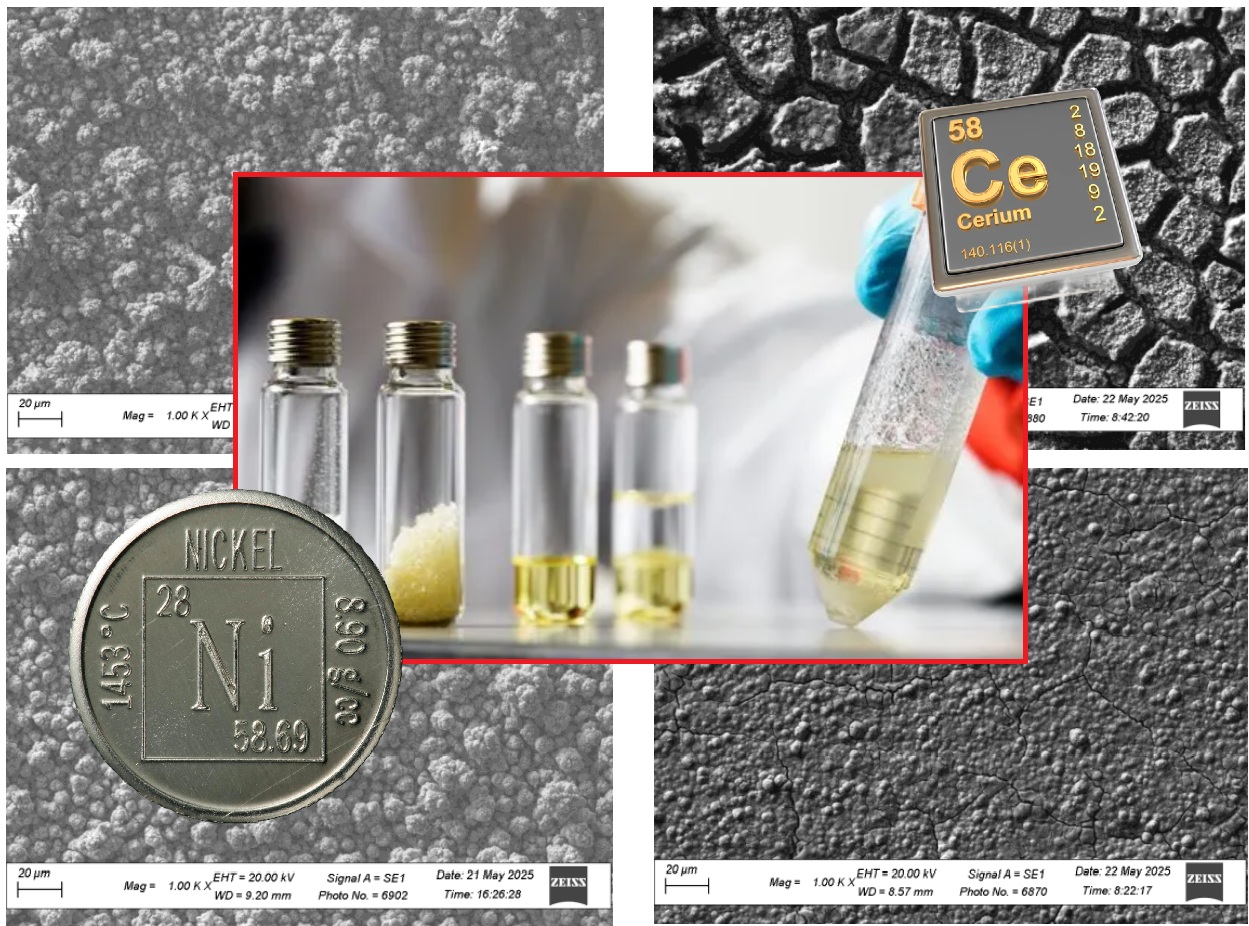
This work examines the electrodeposition of Ni-based composite coatings containing cerium compounds from a eutectic mixture of choline chloride and urea (reline), a typical deep eutectic solvent. The data reveal that depending on the concentrations of NiCl2×6H2O and CeCl3×7H2O dissolved in reline, coatings containing up to 49 wt.% cerium, present as embedded CeO2, can be formed within an electrochemically deposited nanocrystalline nickel matrix. Variation of the Ni(II) and Ce(III) salt concentrations strongly influences the resulting surface morphology. Reaction schemes for the formation of these composite coatings are proposed, and cyclic voltammetry with successive scan cycles was used to identify the potential windows in which the relevant electrochemical reactions occur in reline-based solutions. The deposited coatings were tested as electrocatalysts for water electrolysis in 1 M NaOH. Special attention was paid to the electrocatalytic activity of the Ni-based composite coatings toward the anodic oxidation of urea, a potential alternative to the oxygen evolution reaction in green hydrogen production. Incorporation of CeO2 into the nickel matrix led to a pronounced enhancement of electrocatalytic activity for hydrogen evolution, oxygen evolution and urea oxidation in alkaline aqueous solution. The proposed composite coatings may find application as multifunctional catalysts for green hydrogen generation. Moreover, adjusting the Ni(II) and Ce(III) concentrations in the deep eutectic solvent-based plating bath enables flexible and controlled tuning of the electrocatalytic behavior of deposited coatings.
References
Dawood, F., Anda, M., Shafiullah, G. M. (2020). Hydrogen production for energy: An overview. Int. J. Hydrogen Energy, 45, 3847–3869. https://doi.org/10.1016/j.ijhydene.2019.12.059
Shih, A. J., Monteiro, M. C. O., Dattila, F., Pavesi, D., Philips, M., da Silva, A. H. M., Vos. R. E, Ojha, K., Park, S., van der Heijden, O., Marcandalli, G., Goyal, A., Villalba, M., Chen, X., Gunasooriya, G. T. K. K., McCrum, I., Mom, R., López, N., Koper, M. T. M. (2022). Water electrolysis. Nat. Rev. Methods Primers, 2, 84. https://doi.org/10.1038/s43586-022-00164-0
Squadrito, G., Maggio, G., Nicita, A. (2023). The green hydrogen revolution. Renewable Energy, 216, 119041. https://doi.org/10.1016/j.renene.2023.119041
Qadeer, M. A., Zhang, X., Farid, M. A., Tanveer, M., Yan, Y., Du, S., Huang, Z. F., Tahir, M., Zou, J.J. (2024). A review on fundamentals for designing hydrogen evolution electrocatalyst. J. Power Sources, 613, 234856. https://doi.org/10.1016/j.jpowsour.2024.234856
Zhou, W., Chen, S., Meng, X., Li, J., Gao, J. (2023). Energy-saving cathodic H2 production enabled by non-oxygen evolution anodic reactions: A critical review on fundamental principles and applications. Int. J. Hydrogen Energy, 48, 15748–15770. https://doi.org/10.1016/j.ijhydene.2023.01.063
Paygozar, S., Aghdam, A. S. R., Hassanizadeh, E., Andaveh, R., Darband, G. B. (2023). Recent progress in non-noble metal-based electrocatalysts for urea-assisted electrochemical hydrogen production. Int. J. Hydrogen Energy, 48, 7219–7259. https://doi.org/10.1016/j.ijhydene.2022.11.087
Anuratha, K.S., Rinawati, M., Wu, T.H., Yeh, M.H., Lin, J.Y. (2022). Recent development of nickel-based electrocatalysts for urea electrolysis in alkaline solution. Nanomaterials, 12, 2970. https://doi.org/10.3390/nano12172970
Boggs, B. K., King, R. L., Botte, G. G. (2009). Urea electrolysis: direct hydrogen production from urine. Chem Commun., 4859–4861. https://doi.org/10.1039/b905974a
Protsenko, V. S. (2023). Thermodynamic aspects of urea oxidation reaction in the context of hydrogen production by electrolysis. Int. J. Hydrogen Energy, 48, 24207–24211. https://doi.org/10.1016/j.ijhydene.2023.03.295
Protsenko, V. S., Bobrova, L. S., Butyrina, T. E., Sukhatskyi, O. D. (2024). Thermodynamics of electrochemical urea oxidation reaction coupled with cathodic hydrogen evolution reaction in an alkaline solution: Effect of carbonate formation. Int. J. Hydrogen Energy, 59, 354–358. https://doi.org/10.1016/j.ijhydene.2024.02.006
Li, J., Zhang, J., Yang, J. H. (2022). Research progress and applications of nickel-based catalysts for electrooxidation of urea. Int. J Hydrogen Energy, 47, 7693–7712. https://doi.org/10.1016/j.ijhydene.2021.12.099
Lu, S., Zheng, X., Fang, L., Yin, F., Liu, H. (2023). Rational engineering design of nickel hydroxides for urea oxidation reaction: A mini-review. Electrochem. Commun., 157, 107599. https://doi.org/10.1016/j.elecom.2023.107599
Ge, J., Liu, Z., Guan, M., Kuang, J., Xiao, Y., Yang, Y., Tsang, C. H., Lu, X., Yang, C. (2022). Investigation of the electrocatalytic mechanisms of urea oxidation reaction on the surface of transition metal oxides. J. Colloid Interface Sci., 620, 442–453. https://doi.org/10.1016/j.jcis.2022.03.152
Sun, X., Ding, R. (2020). Recent progress with electrocatalysts for urea electrolysis in alkaline media for energy-saving hydrogen production. Catal. Sci. Technol., 10, 1567–1581. https://doi.org/10.1039/C9CY02618E
Yang, K., Hao, L., Hou, Y., Zhang, J., Yang, J. H. (2024). Summary and application of Ni-based catalysts for electrocatalytic urea oxidation. Int. J. Hydrogen Energy, 51, 966–981. https://doi.org/10.1016/j.ijhydene.2023.10.279
Li, R., Li, Y., Yang, P., Wang, D., Xu, H., Wang, B., Meng, F., Zhang, J., An, M. (2021). Electrodeposition: synthesis of advanced transition metal-based catalyst for hydrogen production via electrolysis of water. J. Energy Chem., 57, 547–566. https://doi.org/10.1016/j.jechem.2020.08.040
Wang, H., Jiao, X., Zeng, W., Zhang, Y., Jiao, Y. (2021). Electrodeposition NiMoSe ternary nanoshperes on nickel foam as bifunctional electrocatalyst for urea electrolysis and hydrogen evolution reaction. Int. J. Hydrogen Energy, 46, 37792–37801. https://doi.org/10.1016/j.ijhydene.2021.09.050
Abd El-Lateef, H. M., Almulhim, N. F., Mohamed, I. M. A. (2020). Physicochemical and electrochemical investigations of an electrodeposited CeNi2@NiO nanomaterial as a novel anode electrocatalyst material for urea oxidation in alkaline media. J. Mol. Liq., 297, 111737. https://doi.org/10.1016/j.molliq.2019.111737
Kityk, A., Pavlik, V., Hnatko, M. (2023). Exploring deep eutectic solvents for the electrochemical and chemical synthesis of photo- and electrocatalysts for hydrogen evolution. Int. J. Hydrogen Energy, 48, 39823–39853. https://doi.org/10.1016/j.ijhydene.2023.07.158
Al-Farsi, R., Hayyan, M. (2024). Deep eutectic solvents: Green multi-task agents for sustainable super green hydrogen technologies. J. Energy Chem., 92, 357–382. https://doi.org/10.1016/j.jechem.2023.12.021
Kityk, A., Pavlik, V., Hnatko, M. (2024). Breaking barriers in electrodeposition: Novel eco-friendly approach based on utilization of deep eutectic solvents. Adv. Colloid Interface Sci., 334, 103310. https://doi.org/10.1016/j.cis.2024.103310
Smith, E. L., Abbott, A. P., Ryder, K. S. (2014). Deep eutectic solvents (DESs) and their applications. Chem. Rev., 114, 11060–11082. https://doi.org/10.1021/cr300162p
Hansen, B. B., Spittle, S., Chen, B., Poe, D., Zhang, Y., Klein, J. M., Horton, A., Adhikari, L., Zelovich, T., Doherty, B. W., Gurkan, B., Maginn, E. J., Ragauskas, A., Dadmun, M., Zawodzinski, T. A., Baker, G. A., Tuckerman, M. E., Savinell, R. F., Sangoro, J. R. (2021). Deep eutectic solvents: a review of fundamentals and applications. Chem. Rev., 121, 1232–1285. https://doi.org/10.1021/acs.chemrev.0c00385
Abbott, A. P. (2022). Deep eutectic solvents and their application in electrochemistry. Curr. Opin. Green Sustainable Chem., 36, 100649. https://doi.org/10.1016/j.cogsc.2022.100649
Zhang, C., Fu, Y., Gao, W., Bai, T., Cao, T., Jin, J., Xin, B. (2022). Deep eutectic solvent-mediated electrocatalysts for water splitting. Molecules, 27, 8098. https://doi.org/10.3390/molecules27228098
Zhang, C., Bai, T., Sun, Y., Xin, B., Zhang, S. (2022). Ionic liquid/deep eutectic solvent-mediated Ni-based catalysts and their application in water splitting electrocatalysis. Catalysts, 12, 928. https://doi.org/10.3390/catal12080928
Wang, H., Kang, X., Han, B. (2024). Electrocatalysis in deep eutectic solvents: from fundamental properties to applications. Chem. Sci., 15, 9949–9976. https://doi.org/10.1039/d4sc02318h
Kityk, A. A., Shaiderov, D. A., Vasil'eva, E. A., Protsenko, V. S., Danilov, F. I. (2017). Choline chloride based ionic liquids containing nickel chloride: Physicochemical properties and kinetics of Ni(II) electroreduction. Electrochim. Acta, 245, 133–145. http://dx.doi.org/10.1016/j.electacta.2017.05.144
Protsenko, V. S., Shaiderov, D. A., Sukhatskyi, O. D., Butyrina, T. E., Korniy, S. A. (2025). Nickel-containing electrocatalysts for green hydrogen production: electrodeposition from deep eutectic solvent-based solutions and electrocatalytic activity for hydrogen evolution, oxygen evolution and urea oxidation reactions. J. Appl. Electrochem., 55, 2129–2148. https://doi.org/10.1007/s10800-025-02288-z
Protsenko, V. S., Butyrina, T. E., Danilov, F. I. (2022). Kinetics and mechanism of electrochemical oxygen evolution in an alkaline solution on nickel coatings. J. Chem. Technol., 30(1), 26–33. https://doi.org/10.15421/jchemtech.v30i1.245490
Protsenko, V. S., Pavlenko, L. M., Bobrova, L. S., Korniy, S. A., Danilov, F. I. (2024). Electrodeposition of coatings from urea–choline chloride-based plating baths containing Ni(II) and Ce(III) chloride salts and electrocatalytic activity of electrodeposits towards the hydrogen evolution reaction. J. Solid State Electrochem., 28, 1641–1655. https://doi.org/10.1007/s10008-023-05499-6
Protsenko, V. S., Shaiderov, D. A., Sukhatskyi, O. D., Butyrina, T. E., Korniy, S. A., Danilov, F. I. (2025). DES-assisted electrodeposition and characterization of an electrocatalyst for enhanced urea oxidation in green hydrogen production. Voprosy Khimii i Khimicheskoi Tekhnologii, (1), 65–70. https://doi.org/10.32434/0321-4095-2025-158-1-65-70
Protsenko, V. S., Bobrova, L. S., Butyrina, T. E., Baskevich, A. S., Korniy, S. A., Danilov, F. I. (2023). Electrodeposited Ni–Mo coatings as electrocatalytic materials for green hydrogen production. Heliyon, 9, e15230. https://doi.org/10.1016/j.heliyon.2023.e15230
Wang, S., Zou, X., Lu, Y., Rao, S., Xie, X., Pang, Z., Lu, X., Xu, Q., Zhou, Z. (2018). Electrodeposition of nano-nickel in deep eutectic solvents for hydrogen evolution reaction in alkaline solution. Int J Hydrogen Energy, 43, 15673–15686. https://doi.org/10.1016/j.ijhydene.2018.06.188
Lukaczynska, M., Cherigui, E. A. M., Ceglia, A., Van Den Bergh, K., De Strycker, J., Terryn, H., Ustarroz, J. (2019). Influence of water content and applied potential on the electrodeposition of Ni coatings from deep eutectic solvents. Electrochim. Acta, 319, 690–704. https://doi.org/10.1016/j.electacta.2019.06.161
Phi, T. L., Nguyen, S. T., Hieu, N. V., Palomar-Pardavé, M., Morales-Gil, P., Le Manh, T. (2022). Insights into electronucleation and electrodeposition of nickel from a non-aqueous solvent based on NiCl26H2O dissolved in ethylene glycol. Inorg. Chem., 61, 5099–5111. https://doi.org/10.1021/acs.inorgchem.2c00127
Hasannejad, H., Shahrabi, T., Jafarian, M., Rouhaghdam, A. S. (2011). EIS study of nano crystalline Ni-cerium oxide coating electrodeposition mechanism. J. Alloys Compd., 509, 1924–1930. https://doi.org/10.1016/j.jallcom.2010.10.089
Hassannejad, H., Mele, C., Shahrabi, T., Bozzini, B. (2012). Electrodeposition of Ni/ceria composites: an in situ visible reflectance investigation. J. Solid State Electrochem., 16, 3429–3441. https://doi.org/10.1007/s10008-012-1830-4
Hasannejad, H., Shahrabi, T. (2012). Economical deposition of Ni high cerium oxide nanocomposite coatings. Surf. Eng., 28, 418–423. https://doi.org/10.1179/1743294411Y.0000000086
Hamlaoui, Y., Pedraza, F., Remazeilles, C., Cohendoz, S., Rebere, C., Tifouti, L., Creus, J. (2009). Cathodic electrodeposition of cerium-based oxides on carbon steel from concentrated cerium nitrate solutions. Part I. Electrochemical and analytical characterisation. Mater. Chem. Phys., 113, 650–657. https://doi.org/10.1016/j.matchemphys.2008.08.027
Protsenko, V. S., Vasil'eva, E. A., Tsurkan, A. V., Kityk, A. A., Korniy, S. A., Danilov, F. I. (2017). Fe/TiO2 composite coatings modified by ceria layer: Electrochemical synthesis using environmentally friendly methanesulfonate electrolytes and application as photocatalysts for organic dyes degradation. J. Environ. Chem. Eng., 5, 136–146. https://doi.org/10.1016/j.jece.2016.11.034
Kityk, A. A., Rublova, Y. D., Kelm, A., Malyshev, V. V., Bannyk, N. G., Flis-Kabulska, I. (2018). Kinetics and mechanism of corrosion of mild steel in new types of ionic liquids. J. Electroanal. Chem., 823, 234–244. https://doi.org/10.1016/j.jelechem.2018.06.018
Haerens, K., Matthijs, E., Binnemans, K., Van der Bruggen, B. (2009). Electrochemical decomposition of choline chloride based ionic liquid analogues. Green Chem., 11, 1357–1365. https://doi.org/10.1039/b906318h
Mares Badea, M. L., Cojocaru, A., Anicai, L. (2014). Electrode processes in ionic liquid solvents as mixtures of choline chloride with urea, ethylene glycol or malonic acid. UPB Scientific Bulletin, Series B: Chemistry and Materials Science, 76(3),. 21–32.
Abbott, A. P., El Ttaib, K., Ryder, K. S., Smith, E. L. (2008). Electrodeposition of nickel using eutectic based ionic liquids. Trans. Inst. Met. Finish., 86, 234–240. https://doi.org/10.1179/174591908X327581
Ali, M. R., Rahman, M. Z., Saha, S. S. (2014). Electroless and electrolytic deposition of nickel from deep eutectic solvents based on choline chloride. Ind. J. Chem. Technol., 21, 127–133.
Protsenko, V.S., Makhota, D.O., Butyrina, T.E., Korniy, S.A., Danilov, F. I. (2024). Anodic surface treatment of nickel in eutectic ionic liquids based on choline chloride for electrochemical polishing and enhancement of electrocatalytic activity in hydrogen evolution reaction. Voprosy Khimii i Khimicheskoi Tekhnologii, (1), 89–98. https://doi.org/10.32434/0321-4095-2024-152-1-89-98
Oriňáková, R., Turoňová, A., Kladeková, D., Gálová, M., Smith, R. M. (2006). Recent developments in the electrodeposition of nickel and some nickel-based alloys. J. Appl. Electrochem., 36, 957–972. https://doi.org/10.1007/s10800-006-9162-7
Lyons, M. E. G., Brandon, M. P. (2008). The oxygen evolution reaction on passive oxide covered transition metal electrodes in aqueous alkaline solution. Part 1 – nickel. Int. J. Electrochem. Sci., 3, 1386–1424.
Vedharathinam, V., Botte, G. G. (2013). Direct evidence of the mechanism for the electro-oxidation of urea on Ni(OH)2 catalyst in alkaline medium. Electrochim. Acta, 108, 660–665. https://doi.org/10.1016/j.electacta.2013.06.137
Protsenko, V. S., Makhota, D. O., Korniy, S. A., Butyrina, T. E., Danilov, F. I. (2024). Influence of anodic treatment of nickel in deep eutectic solvents on electrocatalytic activity in oxygen evolution and urea oxidation reactions. Voprosy Khimii i Khimicheskoi Tekhnologii, (3), 145–154. http://dx.doi.org/10.32434/0321-4095-2024-154-3-145-154
Munde, A. V., Mulik, B. B., Dighole, R. P., Sathe, B. R. (2021). Urea electro-oxidation catalyzed by an efficient and highly stable Ni–Bi bimetallic nanoparticles. ACS Appl. Energy Mater., 4, 13172–13182. https://doi.org/10.1021/acsaem.1c02755
Zhang, J., Zhu, J., Kang, L., Zhang, Q., Liu, L., Guo, F., Li, K., Feng, J., Xia, L., Lv, L., Zong, W., Shearing, P. R.,
Brett, D. J. L., Parkin, I. P., Song, X., Mai, L., He, G. (2023). Balancing dynamic evolution of active sites for urea oxidation in practical scenarios. Energy Environ. Sci., 16, 6015–6025. https://doi.org/10.1039/d3ee03258b
Downloads
Published
Issue
Section
License
Copyright (c) 2025 Oles Honchar Dnipro National University

This work is licensed under a Creative Commons Attribution 4.0 International License.
- Authors reserve the right of attribution for the submitted manuscript, while transferring to the Journal the right to publish the article under the Creative Commons Attribution License. This license allows free distribution of the published work under the condition of proper attribution of the original authors and the initial publication source (i.e. the Journal)
- Authors have the right to enter into separate agreements for additional non-exclusive distribution of the work in the form it was published in the Journal (such as publishing the article on the institutional website or as a part of a monograph), provided the original publication in this Journal is properly referenced
- The Journal allows and encourages online publication of the manuscripts (such as on personal web pages), even when such a manuscript is still under editorial consideration, since it allows for a productive scientific discussion and better citation dynamics (see The Effect of Open Access).