A NEW APPROACH TO PROCESSING POLYMINERAL POTASSIUM ORE FROM THE CARPATHIAN REGION
DOI:
https://doi.org/10.15421/jchemtech.v33i4.340735Keywords:
Carpathian potash raw materials, processing methods, langbeinite, kainite, polymineral ore, sulfate potash fertilizers, productionAbstract
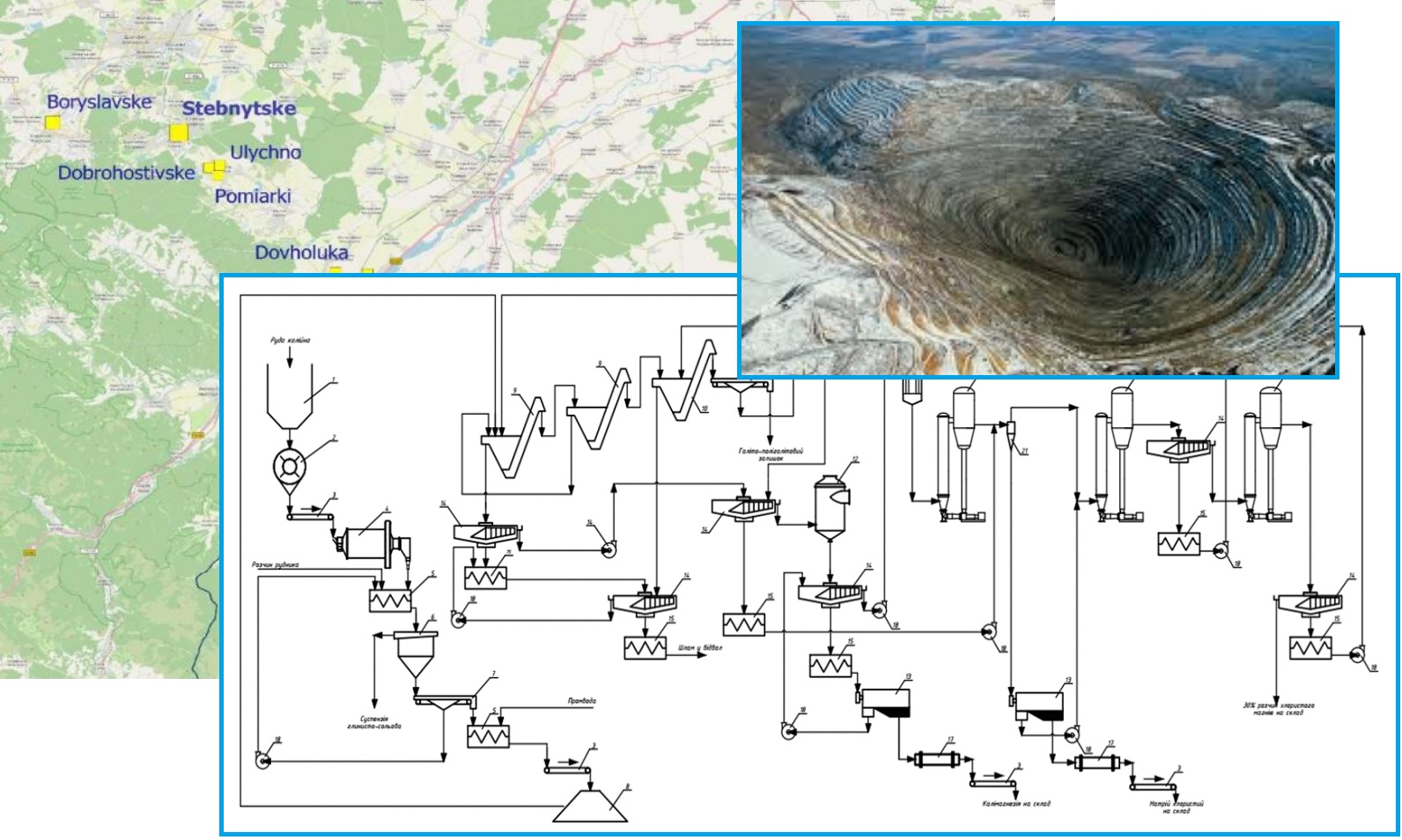
Existing technologies for processing polymineral potash ores of the Carpathian region do not ensure the production of high-quality, highly concentrated fertilizers and are also characterized by a low degree of potassium extraction (less than 60 %). Shenitization of ore in dumps allows achieving a higher degree of conversion of sparingly soluble langbeinite and kieserite into readily soluble minerals but it is a long-term process. Therefore, it is proposed to convert sparingly soluble minerals into readily soluble ones from the residue after ore dissolution using reversible salt suspensions. Based on experimental studies, a new technology for the production of chlorine-free potash fertilizers has been developed which includes the conversion of pre-prepared ore with a reversible salt suspension. This technological method and grinding of the residue before conversion can increase the extraction of potassium into the product up to 82 %. The main products of the proposed technology are table salt, potash fertilizers, magnesium chloride (or bischofite). The residue, which contains insoluble components, in particular, polyhalite can be processed into a long-acting, chloride-free, granular potassium fertilizer with trace elements.
References
Arbacauskas, J., Vaišvila, Z. J., Staugaitis, G., Žickienė, L., Masevičienė, A., Šumskis, D. (2023). The influence of mineral NPK fertiliser rates on potassium dynamics in soil: Data from a long-term agricultural plant fertilisation experiment. Plants, 12, 3700. https://doi.org/10.3390/plants12213700
Prymushko S. I. (2021) Mineral resources of Ukraine Derzhavne naukovo-vyrobnyche pidpryiemstvo 'Derzhavnyi informatsiinyi heolohichnyi fond Ukrainy. Kyiv, Ukraine: Derzhheolfond (in Ukrainian), 270.
Mykhailov, V. A., Malyuk, B., Kovalenko N., at al. (2023). Strategic minerals of Ukraine and their investment attractiveness: Monograph. Orleans, France: BRGM, 257.
Mykhailov, V. (2024). [Highly prospective objects of the mineral resource base of Ukraine. Part 2. Non-metallic minerals]. Visnyk Kyivskoho natsionalnoho universytetu imeni Tarasa Shevchenka. Heolohiia – Bulletin of Taras Shevchenko National University of Kyiv. Geology, 3(106), 47–56. (In Ukrainian) https://doi.org/10.17721/1728-2713.106.06
Eraizer, L. M., Ivanchenko, L. V. (2015). [Processing of polymetallic ores of Prykarpattia into potash fertilisers by the sulfate leaching method: Monograph]. Odesa, Ukraine: Ekolohiia, 136. (in Ukrainian)
Assylkhankyzy, A., Seitmagzimova, G. (2024). Advanced technologies of potash fertiliser production from promising raw materials. The Open Chemical Engineering Journal, 18. https://doi.org/10.2174/0118741231330310240906080722
Kostiv, I. Y., Basystyuk, Y. I. (2016). Crystallization of kainite from processing solutions of polymineral saline raw material marine type. J. Chem. Eng. Process Technol., 7, 313. https://doi.org/10.4172/2157-7048.1000313
Artus, M. I., Kostiv, I. Y. (2014). Ukraine Patent No. 106926. [Method for obtaining schoenite from polymetallic potash ore]. Kyiv, Ukraine: Ukrainian Institute of Industrial Property. (in Ukrainian).
Sharma, P. P., Yadav, V., Rajput, A., Kulshrestha, V. (2018). Synthesis of chloride-free potash fertiliser by ionic metathesis using four-compartment electrodialysis salt engineering. ACS Omega, 3(6), 6895–6902. https://doi.org/10.1021/acsomega.8b01005
Ma, F., Zeng, Y., Yu, X., Chen, K., Ren, S. (2023). The leaching behavior of potassium extraction from polyhalite ore in water. ACS Omega, 8(40), 37162–37175. https://doi.org/10.1021/acsomega.3c04733
Kuzmenko, E., Bahrii, S. (2022). [Assessment of the impact of technogenically induced hydrodynamic processes on groundwater pollution in the Kalush mining industrial district by geophysical methods]. Heodynamika – Geodynamics, 1(32), 119–135. https://doi.org/10.23939/jgd2022.02.119 (in Ukrainian).
Yaremchuk, B. M., Hrebeniuk, D. V. (2001). [Techno-economic analysis of some main technological schemes for processing polymetallic potash ores of Prykarpattia]. Khimichna promyslovist Ukrainy – Chemical Industry of Ukraine, 1, 62–68 (in Ukrainian).
Ciceri, D., Manning, D. A. C., Allanore, A. (2015). Historical and technical developments of potassium resources. Science of The Total Environment, 502, 590–601. https://doi.org/10.1016/j.scitotenv.2014.09.013 (in Ukrainian).
Artus, M., Kostiv, I. (2015). Conversion of langbeinite and kieserite in schoenite with mirabilite and sylvine in water and schoenite solution. J. Chem. Eng. Process Technol., 6, 225. https://doi.org/10.4172/2157-7048.1000225
Khatsevych, O. M. (2007). [Technology of processing polymineral potassium ore with conversion of difficult dissolvent minerals into kainite] (Candidate’s dissertation). Lviv Polytechnic National University (in Ukrainian).
Mykhaylenko V., Yurchenko V., Antonov O., Lukianova O., Gil Z. (2020). Advanced technologies for processing liquid waste of galurgical productions. Journal Environmental Problems. 6(1), 1–6. DOI: https://doi.org/10.23939/ep2021.01.001.
Кhatsevych, O. M., Kostiv, I. Yu., & Khaber, M. V. (2005). Polymineral potassium ores of the Precarpathian region: A new processing technology. Chemical Industry of Ukraine, (4), 3–7.
Khatsevych, O. M., Kostiv, I. Yu. (2005). Investigation of the conversion process of langbeinite and kieserite with a magnesium chloride solution. Bulletin of Lviv Polytechnic National University. Chemistry, Technology of Substances and Their Application, (536), 155–160.
Kostiv, I. Yu., Khatsevych, O. M., Derzhko, O. I. (2023). State and prospects for restoring the production of sulfate potassium fertilizers in the Precarpathian region. In Proceedings of the Eighth International Scientific and Practical Conference «Subsoil Use in Ukraine: Investment Prospects». Lviv, Ukraine, 353–361.
Kostiv, I. Yu., Khatsevych, O. M., Derzhko, O. I., Sadovyi, Yu. V. (2023). Potassium of the Precarpathian region: Its significance and production prospects. In Proceedings of the Eighth International Scientific and Practical Conference «Subsoil Use in Ukraine: Investment Prospects». Lviv, Ukraine, 96–101.
Khatsevych О., Derzhko O. (2024) Resources for restoration of potash industry of Ukraine and features of their processing. XXVIII Miedzynarodowe Sympozjum Solne, Wieliczka, 114–120.
Derzhko, O. I., Chumychkin, A.S., Pasichnyk, V.E., Sadovyi, Y.V. (2025). Ukraine Patent No. 129212. [Method of obtaining shenite from polymineral potassium-magnesium ore]. Kyiv, Ukraine: Ukrainian Institute of Industrial Property. (in Ukrainian).
Haseli, P., Majewski, P., Christo, F., Keane, P., Jafarian, M., Bruno, F. (2023). A review paper on the extraction of potassium from non-soluble resources with the use of acid and alkaline solution and molten salts. Minerals Engineering, 204(4), 108365. https://doi.org/10.1016/j.mineng.2023.108365
Jena, S. K. (2021). A review on potash recovery from different rock and mineral sources. Mining, Metallurgy & Exploration, 38(1), 47–68.
Schleinig, J. P., Höntzsch, S., Barnasch, J., Günther, M., Jungmann, O., Zienert, H., Günther, R. M. (2024). A new technology to increase the extraction rate in potash mining areas–An approach for a safe secondary mining concept. In New Challenges in Rock Mechanics and Rock Engineering. 772–777.
Downloads
Published
Issue
Section
License
Copyright (c) 2025 Oles Honchar Dnipro National University

This work is licensed under a Creative Commons Attribution 4.0 International License.
- Authors reserve the right of attribution for the submitted manuscript, while transferring to the Journal the right to publish the article under the Creative Commons Attribution License. This license allows free distribution of the published work under the condition of proper attribution of the original authors and the initial publication source (i.e. the Journal)
- Authors have the right to enter into separate agreements for additional non-exclusive distribution of the work in the form it was published in the Journal (such as publishing the article on the institutional website or as a part of a monograph), provided the original publication in this Journal is properly referenced
- The Journal allows and encourages online publication of the manuscripts (such as on personal web pages), even when such a manuscript is still under editorial consideration, since it allows for a productive scientific discussion and better citation dynamics (see The Effect of Open Access).