PERIODIC PROCESSES ON A COPPER ELECTRODE IN CHLORIDE ELECTROLYTES
DOI:
https://doi.org/10.15421/jchemtech.v34i1.340769Keywords:
copper, dissolution, chloride electrolytes, passivation, periodic phenomena, amplitude and frequency of oscillationsAbstract
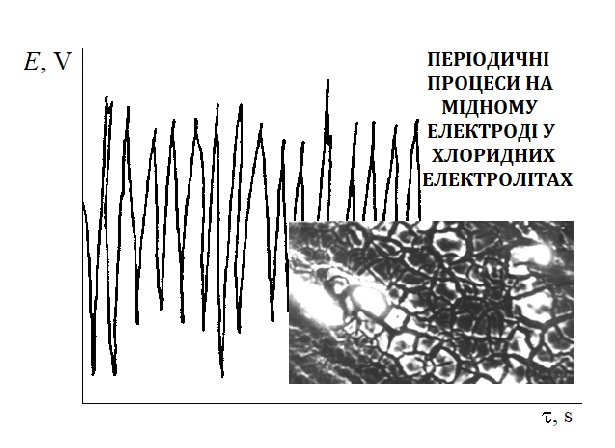
The aim of the work was to determine the region of periodic phenomena during currentless and anodic passivation of copper in CuCl2 solutions and to identify the influence of various factors on the process. Copper dissolution (grade M-99) was studied using the rotating disk electrode method. It is shown that periodic phenomena occur during chemical and anodic dissolution of copper in chloride electrolytes as a result of the formation of CuCl passive film with a certain thickness under conditions of the removal of diffusion limitations through an induction period lasting up to 2 min. An increase in the concentration of Cl−-ions causes a shortening of the induction period of oscillations; in highly concentrated NaCl solutions the induction period increases. The oscillations have a sawtooth shape with no homogeneity; the overall process is a superposition of oscillations with different amplitudes. With an increase in the current density to 3000 A/m2, sub-oscillations disappear. Over time, the oscillation amplitudes equalize and the potential value stabilizes at the level of the upper amplitude value. An increase in the concentration of chloride ions to a certain value reduces the frequency of oscillations and the value of the stationary potential of the copper electrode at which they occur, prolongs the oscillations in time and reduces their amplitude; an increase in the concentration of Cu(II) ions has the opposite effect on the amplitude value. A rise in temperature increases the frequency and chaotic state of oscillations, reduces their induction period and amplitude, and reduces the concentration limit of Cl−-ions above which oscillations do not occur. With an increase in the density of the anode current, the frequency of oscillations increases to a certain value and then stabilizes A mechanism of oscillations is associated with alternation of the processes of formation and dissolution of the passive layer.
References
Larin, V., Egorova, L. (2018). Study of chemical dissolution of Cu98Be аlloy in solutions based on FeCl3. French-Ukrainian journal of chemistry, 6(01), 82–90.
Starosvetsky, D., Khaselev, O., Auinat, M., Ein-Eli, Y. (2006). Initiation of copper dissolution in sodium chloride electrolytes. Electrochim. Acta, 51(26), 5660–5668. https://doi.org/10.1016/j.electacta.2006.01.058
Khobotova, E.B., Larin, V.I., Datsenko, V.V. (2003). Electrochemical dissolution of iron-copper alloys in chloride alkaline solutions. Elektrokhimiya, 39(7), 850–852.
Wang, S., Liu, D., Du, N., Zhao, Q., Liu, S., Xiao, J. (2014). Relationship between dissolved oxygen and corrosion characterization of X80 steel in acidic soil simulated solution. Int. J. Electrochem. Sc., 10(5), 4393–4404. https://doi.org/10.1016/S1452-3981(23)06631-2
Kear, G., Barker, B. D., Walsh, F. C. (2004). Electrochemical corrosion of unalloyed copper in chloride media – a critical review. Corros. Sci., 46(1), 109–135. http://dx.doi.org/10.1016/S0010-938X(02)00257-3
Langley, A. R., Carta, M., Malpass-Evans, R., McKeown, N. B., Dawes, J. H. P., Murphy, E., Marken, F. (2018). Linking the Cu(II/I) potential to the onset of dynamic phenomena at corroding copper microelectrodes immersed in aqueous 0.5 M NaCl. Electrochim. Acta, 260, 348–357. https://doi.org/10.1016/j.electacta.2017.12.083
Cooper, J.F., Muller, R.H., Tobias, C.W. (1980). Periodic phenomena during anodic dissolution of copper at high current densities. J. Electrochem. Soc., 127(8), 1733–1744. https://doi.org/10.1149/1.2129991
Fichthorn, K., Gulari, E., Ziff, R. (1989). Self-sustained oscillations in a heterogeneous catalytic reaction: a Monte Carlo simulation. Chem. Eng. Sci., 44(6), 1403–1411. https://doi.org/10.1016/0009-2509(89)85013-4
Yamazaki, T., Kodera, T., Ohnishi, K., Masuda, M. (1990). Potential oscillation during anodic oxidation of hydrogen at a platinum electrode. II. Kinetic analysis. Electrochim. Acta, 35(2), 431–435. https://doi.org/10.1016/0013-4686(90)87024-V
Talbot, J.B., Orlani, R.A. (1985). Steady state multiplicity and oscillations in passive film formation. Electrochim. Acta, 30(10), 1277–1284.
Jorne, J. (1983). Oscillations and concentration patterns in electrochemical systems. Electrochim. Acta, 28(12), 1713–1717.
St-Pierre, J., Piron, D.L. (1990). Mechanism of cathodic potential oscillations of the zinc electrode in alkaline solutions. J. Electrochem. Soc., 137(8), 2491–2498. https://doi.org/10.1149/1.2086974
St-Pierre, J., Piron, D.L. (1987). A model for the potential oscillations of the zinc electrode polarized cathodically in an alkaline medium. J. Electrochem. Soc., 134(7), 1689–169. https://doi.org/10.1149/1.2100737
Talbot, J.B., Orlani, R.A. (1989). Steady state multiplicity and oscillations in passive film formation. Electrochim. Acta, 35(2), 431−435.
Teschke, O., Soares, D.M., Kleinke, M.U. (1989). Colloidal iron sulfate layer formation and breakdown as a source of current oscillations. Langmuir, 5(5), 1162–1169.
Dolata, M., Kawczynski, A.L. (1997). Chaotic and periodic oscillations during anodic dissolution of copper at potentiostatic conditions. Polish J. Chem., 71, 1699–1706.
Potkonjak, N., Kolar-Anić, Lj., Potkonjak, T., Blagojević, S. N., Anić, S. (2006). Oscillatory Phenomena during Anodic Copper Electrodissolution in Trifluoroacetic Acid Solution. Materials Science Forum, 518, 301–306. https://doi.org/10.4028/www.scientific.net/msf.518.301
Köhler, J.M., Gekoppelte, H. (1989). Oszillationen beim auβenstromlosen Ätzen dünner Kupferschichten in Schwefelsauren Chromatlösungen. Z. Phys. Chem. (DDR), 270(3), 545–554.
Bassett, M.R., Hudson, J.L. (1988). Shil’nikov сhaos during copper electrodissolution. J. Phys. Chem., 92(24), 6963–6966.
Amariglio, A., Benals, O., Amariglio, H. (1989). Oscillating oxidation of propene on copper oxides. J. Catal., 118(1), 164–174. https://doi.org/10.1016/0021-9517(89)90308-4
Fahidy, T.Z., Gu, Z.H. (1995). Recent advances in the study of the dynamics of electrode processes. Modern aspects of electrochemistry. New York: Springer, 555 p. https://doi.org/10.1007/978-1-4899-1724-9
Bassett, M.R., Hudson, J.L. (1990). The oscillatory electrodissolution of copper in acidic chloride solution 1. 0,1 M Chloride. J. Electrochem. Soc., 137(3), 922–932. https://doi.org/10.1149/1.2086580
Deward, H.D., Parmananda, P., Rollins, R.W. (1991). Periodic current oscillations in the anodic dissolution of copper in acetate buffer. J. Electroanal. Chem., 306(1–2), 297–300. https://doi.org/10.1016/0022-0728(91)85240-P
Tritsopoulos, L.T., Tsotsis, T.T., Webster, I.A. (1987). An ellipsometric investigation of reaction rate oscillations during the electrochemical anodization of Cu in H3PO4 solutions. Surface Sci., 191(1–2), 225–238. https://doi.org/10.1016/S0039-6028(87)81058-0
Al-Kharafi, F.M., El-Tantawy, I.A. (1981). Potentiodynamic investigation of Cu in alkaline phosphate solution containing added anions. J. Electrochem. Soc., 128(10), 2073–2077. https://doi.org/10.1149/1.2127192
Al-Kharafi, F.M., El-Tantawy, I.A. (1982). Passivation of copper: role of some anions in the mechanism of film formation and breakdown. Corros. Sci., 22(1), 1–12.
Li, W., Wang, X., Nobe, K. (1990). Electrodissolution kinetics of iron in chloride solutions. VII. Experimental potential/ current oscillations. J. Electrochem. Soc., 137(4), 1184–1188. https://doi.org/10.1149/1.2086625
Treindl, L., Olexova, A. (1983). Electrochemical oscillations of the system Hg, HSO4−, BrO3− and phenol. Electrochim. Acta, 28(11), 1495–1499.
Cui, Q., Dewald, H. D. (2007). Current oscillations during copper electrodissolution under solution sparging in acidic NaCl solutions. Microchem. J., 86(1), 80–88. https://doi.org/10.1016/j.microc.2006.11.003
Bassett, M.R., Hudson, J.L. (1990). The oscillatory electrodissolution of copper in acidic chloride solution. II. 0,3 and 0,5 M chloride. J. Electrochem. Soc., 137(6), 1815–1826. https://doi.org/10.1149/1.2086811
Bassett, M.R., Hudson, J.L. (1989). Quasi-periodicity and chaos during an electrochemical reaction. J. Phys. Chem., 93(7), 2731–2737. https://doi.org/10.1021/j100344a009
Albahadily, F.N., Schell, M. (1988). An experimental investigation of periodic and chaotic electrochemical oscillations in the anodic dissolution of copper in phosphoric acid. J. Chem. Phys., 88(7), 4312–4319. https://doi.org/10.1063/1.453790
Albahadily, F.N., Ringland, J., Schell, M. (1989). Mixed-mode oscillations in an electrochemical system. I. A Farey sequence which does not occur a torus. J. Chem. Phys., 90(2), 813–821. https://doi.org/10.1063/1.456106
Schell, M., Albahadily, F.N. (1989). Mixed-mode oscillations in an electrochemical system. II. A periodic-chaotic sequence. J. Chem. Phys., 90(2), 822–829. https://doi.org/10.1063/1.456107
Langley, A.R., Fletcher, P.J., Dawes, J.H.P., Marken, F. (2020). Effects of dissolved gases on partial anodic passivation phenomena at copper microelectrodes immersed in aqueous NaCl. J. Electroanal. Chem., 872, 113589. https://doi.org/10.1016/j.jelechem.2019.113589
JCPDS PDF-1 File (1994) Intern. Committee for Diffraction Data, release 1994 PA, USA.
Piatti, R.C.V., Podesta, J.J., Arvia, A.J. (1980). Characteristics of the periodic faradaic current oscillations of Zn/ alkaline solution interfaces under potentiostatic conditions. Electrochim. Acta, 25(6), 827–831.
Bar-Eli, K., Brons, M. (1990). Period lengthening near the end of osсillations in chemical systems. J. Phys. Chem., 94(18), 7170–7177.
Downloads
Published
Issue
Section
License
Copyright (c) 2025 Oles Honchar Dnipro National University

This work is licensed under a Creative Commons Attribution 4.0 International License.
- Authors reserve the right of attribution for the submitted manuscript, while transferring to the Journal the right to publish the article under the Creative Commons Attribution License. This license allows free distribution of the published work under the condition of proper attribution of the original authors and the initial publication source (i.e. the Journal)
- Authors have the right to enter into separate agreements for additional non-exclusive distribution of the work in the form it was published in the Journal (such as publishing the article on the institutional website or as a part of a monograph), provided the original publication in this Journal is properly referenced
- The Journal allows and encourages online publication of the manuscripts (such as on personal web pages), even when such a manuscript is still under editorial consideration, since it allows for a productive scientific discussion and better citation dynamics (see The Effect of Open Access).