THE EFFECT OF PRE-TREATMENT WITH CHITOSAN AND SALICYLIC ACID COMPOSITION ON CHANGE IN THE QUALITY OF SOUR CHERRIES DURING STORAGE
DOI:
https://doi.org/10.15421/jchemtech.v34i2.340782Keywords:
плоди вишні; таніни та пігменти; антиоксидантна активність; хітозан; антиоксидантна активність.Abstract
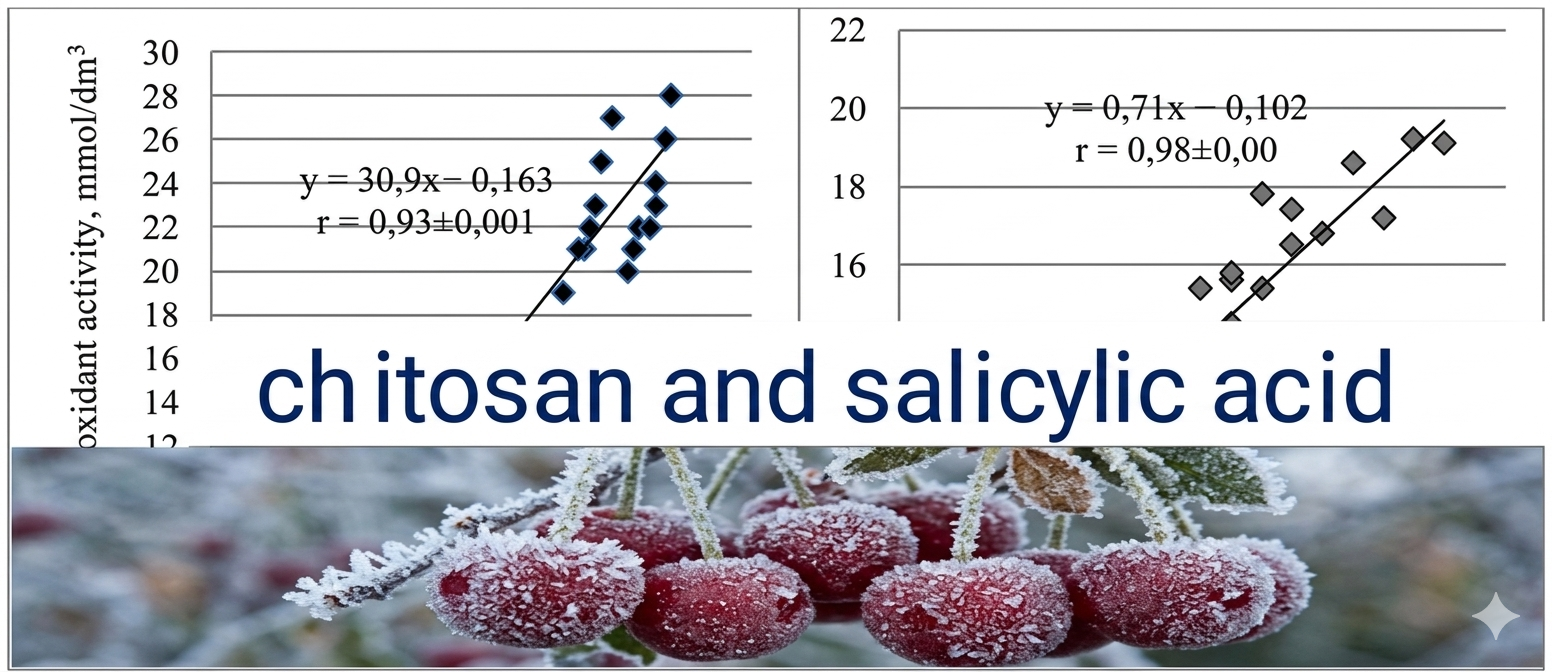
Cherry fruits are valued for their anthocyanin content, but their shelf life is short. Therefore, it is necessary to extend the shelf life of the fruit by developing new storage technologies. To this end, Alpha and Pam'yat Artemenka sour cherry varieties were sprayed with a solution of chitosan and salicylic acid and stored in a refrigerator at a temperature of 1±0.5 °C and a relative humidity of 95±1 %. The results of the studies showed that spraying cherry fruits with a 1 % chitosan solution with the addition of 100 mg/l of salicylic acid had a beneficial effect on the preservation of ascorbic acid, tannins, and pigments. Their content decreased by 18.3−19.8 % and 8.2−9.5 %. At the same time, the loss of antioxidant activity was 25−26 %. A strong correlation was found between antioxidant activity and the content of tannins and pigments (r = 0.93±0.00).
References
Blando, F., Gerardi, C., Nicoletti, I. (2004). Sour cherry (Prunus cerasus L) anthocyanins as ingredients for functional foods. Journal of biomedicine and biotechnology. 5, 253–258. doi:10.1155/S1110724304404136
Capanoglu, E., Boyacioglu, D., Vos, Ric, C.H., Hall, R. D., Beekwilder, J. (2011). Procyanidins in fruit from sour cherry (Prunus cerasus) differ strongly in chainlength from those in laurel cherry (Prunus lauracerasus) and cornelian cherry (Cornus mas). Journal of Berry Research. 1, 137–146. https://doi.org/10.3233/BR-2011-015
European Parliament, & Council of the European Union. (2015). Directive (EU) 2015/720 of the European Parliament and of the Council of 29 April 2015 amending Directive 94/62/EC as regards reducing the consumption of lightweight plastic carrier bags. http://eur-lex.europa.eu/legal-content/EN/TXT/?uri=CELEX:32015L0720
Donno, D., Mellano, M.G., Biaggi, M., Riondato, I., Rakotoniaina, E.N., Beccaro, G.L. (2018). New findings in Prunus padus L. fruits as a source of natural compounds: Characterization of metabolite profiles and preliminary evaluation of antioxidant activity. Molecules. 22(4), 23. https://doi.org/10.3390/molecules23040725
National Standard of Ukraine. (2015). Fruits, vegetables and their processed products. Determination of ascorbic acid content (DSTU ISO 6557-2:2014; ISO 6557-2:1984, IDT). Ministry of Economic Development and Trade of Ukraine.
Gimeneza, M.G., Valverdea, J.M., Valero, D., Zapata, P.J., Castillo, S., Serrano, M. (2016). Postharvest methyl salicylate treatments delay ripening and maintain quality attributes and antioxidant compounds of ‘Early Lory’ sweet cherry. Postharvest Biology and Technology. 117, 102−109. doi:10.1016/j.postharvbio.2016.02.006
Goncalves, B., Silva, A.P., Moutinho-Pereira, J., Bacelar, E., Rosa, E., Meyer, A.S. (2007). Effect of ripeness and postharvest storage on the evolution of colour and anthocyanins in cherries (Prunus avium L.). Food Chemistry. 103, 976–984. doi:10.1016/j.foodchem.2006.08.039
Khasanov, V.V., Ryzhova, G.L., Maltseva, E.V. (2004). Methods for the determination of antioxidants. Chem. Plant Raw Mater. 3, 63−75.
Lien, N., Visy, A., Baranyaim, L., Friedrich, L., Mahajan, P. (2020). Application of hue spectra fingerprinting during cold storage and shelf-life of packaged sweet cherry. Journal of Food Measurement and Characterization. 14, 2689–2702. doi:10.1007/s11694-020-00515-z
Naichenko, V.M. (2001). [Practicum on technology of storage and processing of fruits and vegetables]. Kyiv: Pupil. (In Ukrainian).
Oancea, S., Draghici, О., Ketney, О. (2016). Changes in total anthocyanin content and antioxidant activity in sweet cherries during frozen storage, and air-oven and infrared drying. Fruits. 71(5), 281−288. https://doi.org/10.1051/fruits/2016025
Picariello, G., De Vito, V., Ferranti, P., Paolucci, M., Volpe, M.G. (2016). Species-and cultivar-dependent traits of Prunus avium and Prunus cerasus polyphenols. Journal of Food Composition and Analysis. 45, 50–57. https://doi.org/10.1016/j.jfca.2015.10.002
Pissard, A., Lateur, M., Baeten, V., Magein, H., Dupont, P., Tabart, J., Pincemail, J., Kevers, C. (2016). Determination of total phenolic compound content and antioxidant activity in cherry species and cultivars. Journal of Berry Research. 6, 81−91. doi:10.3233/JBR-150109
Razavi, F., Hajilou, J., Aghdam, M. S. (2018). Salicylic acid treatment of peach trees maintains nutritional quality of fruits during cold storage. Advances in Horticultural Science. 32(1), 33–40.
Serradilla, M.J., Aksicґ, M.F., Manganaris, G.A., Ercisli, S., Gonzblez-Gуmez, Valero, D. (2017). Fruit chemistry, nutritional benefits and social aspects of cherries. Cherries: Botany, Production and Uses. 420−441. doi:10.1079/9781780648378.0420
Sing, R., Martins, V., Soares, B., Castro I., Falco, V. (2020). Chitosan application in vineyards (Vitis vinifera L. cv. Tinto Cao) induces accumulation of anthocyanins and other phenolics in berries, mediated by modifications in the transcription of secondary metabolism genes. International Journal of Molecular Sciences. 21, 306−314. https://doi.org/10.3390/ijms21010306
Stan, A., Popa, M. E. 2015. Pretreatment and freezing storage effect on antioxidant capacity of sour cherries and correlation with color changes. Romanian Biotechnological Letters. 20(5), 10726−10834.
Valero, D., Diaz-Mula, H.M., Zapata, P.J, Guillen, F., Martinez-Romero, D., Castillo S., Serrano M. (2013). Effects of alginate edible coating on preserving fruit quality in four plum cultivars during postharvest storage. Postharvest Biology and Technology. 77, 1−6. doi:10.1016/j.postharvbio.2012.10.011
Vasylyshyna, O., Postolenko, Y. (2019). Influence of freezing method on color change and antioxidant activity in cherry fruit. Сarpathian gournal of food science and technology. 11(4), 133−140. https://doi.org/10.34302/2019.11.4.12
Wojdyło, A., Nowicka, P, Laskowski, P., Oszmiański, J. (2014). Evaluation of sour cherry (Prunus cerasus L.) fruits for their polyphenol content, antioxidant properties, and nutritional components. Journal of Agricultural and Food Chemistry. 62, 12332−12345. doi:10.1021/jf504023z
Xin, Y., Chen, F., Lai, S., Yang, H. (2017). Influence of chitosan-based coatings on the physicochemical properties and pectin nanostructure of Chinese cherry. Postharvest Biology and Technology. 133, 64–71.
Yeshchenko, V. O., Kopytko, P. G., Kostogryz, P. V., Opryshko, V. P. (2014). [Fundamentals of Scientific Research in Agronomy], Vinnytsia: PP ‘TD ’Edelweiss and K‘. (In Ukrainian).
Youwei, Y., Yinzhe, R. (2013). Effect of chitosan coating on preserving character of post-harvest fruit and vegetable: a review. Journal of Food Processing & Technology. 4 (8), 254–257.
Downloads
Published
Issue
Section
License
Copyright (c) 2026 Oles Honchar Dnipro National University

This work is licensed under a Creative Commons Attribution 4.0 International License.
- Authors reserve the right of attribution for the submitted manuscript, while transferring to the Journal the right to publish the article under the Creative Commons Attribution License. This license allows free distribution of the published work under the condition of proper attribution of the original authors and the initial publication source (i.e. the Journal)
- Authors have the right to enter into separate agreements for additional non-exclusive distribution of the work in the form it was published in the Journal (such as publishing the article on the institutional website or as a part of a monograph), provided the original publication in this Journal is properly referenced
- The Journal allows and encourages online publication of the manuscripts (such as on personal web pages), even when such a manuscript is still under editorial consideration, since it allows for a productive scientific discussion and better citation dynamics (see The Effect of Open Access).