
BIOCHEMICAL, FUNCTIONAL, AND TECHNOLOGICAL EVALUATION OF WILD BOAR MEAT PREPARED BY DIFFERENT CULINARY METHODS
DOI:
https://doi.org/10.15421/jchemtech.v34i1.340998Keywords:
wild boar meat, functional properties, culinary processing, cooking methodsAbstract
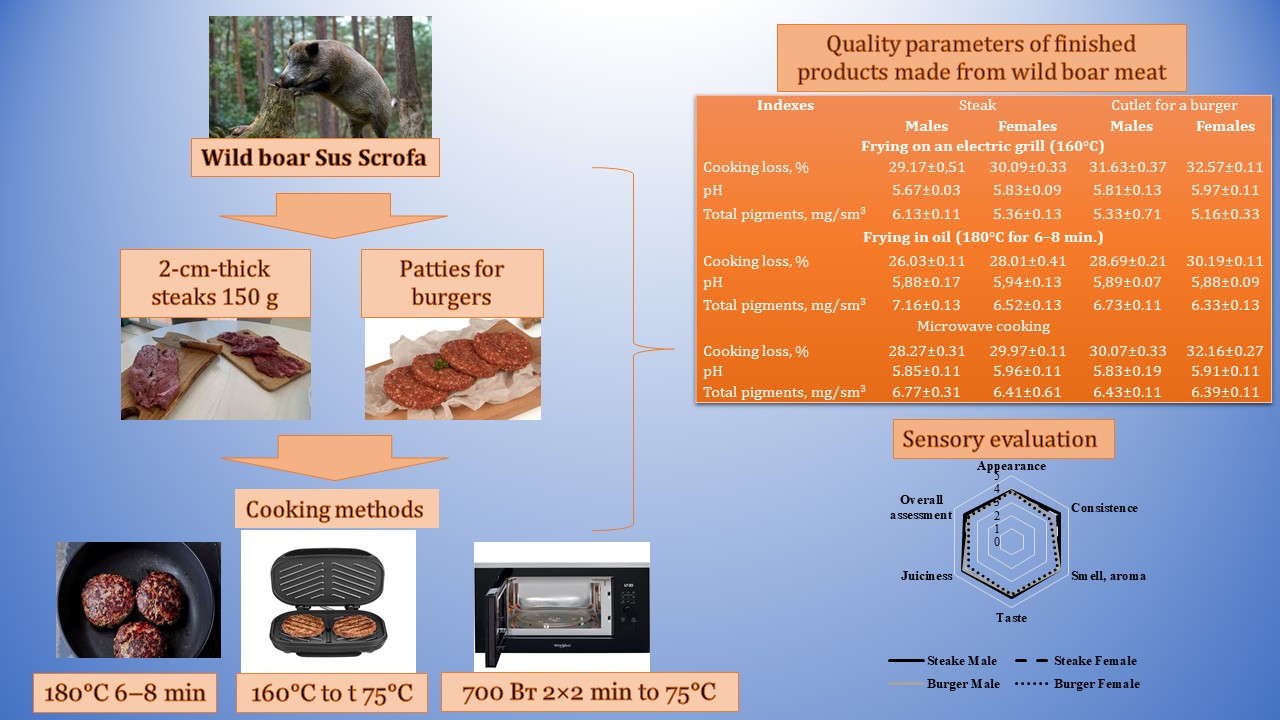
Aim. The purpose of the work is to study the functional, technological, and culinary properties of wild boar meat and to establish the influence of different heat treatment methods on sensory parameters and product yield. Methods. The study focused on wild boar meat obtained through traditional hunting in the hunting grounds of the Sumy region, Ukraine. Results. The protein content was 21.56–22.68 %, fat – 2.25–2.64 %, which affected the energy value of the meat: 112–118 kcal/100 g. It was found that the meat of female wild boars under the age of one year has a slightly lower nutritional value (112 kcal/100 g) compared to the meat of males, which is due to the lower protein and fat content and higher moisture content. When comparing the functional and technological parameters of raw meat between male and female wild boar, no significant differences were found, indicating a lack of special strategies for processing or marketing meat of animals of different sexes. Cooking wild boar meat by frying (180 °C for 5–10 min) proved to be the most effective heat treatment method for preserving optimal quality characteristics, particularly in terms of sensory and textural characteristics preferred by consumers. Conclusion. Based on the results of the study of the functional, technological, and culinary properties of wild boar meat of both sexes and the establishment of the influence of various heat treatment methods on sensory indicators and losses during cooking, it can be concluded that wild boar meat has high nutritional value, sufficient functional indicators, and has a favorable sensory assessment during culinary processing.
References
Riccioli, F., Dominici, A., Russo, C., & Boncinelli, F. (2024). Consumers’ preferences for game meat safety: Results from a choice experiment. Journal of International Food & Agribusiness Marketing, 37(3), 489–514. https://doi.org/10.1080/08974438.2024.2363389
Pedrazzoli, M., Dal Bosco, A., Castellini, C., Ranucci, D., Mattioli, S., Pauselli, M., & Roscini, V. (2017). Effect of age and feeding area on meat quality of wild boars. Italian Journal of Animal Science, 16(3), 353–362. https://doi.org/10.1080/1828051X.2017.1292114
Tesařová, S., Ježek, F., Hulánková, R., Plhal, R., Drimaj, J., Steinhauserová, I., & Bořilová, G. (2018). The individual effect of different production systems, age and sex on the chemical composition of wild boar meat. Acta Veterinaria Brno, 87(4), 395–402. https://doi.org/10.2754/avb201887040395
Bozhko N.V., Tischenko V.I., Pasichnyi V.M., Marinin A. I., Matsuk Y. A. (2023). Comparative analysis of the chemical composition, functional-technological, rheological, and antioxidant properties of wild boar meat (Sus scrofa) with DFD properties and industrial pork. Acta Scientiarum Polonorum Technologia Alimentary, 22(3), 257–266. https://www.food.actapol.net/volume22/issue3/2_3_2023.pdf
Reitznerová, A., Semjon, B., Bartkovský, M., Šuleková, M., Nagy, J., Klempová, T., & Marcinčák, S. (2023). Comparison of lipid profile and oxidative stability of vacuum-packed and longtime-frozen fallow deer, wild boar, and pig meat. Applied Sciences, 13(6), 4059. https://doi.org/10.3390/app13064059
Niewiadomska, K., Kosicka-Gębska, M., Gębski, J., Gutkowska, K., Jeżewska-Zychowicz, M., & Sułek, M. (2020). Game meat consumption– Conscious choice or just a game? Foods, 9(10), 1357. https://doi.org/10.3390/foods9101357
Wach, J., Komosa, M., Serwańska-Leja, K., Nowicki, W., & Babiński, B. (2023). Comparison of the nutritional value of meat from farm-raised and wild fallow deer (Dama dama). Animal Science and Genetics, 19(4), 81–90. https://doi.org/10.5604/01.3001.0054.3063
Hedman, H. D., Varga, C., Duquette, J., Novakofski, J., & Mateus-Pinilla, N. E. (2020). Food safety considerations related to the consumption and handling of game meat in North America. Veterinary Sciences, 7(4), 188. https://doi.org/10.3390/vetsci7040188
Corradini, A., Marescotti, M. E., Demartini, E., & Gaviglio, A. (2022). Consumers' perceptions and attitudes toward hunted wild game meat in the modern world: A literature review. Meat Science, 194, 108955. https://doi.org/10.1016/j.meatsci.2022.108955
Gren, I. M., Andersson, H., Jonasson, L., & Knutsson, R. (2024). Food security and the value of game animals—A study of Sweden. European Journal of Wildlife Research, 70, 35. https://doi.org/10.1007/s10344-024-01786-3
Tomić Maksan, M., Gerini, F., & Šprem, N. (2025). Investigating consumer attitudes about game meat: A market segmentation approach. Sustainability, 17, 3147. https://doi.org/10.3390/su17083147
Tomljanović, K., Grubešić, M., Medić, H., Potočnik, H., Topolovčan, T., Kelava Ugarković, N., & Marušić Radovčić, N. (2022). The impact of premortality stress on some quality parameters of roe deer, wild boar, and red deer meat. Foods, 11(9), 1275. https://doi.org/10.3390/foods11091275
Viganò, R., Demartini, E., Riccardi, F., Corradini, A., Besozzi, M., Lanfranchi, P., ... Gaviglio, A. (2019). Quality parameters of hunted game meat: Sensory analysis and pH monitoring. Italian Journal of Food Safety, 8(1), 55–59. https://doi.org/10.4081/ijfs.2019.7724
Fabijanić, N., Konjačić, M., Luković, Z., Prpić, Z., & Ugarković, N. (2023). Physical parameters of wild boar meat quality: A review. Journal of Central European Agriculture, 24(2), 340–348. https://doi.org/10.5513/JCEA01/24.2.3843
Sampels, S., Jonsson, M., Sandgren, M., Karlsson, A., & Segerkvist, K. A. (2023). Sustainable delicacy: Variation in quality and sensory aspects in wild boar (Sus scrofa) meat and comparison to pork meat—A case study. Foods, 12(8), 1644. https://doi.org/10.3390/foods12081644
Macháčková, K., Zelený, J., Lang, D., & Vinš, Z. (2021). Wild boar meat as a sustainable substitute for pork: A mixed methods approach. Sustainability, 13(5), 2490. https://doi.org/10.3390/su13052490
Carpio, A. J., Apollonio, M., & Acevedo, P. (2021). Wild ungulate overabundance in Europe: Contexts, causes, monitoring and management recommendations. Mammal Review, 51(1), 95–108. https://doi.org/10.1111/mam.12221
Castillo-Contreras, R., Mentaberre, G., Aguilar, X. F., Conejero, C., Colom-Cadena, A., Ráez-Bravo, A., & López-Olvera, J. R. (2021). Wild boar in the city: Phenotypic responses to urbanisation. Science of The Total Environment, 773, 145593. https://doi.org/10.1016/j.scitotenv.2021.145593
Ilic, J., Tomasevic, I., & Djekic, I. (2022). Influence of boiling, grilling, and sous-vide on mastication, bolus formation, and dynamic sensory perception of wild boar ham. Meat Science, 188, 108805. https://doi.org/10.1016/j.meatsci.2022.108805
Freschi, P., Braghieri, A., Pacelli, C., Langella, E., Riviezzi, A. A., Paolino, R., & Cosentino, C. (2023). Sensory profile and consumer liking of sustainable salamis differing in wild boar meat and seasoning ingredients addition. Foods, 12(5), 1089. https://doi.org/10.3390/foods12051089
Ge, G., Han, Y., Zheng, J., Zhao, M., & Sun, W. (2020). Physicochemical characteristics and gel-forming properties of myofibrillar protein in an oxidative system affected by partial substitution of NaCl with KCl, MgCl2 or CaCl2. Food Chemistry, 309, 125614. https://doi.org/10.1016/j.foodchem.2019.125614
He, J., Zhou, G., Bai, Y., Wang, C., Zhu, S., Xu, X., & Li, C. (2018). The effect of meat processing methods on changes in disulfide bonding and alteration of protein structures: Impact on protein digestion products. RSC Advances, 8(31), 17595–17605. https://doi.org/10.1016/j.foodchem.2019.125614
Dominguez-Hernandez, E., Alvija, S., & Per, E. (2018). Low-temperature long-time cooking of meat: Eating quality and underlying mechanisms. Meat Science, 143, 104–113. https://doi.org/10.1016/j.meatsci.2018.04.032
Choi, Y. M., Garcia, L. G., & Lee, K. (2019). Correlations of sensory quality characteristics with intramuscular fat content and bundle characteristics in bovine longissimus thoracis muscle. Food Science of Animal Resources, 39(2), 197–208. https://doi.org/10.5851/kosfa.2019.e15
Starowicz, M., & Zieliński, H. (2019). How Maillard reaction influences sensorial properties (color, flavor, and texture) of food products? Food Reviews International, 35(8), 707–725. https://doi.org/10.1080/87559129.2019.1600538
Ladyka, V.I., Tymchenko, O.L., Bolhova, N.V., Tischenko, V.I., Bozhko, N. V. (2024). Evaluation of culinary and functional-technological properties of the meat of steers of different genotypes. Acta Scientiarum Polonorum Technologia Alimentaria, 23(4), 439-449. https://doi.org/10.17306/J.AFS.001273
Pasichnyi, V., Shevchenko, O., Tischenko, V., Bozhko, N., Marynin, A., Strashynskyi, I., Matsuk, Y. (2024). Substantiating the feasibility of using hemp seed protein in cooked sausage technology. Eastern-European Journal of Enterprise Technologies, 4(11 (130), 56–66. https://doi.org/10.15587/1729-4061.2024.310668
Strashinsky, I. M., Goncharov, G. I., Borsolyuk, L. V., & Severyn, V. Y. (2010). [Improvement of recipes of cooked poultry sausages]. Scientific Bulletin of LNUVMBT named after S.Z. Gzhitskyi, 12(2), 94–99.
Honikel, K. O. (1998). Reference methods for the assessment of physical characteristics of meat. Meat Science, 49(4), 447–457. https://doi.org/10.1016/s0309-1740(98)00034-5
Bozhko, N., Tischenko, V., Pasichnyi, V., Polumbryk, M., Haschuk, O. (2018). Development of meat-containing minced semi-finished products based on the locally produced raw materials. Eastern-European Journal of Enterprise Technologies, 94(11), 49–54. https://doi.org/10.15587/1729-4061.2018.140052
Murphy, R. Y., & Marks, B. P. (2000). Effect of meat temperature on proteins, texture, and cook loss for ground chicken breast patties. Poultry Science, 79(1), 99–104. https://doi.org/10.1093/ps/79.1.99
Ahumada, P. G. F., Pavez, R. M., & Ramm, O. S. (2021). Chemical properties and sensory characteristics of wild boar meat (Sus scrofa scrofa) fed with acorns (Quercus robur). Revista de Producción Animal, 33(1).
Bozhko, N., Pasichnyi, V., Marynin, A., Tischenko, V., Strashynskyi, I., Kyselov, O. (2020). The efficiency of stabilizing the oxidative spoilage of meat-containing products with a balanced fat-acid composition. Eastern-European Journal of Enterprise Technologies, 3(11 (105), 38–45. https://doi.org/10.15587/1729-4061.2020.205201
Stepanova, T. M., Golovko, M. P., Golovko, T. M., Pertsevoi, F. V., Vasylenko, O. O., Prymenko, V. G., ... Koshel, O. Y. (2022). Chemical composition of vetch seeds and protein isolate obtained by pH-shifting treatment. Journal of Chemistry and Technologies, 30(4), 652–658. https://doi.org/10.15421/jchemtech.v30i4.270685
Food and Agriculture Organization of the United Nations. (2003). Food energy – Methods of analysis and conversion factors (Food and Nutrition Paper 77). https://www.fao.org/3/Y5022E/Y5022E00.htm
Bozhko, N., Tischenko, V., Pasichnyi, V., Shubina, Y., Kyselov, O., Marynin, A., Strashynskyi, I. (2021). The quality characteristics of sausage prepared from different ratios of fish and duck meat. Potravinarstvo, 15(1), 26–32. https://doi.org/10.5219/1482
Kim, H., Do, H. W., & Chung, H. (2017). A comparison of the essential amino acid content and the retention rate by chicken part according to different cooking methods. Korean Journal for Food Science of Animal Resources, 37(5), 626–634. https://doi.org/10.5851/kosfa.2017.37.5.626
Amici, A., Cifuni, G. F., Contò, M., Esposito, L., & Failla, S. (2015). Hunting area affects chemical and physical characteristics and fatty acid composition of wild boar (Sus scrofa) meat. Rendiconti Lincei. Scienze Fisiche e Naturali, 26(Suppl 3), 527–534. https://doi.org/10.1007/s12210-015-0412-7
Kamieniarz, R., Jankowiak, Ł., Fratczak, M., Panek, M., Wojtczak, J., & Tryjanowski, P. (2020). The relationship between hunting methods and the sex, age and body mass of wild boar Sus scrofa. Animals, 10(12), 2345. https://doi.org/10.3390/ani10122345
Ludwiczak, A., Składanowska-Baryza, J., & Stanisz, M. (2020). Effect of age and sex on the quality of offal and meat of the wild boar (Sus scrofa). Animals, 10(4), Article 660. https://doi.org/10.3390/ani10040660
Modzelewska-Kapituła, M., & Żmijewski, T. (2021). The influence of age and gender on the quality of raw and roasted wild boars (Sus scrofa) meat. Meat Science, 181, 108600. https://doi.org/10.1016/j.meatsci.2021.108600
Żmijewski, T., & Modzelewska-Kapituła, M. (2021). The influence of age and sex on carcass characteristics and chemical composition of the longissimus thoracis et lumborum muscle in wild boars (Sus scrofa). Archives Animal Breeding, 64(1), 199–210. https://doi.org/10.5194/aab-64-199-2021
Eaton, S. A., & Sethi, J. K. (2019). Immunometabolic links between estrogen, adipose tissue and female reproductive metabolism. Biology, 8(1), 8. https://doi.org/10.3390/biology8010008
Nethra, P. V., Sunooj, K. V., Aaliya, B., Navaf, M., Akhila, P. P., Sudheesh, C., & George, J. (2023). Critical factors affecting the shelf life of packaged fresh red meat–A review. Measurement: Food, 10, 100086. https://doi.org/10.1016/j.meafoo.2023.100086
Morán, L., Insausti, K., Barron, L. J. R., & Aldai, N. (2019). Wild boar – Production, meat quality traits and derived products. In J. Lorenzo, P. Munekata, F. Barba, & F. Toldrá (Eds.), More than Beef, Pork and Chicken – The Production, Processing, and Quality Traits of Other Sources of Meat for Human Diet (pp. 211–226). Springer, Cham. https://doi.org/10.1007/978-3-030-05484-7_8
Ciobanu, M.M., Postolache, A.N., Lipşa, F.D., Munteanu, M., Rațu, R. N., Murariu, O. C., & Boișteanu, P. C. (2022). Meat fatty acid composition of wild boars hunted in Romania in relationship to gender and age-class. Animals, 12(7), 810. https://doi.org/10.3390/ani12070810
Korpysa-Dzirba, W., Różycki, M., Bilska-Zając, E., Karamon, J., Sroka, J., Bełcik, A., Cencek, T. (2021). Alaria alata in terms of risks to consumers’ health. Foods, 10(7), 1614. https://doi.org/10.3390/foods10071614
Guardone, L., Armani, A., Mancianti, F., & Ferroglio, E. (2022). A review on Alaria alata, Toxoplasma gondii and Sarcocystis spp. in mammalian game meat consumed in Europe: Epidemiology, risk management and future directions. Animals, 12(3), 263. https://doi.org/10.3390/ani12030263
Wang, X., Muhoza, B., Wang, X., Feng, T., Xia, S., & Zhang, X. (2019). Comparison between microwave and traditional water bath cooking on saltiness perception, water distribution and microstructure of grass carp meat. Food Research International, 125, 108521. https://doi.org/10.1016/j.foodres.2019.108521
Chen, F., Zhang, M., Fan, K., & Mujumdar, A. S. (2020). Non-thermal technology and heating technology for fresh food cooking in the central kitchen processing: A review. Food Reviews International, 38(4), 608–627. https://doi.org/10.1080/87559129.2020.1740246
Downloads
Published
Issue
Section
License
Copyright (c) 2026 Oles Honchar Dnipro National University

This work is licensed under a Creative Commons Attribution 4.0 International License.
- Authors reserve the right of attribution for the submitted manuscript, while transferring to the Journal the right to publish the article under the Creative Commons Attribution License. This license allows free distribution of the published work under the condition of proper attribution of the original authors and the initial publication source (i.e. the Journal)
- Authors have the right to enter into separate agreements for additional non-exclusive distribution of the work in the form it was published in the Journal (such as publishing the article on the institutional website or as a part of a monograph), provided the original publication in this Journal is properly referenced
- The Journal allows and encourages online publication of the manuscripts (such as on personal web pages), even when such a manuscript is still under editorial consideration, since it allows for a productive scientific discussion and better citation dynamics (see The Effect of Open Access).