GREEN SYNTHESIS OF COPPER OXIDE (CuO) NANOPARTICLES AND THEIR EFFECTS ON THE ELECTRICAL PROPERTIES OF POLYMER COMPOSITES
DOI:
https://doi.org/10.15421/jchemtech.v34i1.341288Keywords:
Green synthesis, Copperoxide nanoparticles, Polymer composites, Electrical conductivity, Antimicrobial activity, CharacterizationAbstract
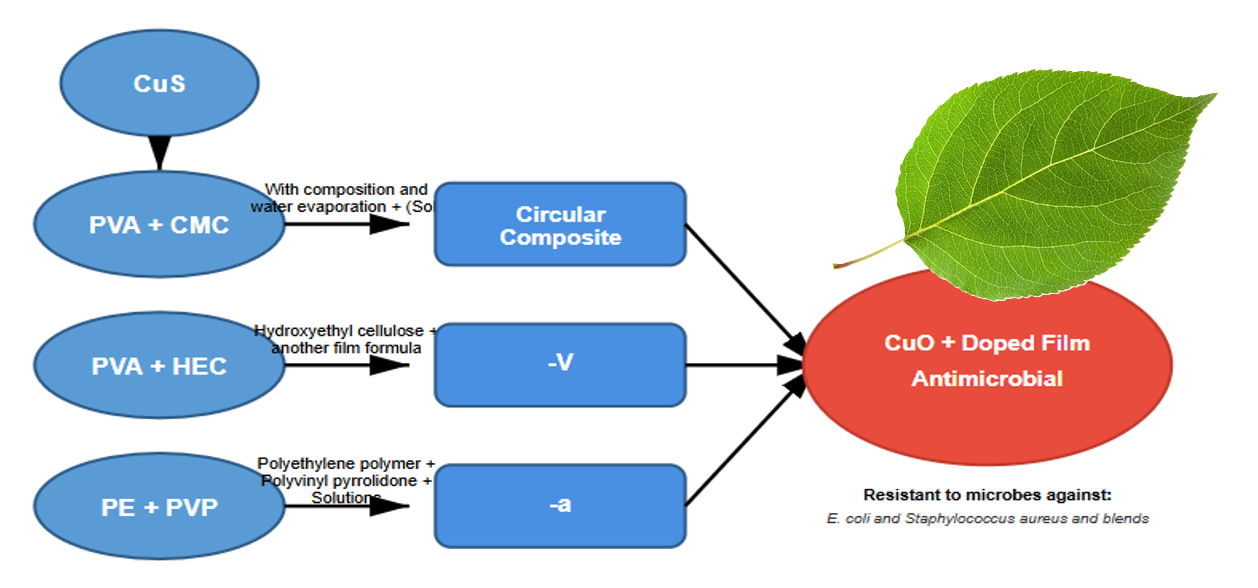
In this study, metal oxide nanoparticles were obtained using a plant-leaf extract, which was an environmentally friendly synthetic method for obtaining copper oxide nanoparticles as a reducing and stabilizing agent. These nanoparticles were incorporated into various polymer matrices to increase their electrical and anti-microbial performance. The synthesized CuO nanoparticles were structurally and morphologically characterized using FTIR, UV–Vis spectroscopy, SEM, and EDS analyses which shows a spherical structure with an average size of 20–50 nm. Films of polymer nanocomposite were prepared using PVA, CMC, PVP and PE matrices loaded with CuO concentrations (1–7 %). Electrical conductivity measurements show an increase in conductivity with a subsequent maximum of 1.65·10-4 S/cm for the optimised film, which is due to the efficient dispersion of CuO nanoparticles, i.e., an improved energy pathway. The test with Escherichia coli and Staphylococcus aureus shows the presence of a significant inhibition zone, which indicates strong antibacterial properties of the compound. It is due to the formation of reactive oxygen species. Moreover, they caused a nanoscale interaction with the membrane of the bacteria. In general, the findings indicate that the electrical and biological properties of polymer composites can be greatly enhanced using green-synthesized CuO nanoparticles. Such polymer composites can be used in flexible electronics, antimicrobial coatings, and other applications.
References
Ahmad, T., Iqbal, J., & Khan, S. A. (2023). Green synthesis of copper oxide nanoparticles using plant extracts: A comprehensive review. Journal of Cleaner Production, 398, 136589. https://doi.org/10.1016/j.jclepro.2023.136589
Al-Hakkani, M. F. (2020). Biogenic copper nanoparticles and their applications: A review. SN Applied Sciences, 2(3), 505. https://doi.org/10.1007/s42452-020-2279-1
Badawi, N. M., Ramadan, A. R., & El-Latif, M. M. A. (2021). Synthesis and characterization of CuO nanoparticles and their effects on the structural and electrical properties of PVA/CuO nanocomposite films. Journal of Materials Science: Materials in Electronics, 32(11), 14895–14906. https://doi.org/10.1007/s10854-021-06048-w
Devi, H. S., Boda, M. A., Shah, M. A., Parveen, S., & Wani, H. H. (2019). Green synthesis of iron oxide nanoparticles using Platanus orientalis leaf extract for antifungal activity. Green Processing and Synthesis, 8(1), 38–45. https://doi.org/10.1515/gps-2018-0084
Grigore, M. E., Biscu, E. R., Holban, A. M., Gestal, M. C., & Grumezescu, A. M. (2016). Methods of synthesis, properties and biomedical applications of CuO nanoparticles. Pharmaceuticals, 9(4), 75. https://doi.org/10.3390/ph9040075
Hossain, A., Hong, X., Ibrahim, E., Li, B., Sun, G., Kan, A.T., & Tomson, M. B. (2022). Antimicrobial and electrical conductivity enhancement of polymer composites through green synthesized CuO nanoparticles. Composites Part B: Engineering, 234, 109687. https://doi.org/10.1016/j.compositesb.2022.109687
Kumar, V., Singh, K., Panwar, S., Mehta, S. K., & Sangwan, S. K. (2020). Green synthesis of copper oxide nanoparticles using Aloe vera leaf extract and its antibacterial activity against bacterial pathogens. Journal of Sol-Gel Science and Technology, 96(2), 418–432. https://doi.org/10.1007/s10971-020-05369-5
Malaikozhundan, B., Vaseeharan, B., Vijayakumar, S., & Thangaraj, M. P. (2017). Bacillus thuringiensis coated zinc oxide nanoparticle and its biopesticidal effects on the pulse beetle Callosobruchus maculatus. Journal of Photochemistry and Photobiology B: Biology, 174, 306–314. https://doi.org/10.1016/j.jphotobiol.2017.08.014
Naikoo, G. A., Mustaqeem, M., Hassan, I. U., Awan, T., Arshad, F., Salim, H., & Qurashi, A. (2021). Bioinspired and green synthesis of nanoparticles from plant extracts with antiviral and antimicrobial properties: A critical review. Journal of the Saudi Chemical Society, 25(9), 101304. https://doi.org/10.1016/j.jscs.2021.101304
Raghunath, A., & Perumal, E. (2017). Metal oxide nanoparticles as antimicrobial agents: A promise for the future. International Journal of Antimicrobial Agents, 49(2), 137–152. https://doi.org/10.1016/j.ijantimicag.2016.11.011
Singh, J., Dutta, T., Kim, K. H., Rawat, M., Samddar, P., & Kumar, P. (2018). 'Green' synthesis of metals and their oxide nanoparticles: Applications for environmental remediation. Journal of Nanobiotechnology, 16(1), 84. https://doi.org/10.1186/s12951-018-0408-4
Sweah, Z. J. (2021). Electrical conductivity measurements in thin films: Methods and applications. Thin Solid Films, 734, 138856. https://doi.org/10.1016/j.tsf.2021.138856
Yallappa, S., Manjanna, J., Sindhe, M.A., Satyanarayan, N.D., Pramod, S. N., & Nagaraja, K. (2013). Microwave assisted rapid synthesis and biological evaluation of stable copper nanoparticles using T. arjuna bark extract. Spectrochimica Acta Part A: Molecular and Biomolecular Spectroscopy, 110, 108–115. https://doi.org/10.1016/j.saa.2013.03.005
Zhang, Q. L., & Yang, Z. M. (2016). CuO nanostructures: Synthesis, characterization, properties, and applications. Progress in Materials Science, 83, 472–535. https://doi.org/10.1016/j.pmatsci.2016.07.005
Kashyap, B.K., Singh, V.V., Solanki, M.K., Kumar, A., Ruokolainen, J., Kesari, K.K. (2023). Smart Nanomaterials in Cancer Theranostics: Challenges and Opportunities. ACS Omega, 8, 14290–14320. https://doi.org/10.1021/acsomega.2c07840
Maqusood Ahamed, Rashid Lateef, Mohd Javed Akhtar,Pavan Rajanahalli, (2022).Dietary Antioxidant Curcumin Mitigates CuO Nanoparticle-Induced Cytotoxicity through the Oxidative Stress Pathway in Human Placental Cells. Molecules, 27(21), 7378, https://doi.org/10.3390/molecules27217378
Al-Musawi, M., Al-Shmgani, H., Al-bairuty, G. (2022). Histopathological and biochemical comparative study of copper oxide nanoparticles and copper sulphate toxicity in male albino mice reproductive system. Int. J. Biomater., 2022, 1–12 https://doi.org/10.1155/2022/4877637
Amaregouda, Y., Kamanna, K. (2022). Physico-chemical, in-vitro cytotoxicity and antimicrobial evaluation of L-valine functionalised CuO NPs on polyvinyl alcohol and blended carboxymethyl cellulose films. Indian Chem. Eng., 64(18), 1–10. https://doi.org/10.1080/00194506.2022.2046511
Bhunia, A. K., Saha, S. (2020). CuO nanoparticle-protein bioconjugate: characterization of CuO nanoparticles for the study of the interaction and dynamic of energy transfer with bovine serum albumin. Bio Nano Science, 10(9), 1–17. https://doi.org/10.1007/s12668-019-00687-z
Thapa, R. K., Kim, J. O. (2023). Nanomedicine-based commercial formulations: current developments and future prospects. J Pharm Investig., 53(1), 19–33. https://doi.org/10.1007/s40005-022-00607-6
Zhu, R., Zhang, F., Peng, Y., Xie, T., Wang, Y., Lan, Y. (2022). Current Progress in Cancer Treatment Using Nanomaterials. Front. Oncol., 12, 930125. https://doi.org/10.3389/fonc.2022.930125
Sarkar, J., Das, S., Aich, S., Bhattacharyya, P., Acharya, K. (2022). Antiviral potential of nanoparticles for the treatment of Coronavirus infections. J. Trace Elem. Med. Biol. 72, 126977. https://doi.org/10.1016/j.jtemb.2022.126977
Waris, A., Ali, A., Khan, A. U., Asim, M., Zamel, D., Fatima, K., Raziq, A., Khan, M.A., Akbar, N., Baset, A., et al. (2022). Applications of Various Types of Nanomaterials for the Treatment of Neurological Disorders. Review Nanomaterials (Basel)., 12(13), 2140. https://doi.org/10.3390/nano12132140
Yang, H., Wang, H., Wen, C., Bai, S., Wei, P., Xu, B., Xu, Y., Liang, C., Zhang, Y., Zhang, G. (2022). Effects of iron oxide nanoparticles as T2-MRI contrast agents on reproductive system in male mice. J. Nanobiotechnol, 2(20), 98. https://doi.org/10.1186/s12951-022-01291-2
Downloads
Published
Issue
Section
License
Copyright (c) 2026 Oles Honchar Dnipro National University

This work is licensed under a Creative Commons Attribution 4.0 International License.
- Authors reserve the right of attribution for the submitted manuscript, while transferring to the Journal the right to publish the article under the Creative Commons Attribution License. This license allows free distribution of the published work under the condition of proper attribution of the original authors and the initial publication source (i.e. the Journal)
- Authors have the right to enter into separate agreements for additional non-exclusive distribution of the work in the form it was published in the Journal (such as publishing the article on the institutional website or as a part of a monograph), provided the original publication in this Journal is properly referenced
- The Journal allows and encourages online publication of the manuscripts (such as on personal web pages), even when such a manuscript is still under editorial consideration, since it allows for a productive scientific discussion and better citation dynamics (see The Effect of Open Access).