COMPREHENSIVE EVALUATION OF ULTRAVIOLET DISINFECTION SYSTEMS CONSIDERING MAINTENANCE, SPECTRAL, AND OPERATIONAL COEFFICIENTS
DOI:
https://doi.org/10.15421/jchemtech.v34i1.342827Keywords:
ultraviolet disinfection, photobiological systems, maintenance factor, spectral efficiency, ballast factor, utilization coefficient, degradation modelingAbstract
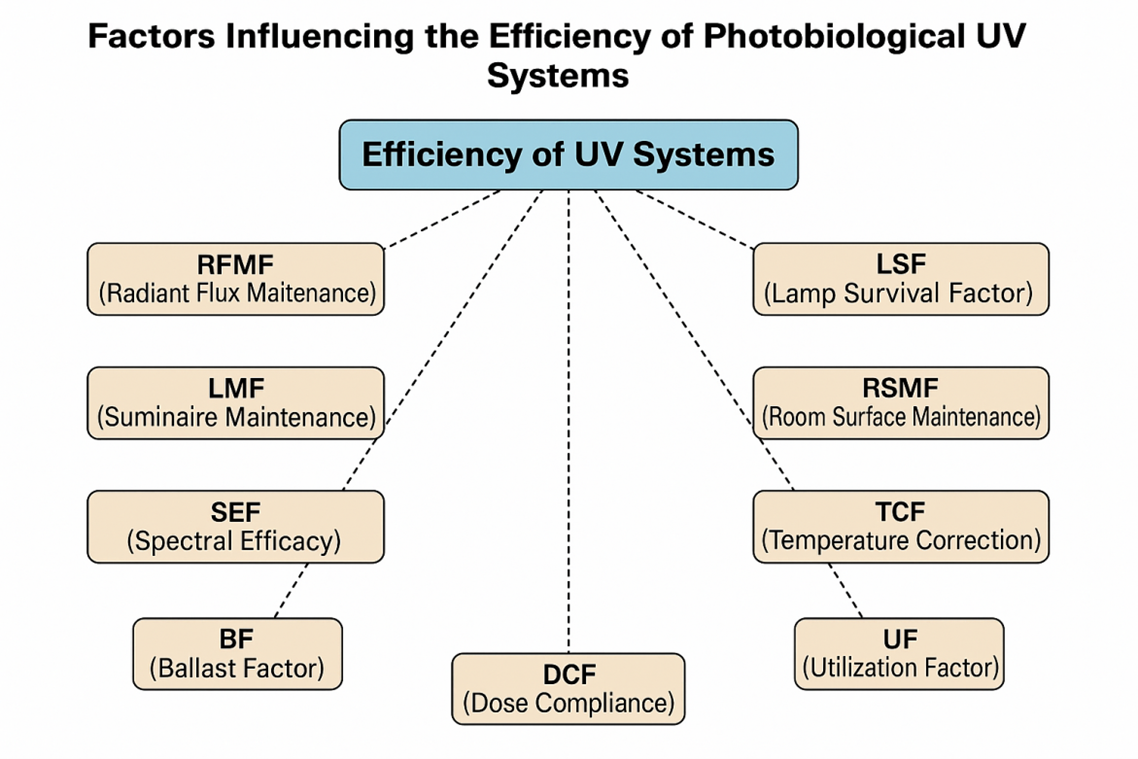
The paper presents a comprehensive evaluation of ultraviolet (UV) disinfection systems by integrating maintenance, spectral, and operational coefficients into a unified analytical model. The study addresses the progressive decline in UV radiation efficiency caused by lamp aging, surface contamination, and changes in the reflective properties of operating environments. The proposed methodology extends the classical Maintenance Factor (MF) model defined in CIE standards by incorporating additional coefficients that account for spectral effectiveness (SEF), temperature influence (TCF), ballast performance (BF), irradiation geometry (UF), and dose compliance (DCF). Experimental data obtained for various UV systems (TUV15WG13, HNS15G13, TUV36WG13, ZW20D15Y, ZW20D15W) demonstrated that overall system efficiency decreases to 27–36 % of the initial level after 6,000 operating hours. The dominant loss factors were identified as UF (17–38 %), RFMF (20–35 %), and LMF (18–28 %), while RSMF, TCF, and BF contributed minor yet consistent effects. The developed integrated approach provides a more accurate prediction of degradation processes, allowing preventive maintenance scheduling, optimization of energy consumption, and stable disinfection efficiency throughout the service life of UV systems.
References
Gómez-López, V.M., Jubinville, E., Rodríguez-López, M. I., Trudel-Ferland, M., Bouchard, S., & Jean, J. (2021). Inactivation of foodborne viruses by UV light: A review. Foods, 10(12), 3141. https://doi.org/10.3390/foods10123141
Heilingloh, C. S., Aufderhorst, U. W., Schipper, L., Dittmer, U., Witzke, O., Yang, D., et al. (2020). Susceptibility of SARS-CoV-2 to UV irradiation. American Journal of Infection Control, 48(10), 1273–1275. https://doi.org/10.1016/j.ajic.2020.07.031
Lee, B., & Bahnfleth, W. P. (2013). Effects of installation location on performance and economics of in-duct ultraviolet germicidal irradiation systems for air disinfection. Building and Environment, 67, 193–201. https://doi.org/10.1016/j.buildenv.2013.05.019
Gidari, A., Sabbatini, S., Bastianelli, S., Pierucci, S., Busti, C., Bartolini, D., Stabile, A. M., Monari, C., Galli, F., Rende, M., et al. (2021). SARS-CoV-2 survival on surfaces and the effect of UV-C light. Viruses, 13(3), 408. https://doi.org/10.3390/v13030408
Bergman, R. S. (2021). Germicidal UV sources and systems. Photochemical & Photobiological Sciences, 97(3), 466–470. https://doi.org/10.1111/php.13387
Inagaki, H., Saito, A., Sugiyama, H., Okabayashi, T., & Fujimoto, S. (2020). Rapid inactivation of SARS-CoV-2 with deep-UV LED irradiation. Emerging Microbes & Infections, 9(1), 1744–1747. https://doi.org/10.1080/22221751.2020.1796529
Memarzadeh, F. A. (2021). Review of recent evidence for utilizing ultraviolet irradiation technology to disinfect both indoor air and surfaces. Applied Biosafety, 26(1), 52–56. https://doi.org/10.1177/15356760211007324
Semenov, A., & Koshushko, G. (2014). Device for germicidal air disinfection by ultraviolet radiation. Eastern-European Journal of Enterprise Technologies, 3(10(69)), 13–17. https://doi.org/10.15587/1729-4061.2014.24822
Nazarenko, V. I., Leonov, Y. I., Glyva, V. A., et al. (2023). The influence of UV-LED lamp radiation on indicators of microflora in university auditoriums. Ukrainian Journal of Occupational Health, 19(1), 42–50. https://doi.org/10.33573/ujoh2023.01.042
Van Osdell, D., & Foarde, K. (2002). Defining the Effectiveness of UV Lamps Installed in Circulating Air Ductwork. https://doi.org/10.2172/810964
Semenov, A., & Hmelnitska, Y. (2022). Ultraviolet disinfection of activated carbon from microbiological contamination. Archives of Materials Science and Engineering, 115(1), 34–41. https://doi.org/10.5604/01.3001.0016.0680
Semenov, A., & Semenova, K. (2022). Ultraviolet disinfection of water in a recirculating aquaculture system: A case study at a sturgeon caviar fish farm. Acta Agriculturae Slovenica, 118(3), 1–4. https://doi.org/10.14720/aas.2022.118.3.2488
Semenov, A., Sakhno, T., Hordieieva, O., & Sakhno, Y. (2021). Pre-sowing treatment of vetch hairy seeds, Vicia villosa using ultraviolet irradiation. Global Journal of Environmental Science and Management, 7(4), 555–564. https://doi.org/10.22034/gjesm.2021.04.05
Wiśniewski, A. (2021). Promieniowanie UV-C i promienniki promieniowania UV-C w zastosowaniu bakteriobójczym. Przegląd Elektrotechniczny, 97(4), 170–174. https://doi.org/10.15199/48.2021.04.31
IEC/PAS 62717:2011. (2011). LED modules for general lighting – Performance requirements.
EN IEC 62471-7:2023. (2023). Photobiological safety of lamps and lamp systems – Part 7: Light sources and luminaires primarily emitting visible radiation (IEC 62471-7:2023).
Stowe, R. W. (1999). Practical aspects of irradiance and energy in UV curing. In Proceedings of the RadTech Conference,436-444.
Lynn, D. J., Rountree, K., Pope, R., Clayton, C., Wallace, A., Riter, K., Dart, A., & McCombs, M. (2022). Operating lifetime study of ultraviolet (UV) light-emitting diode (LED) products. United States: N. p. https://doi.org/10.2172/1879172
Lall, P., Wei, J., & Sakalaukus, P. (2014). Life prediction and classification of failure modes in solid state luminaires using Bayesian probabilistic models. Electronic Components & Technology Conference, 2053–2062. https://doi.org/10.1109/ECTC.2014.6897585
Semenov, A., Kharak, R., Bychkov, Y., Dudnyk, V., & Yeleussinov, B. (2024). Method of predicting the useful life of ultraviolet lamps in electrotechnical systems under UV radiation. Przegląd Elektrotechniczny, 100(8), 280–283. https://doi.org/10.15199/48.2024.08.56
Salata, F., de Lieto Vollaro, A., & Ferraro, A. (2014). An economic perspective on the reliability of lighting systems in building with highly efficient energy: A case study. Energy Conversion and Management, 84, 623–632. https://doi.org/10.1016/j.enconman.2014.04.063
CIE. (2005). CIE 97:2005 (2nd ed.). Guide on the maintenance of indoor electric lighting systems. International Commission on Illumination.
CIE. (2003). CIE 154:2003. The maintenance of outdoor lighting systems (Technical report). International Commission on Illumination.
Pawlak, A. (2019). Spektroradiometryczna metoda oceny bezpieczeństwa fotobiologicznego źródeł emitujących promieniowanie. Przegląd Elektrotechniczny, 95(10), 219–224. https://doi.org/10.15199/48.2019.10.47
25. European Committee for Electrotechnical Standardization. (2013). EN IEC 60529: Degrees of protection provided by enclosures (IP Code). Geneva: IEC.
Makaremi, N., Schiavoni, S., Pisello, A. L., & Cotana, F. (2018). Effects of surface reflectance and lighting design strategies on energy consumption and visual comfort. Indoor and Built Environment, 28(4), 1420326X1879317. https://doi.org/10.1177/1420326X18793170
Downloads
Published
Issue
Section
License
Copyright (c) 2025 Oles Honchar Dnipro National University

This work is licensed under a Creative Commons Attribution 4.0 International License.
- Authors reserve the right of attribution for the submitted manuscript, while transferring to the Journal the right to publish the article under the Creative Commons Attribution License. This license allows free distribution of the published work under the condition of proper attribution of the original authors and the initial publication source (i.e. the Journal)
- Authors have the right to enter into separate agreements for additional non-exclusive distribution of the work in the form it was published in the Journal (such as publishing the article on the institutional website or as a part of a monograph), provided the original publication in this Journal is properly referenced
- The Journal allows and encourages online publication of the manuscripts (such as on personal web pages), even when such a manuscript is still under editorial consideration, since it allows for a productive scientific discussion and better citation dynamics (see The Effect of Open Access).