PRODUCTS OF THE INTERACTION OF CHROMIUM(VI) WITH SOME DERIVATIVES OF 6,7-DIHYDROXYBENZOPYRILYLIUM SALTS AND THEIR APPLICATION IN CLOUD POINT EXTRACTION
DOI:
https://doi.org/10.15421/jchemtech.v33i4.342853Keywords:
6,7-dihydroxybenzopyrylium salts, chromium(VI), spectrophotometry, potentiometry, electrothermal atomic-absorption spectrometry, cloud point extractionAbstract
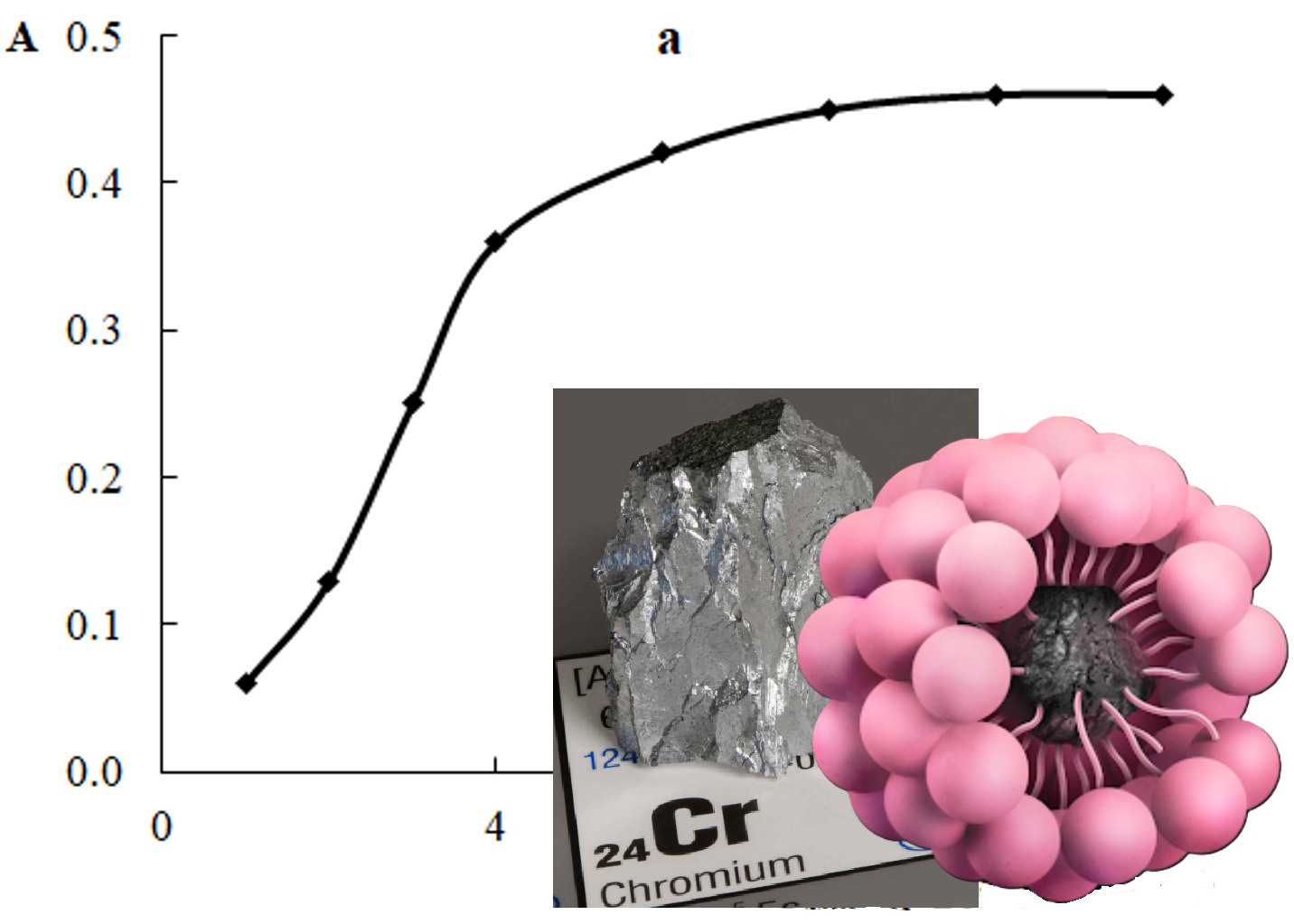
The interaction of chromium(VI) with a series of alkyl- and phenyl-substituted salts of 6,7-dihydroxybenzopyrylium was studied. Using spectrophotometric methods, the stoichiometry of the reaction products was established. Based on the data obtained from potentiometric, spectrophotometric, and mass spectrometric studies, a reaction mechanism was proposed. The chemical and analytical characteristics of the reaction products were determined, and it was noted that the most intensely colored analytical forms were those based on perchlorates of 6,7-dihydroxy-2,4-diphenylbenzopyrylium and 6,7-dihydroxy-4-methyl-2-phenylbenzopyrylium. The optimal conditions for micellar-extraction preconcentration of the reaction product of chromium(VI) with 6,7-dihydroxy-4-methyl-2-phenylbenzopyrylium perchlorate were established as follows: 1 vol.% Triton X-100, pH 2.0, 5×10⁻⁴ mol/dm³ of dye, 0.2 mol/dm³ sodium sulfate, and heating for 30 minutes at 70–80 °C. The calibration graph was linear within the concentration range of 0.05–1.7 mg/dm³, with detection and quantification limits of 0.015 and 0.05 mg/dm³, respectively. The developed method was tested on model solutions and samples of mineral waters.
References
Greenwood, N.N., Earnshaw, A. (1997). Chemistry of the Elements. Butterworth-Heinemann, U.K. https://doi.org/10.1016/C2009-0-30414-6
Zhigalenok, Y., Tazhibayeva, A., Kokhmetova, S., Starodubtseva, A., Kan, T., Isbergenova, D., Malchik F. (2025). Hexavalent chromium at the crossroads of science, environment and public health. RSC Advances, 15(27), 21439–21464. https://doi.org/10.1039/d5ra03104d
Marczenko, Z., Balcerzak, M. (1998). Spectrophotometric methods in inorganic analysis Р.: Wydawnictwo Naukowe PWN.
Bhat, M. A., Mishra, A. K., Jan, S., Shah, S. A., Asgher, M., Rahman, S., Jan, A. T. (2023). Chromium and plant health: A prospective study of toxicity to remediation and restoration of the environment. South African Journal of Botany, 162, 505–518. https://doi.org/10.1016/j.sajb.2023.09.043
Sazakli, E. (2024). Human Health Effects of Oral Exposure to Chromium: A Systematic Review of the Epidemiological Evidence. International Journal of Environmental Research and Public Health, 21(4), 406. https://doi.org/10.3390/ijerph21040406
Shin, D. Y., Lee, S. M., Jang, Y., Lee, J., Lee, C. M., Cho, E.-M., Seo, Y. R. (2023). Adverse Human Health Effects of Chromium by Exposure Route: A Comprehensive Review Based on Toxicogenomic Approach. International Journal of Molecular Sciences, 24(4), 3410. https://doi.org/10.3390/ijms24043410
Hossini, H., Shafie, B., Niri, A.D., Nazari, M., Esfahlan, A.J., Ahmadpour, M., Nazmara, Z., Ahmadimanesh, M., Makhdoumi, P., Mirzaei, N., Hoseinzadeh, E. (2022) A comprehensive review on human health effects of chromium: insights on induced toxicity. Environmental Science and Pollution Research, 29, 70686–70705. https://doi.org/10.1007/s11356-022-22705-6
DesMarais, T. L., Costa, M. (2019). Mechanisms of Chromium-Induced Toxicity. Current opinion in toxicology, 14, 1–7. https://doi.org/10.1016/j.cotox.2019.05.003
Rawtani, D., Gupta, G., Khatri, N., Rao, P. K., Hussain, C.M. (2022). Environmental damages due to war in Ukraine: A perspective. Science of The Total Environment, 850, 157932. https://doi.org/10.1016/j.scitotenv.2022.157932
Petrushka, K., Petrushka, I. (2025). Ecological risks of chromium contamination in Ukrainian soils affected by military activity: SEM‑EDS and EPMA analysis. Environmental Problems, 10(3), 298–308. https://doi.org/10.23939/ep2025.03.298
Bondar, K. M., Tsiupa, I. V., Menshov, O. (2025). War-time changes in air pollution across Ukrainian cities were assessed through magnetic susceptibility and heavy metal contents in particulate matter collected on air filters. Environmental Pollution, 385, 127076. https://doi.org/10.1016/j.envpol.2025.127076
Bonnand, P., James, R. H., Parkinson, I. J., Connelly, D. P., Fairchild, I. J. (2013). The chromium isotopic composition of seawater and marine carbonates. Earth and Planetary Science Letters, 382, 10–20. https://doi.org/10.1016/j.epsl.2013.09.001
Eliopoulos, I.-P. D., Eliopoulos, G. D., Economou-Eliopoulos, M. (2021). The Cr(VI) Stability in Contaminated Coastal Groundwater: Salinity as a Driving Force. Minerals, 11(2), 160. https://doi.org/10.3390/min11020160
Dikobe, J., Melato, F. A., Adlem, C. J. L., Netshiongolwe, K. (2024). Determination of chromium species in water using diphenylcarbazide with a sequential spectrophotometric discrete robotic analyser. Helion, 10(14), e34670 https://doi.org/10.1016/j.heliyon.2024.e34670
Sereshti, H., Farahani, M. V., Baghdadi, M. (2016). Trace determination of chromium(VI) in environmental water samples using innovative thermally reduced graphene (TRG) modified SiO2 adsorbent for solid phase extraction and UV–vis spectrophotometry. Talanta, 146, 662–669. https://doi.org/10.1016/j.talanta.2015.06.051
Zhukovetska, O., Fizer, M., Mariychuk, R., Guzenko, O., Snigur, D. (2024). Spectrophotometric and DFT study of Germanium(IV) interaction with 6,7-dihydroxy-2,4-diphenyl-1-benzopyran-1-ium bromide in solutions: Room-temperature cloud point extraction and its analytical application. Journal of Molecular Liquids, 401, 124724. https://doi.org/10.1016/j.molliq.2024.124724
Snigur, D., Chebotarev, A., Dubovyiy, V., Barbalat, D., Bevziuk K. (2018). Salicylic acid assisted cloud point extraction at room temperature: Application for preconcentration and spectrophotometric determination of molybdenum(VI). Microchemical Journal, 142, 273–278. https://doi.org/10.1016/j.microc.2018.07.010
Snigur, D., Duboviy, V., Barbalat, D., Zhukovetska, O., Chebotarev, A., Bevziuk, K. (2022). A rapid room-temperature cloud point extraction for spectrophotometric determination of copper(II) with 6,7-dihydroxy-2,4-diphenylbenzopyrylium chloride. Analytical Sciences, 38, 949–954. https://doi.org/10.1007/s44211-022-00116-4
Fizer, M., Fizer, O., Barbalat, D., Shishkina, S., Snigur, D. (2022). Structural peculiarities of new benzopyrylium dyes: X-ray, FT-IR, and DFT complex study. J. Molec. Struct. 1252, 132178. https://doi.org/10.1016/j.molstruc.2021.132178.
Snigur, D., Barbalat, D., Fizer, M., Chebotarev, A., Shishkina, S. (2020). Synthesis and properties of 6,7-dihydroxybenzopyrylium perchlorate halogen derivatives: X-ray, spectroscopic and theoretical studies. Tetrahedron. 76, 131514. https://doi.org/10.1016/j.tet.2020.131514.
Leite, V. d. S. A., de Jesus, B. G. L., Duarte, V. G. d. O., Constantino, V. R. L. , Izumi, C. M. S., Tronto J., Pinto, F. G. (2019). Determination of chromium (VI) by dispersive solid-phase extraction using dissolvable Zn-Al layered double hydroxide intercalated with l-Alanine as adsorbent. Microchemical Journal. 146, 650–657. https://doi.org/10.1016/j.microc.2019.01.063
Hashemi, M., Daryanavard, S. M. (2012) Ultrasound-assisted cloud point extraction for speciation and indirect spectrophotometric determination of chromium(III) and (VI) in water samples. Spectrochimica Acta Part A: Molecular and Biomolecular Spectroscopy. 92, 189–193. https://doi.org/10.1016/j.saa.2012.02.073
Kim, J.S., Choi, Y.R., Kim, Y.S., Lee, Y.J., Ko, J.H., Kwon, S.Y., Heo, S. B. (2011). Determination of hexavalent chromium (Cr(VI)) in plastics using organic-assisted alkaline extraction. Analytica Chimica Acta. 690(2), 182–189. https://doi.org/10.1016/j.aca.2011.01.060
Fan, W., Qiao, J., Guan, X. (2017). Multi-wavelength spectrophotometric determination of Cr(VI) in water with ABTS. Chemosphere, 171, 460–467. https://doi.org/10.1016/j.chemosphere.2016.11.153
Bruzzoniti, M. C., Schilirò, T., Gea, M., Rivoira, L. (2024). Determination of hexavalent chromium in textiles of daily use by ion chromatography and dermal risk assessment. Environmental Research. 242, 117731. https://doi.org/10.1016/j.envres.2023.117731
Downloads
Published
Issue
Section
License
Copyright (c) 2025 Oles Honchar Dnipro National University

This work is licensed under a Creative Commons Attribution 4.0 International License.
- Authors reserve the right of attribution for the submitted manuscript, while transferring to the Journal the right to publish the article under the Creative Commons Attribution License. This license allows free distribution of the published work under the condition of proper attribution of the original authors and the initial publication source (i.e. the Journal)
- Authors have the right to enter into separate agreements for additional non-exclusive distribution of the work in the form it was published in the Journal (such as publishing the article on the institutional website or as a part of a monograph), provided the original publication in this Journal is properly referenced
- The Journal allows and encourages online publication of the manuscripts (such as on personal web pages), even when such a manuscript is still under editorial consideration, since it allows for a productive scientific discussion and better citation dynamics (see The Effect of Open Access).