BIOMASS-BASED AMIDES AS MULTIFUNCTIONAL ADDITIVES FOR ELASTOMERIC COMPOSITIONS
DOI:
https://doi.org/10.15421/jchemtech.v34i2.343271Keywords:
elastomeric composition; fatty acid amides; bioingredient; sunflower oil production waste; environmentally friendly rubber; sulfur vulcanization; technological additive.Abstract
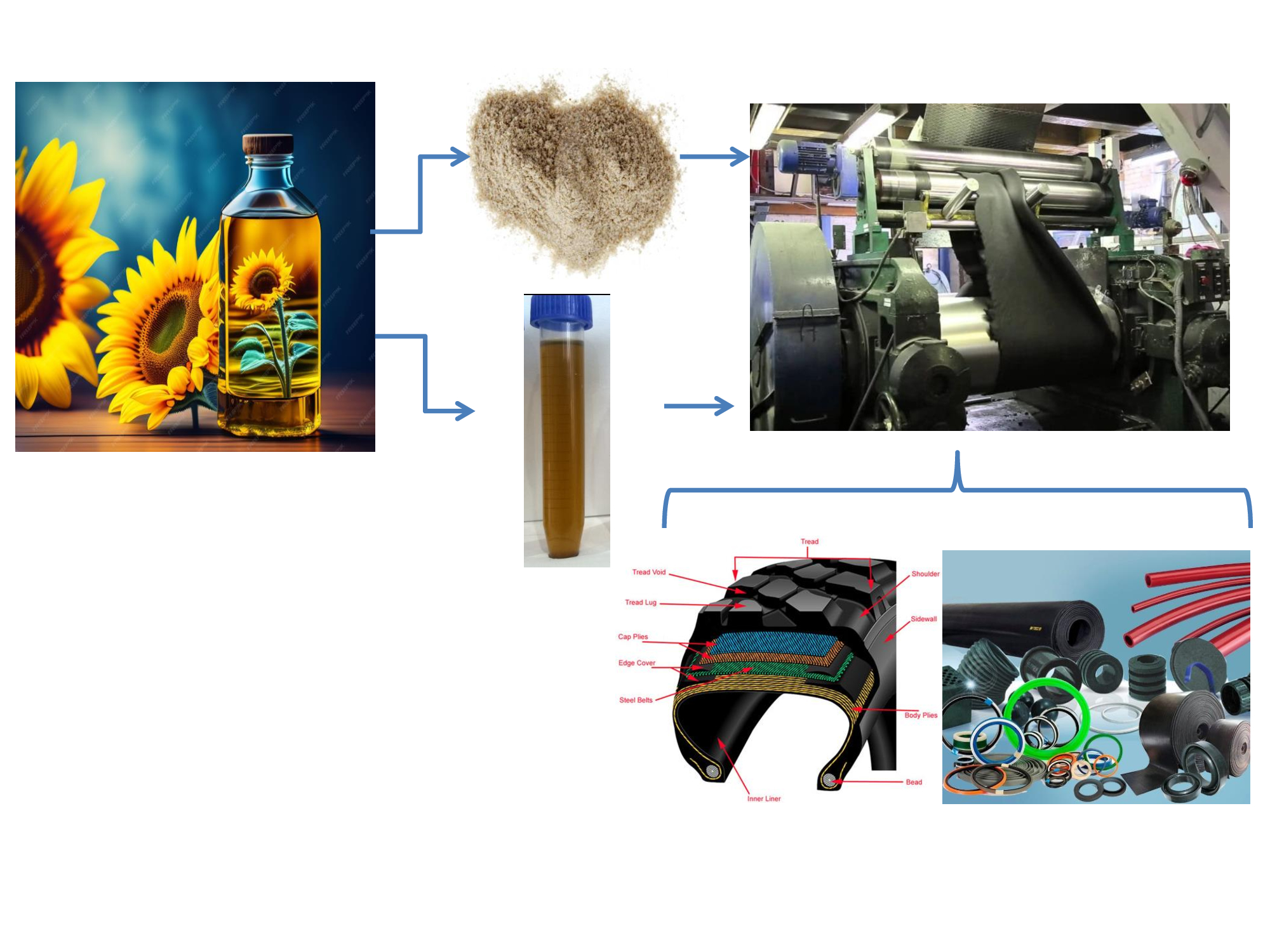
Study investigates the effect of diethanolamides synthesized from renewable plant raw materials (spent sunflower oil production adsorbent) on the properties of filled elastomeric compositions based on butadiene-α-methylstyrene rubber. It has been established that the studied amides are multifunctional additives that combine the properties of plasticizers, dispersing agents, activators, and secondary accelerators in sulfur vulcanization. Their use improves the technological characteristics of rubber compounds, reduces viscosity, and increases plasticity, thereby ensuring better processability of elastomeric compositions. It has been shown that the addition of amides significantly accelerates the sulfur vulcanization process: the cross-linking rate and the apparent rate constant of vulcanization increase by 2–4 times compared to traditional stearic acid, and the time required to reach the vulcanization optimum is reduced. A positive effect of amides on the formation of the vulcanization network structure has been established, which improves the heat resistance and thermal stability of rubbers. The highest effectiveness was demonstrated by glycerol-free fatty acid diethanolamide, which reduces the loss of strength properties after exposure to elevated temperatures by 25 % and provides a relative elongation at break that is 22 % higher than in rubber without additives. The results obtained confirm the potential of using plant-derived amides as environmentally safe, multifunctional ingredients for the production of modern elastomeric compositions and products made from them.
References
Rodgers, B. (Ed.). (2015). Rubber Compounding: Chemistry and Applications. Second edition. London, New York : CRC Press. https://doi.org/10.1201/b18931
Dick, J. S. (2020). Rubber Technology: Compounding and Testing for Performance. 3td Ed. Munich, Germany: Hanser Publications. https://doi.org/10.1016/C2017-0-01398-8
Alarifi, I. M. (2023). A comprehensive review on advancements of elastomers for engineering applications. Advanced Industrial and Engineering Polymer Research, 6(4), 451–464. https://doi.org/10.1016/j.aiepr.2023.05.001
Mostoni, S., Milana, P., Credico, B., D’Arienzo M., Scotti R. (2019). Zinc-Based Curing Activators: New Trends for Reducing Zinc Content in Rubber Vulcanization Process. Catalysts, 9(8), 664. https://doi.org/10.3390/catal9080664
Naebpetch, W., Chamnankit, N., Boonkongkaew, M., Uthaipan, N., Sengloyluan, K., Indriasari, Halim, K. A. A., Nakaramontri, Y., Sattayanurak, S. (2024). Utilization of waste high calcium oxide fly ash as hybrid activator for vulcanization of natural rubber/carbon black composites: Reducing zinc oxide requirement. Industrial Crops and Products, 215, 118648. https://doi.org/10.1016/j.indcrop.2024.118648
Zanchet, A., Sousa, F.D.B., Crespo, J.S., Scuracchio, C.H. (2018). Activator from sugar cane as a green alternative to conventional vulcanization additives. Journal of Cleaner Production, 174, 437–446. https://doi.org/10.1016/j.jclepro.2017.10.329
Brito, K. J., Mauss, C. J., Cofferri, P., Forte, M. M. C. (2023). Sustainable plasticizer from agroindustrial waste for natural rubber compounds: Influence on the curing system and compound properties. Journal of Elastomers and Plastics, 55(3). https://doi.org/10.1177/00952443221150762
Loviso, V.M.H., Freitas, M.A., Forte, M.M.d.C. (2021). Chemically modified soybean oils as plasticizers for silica-filled e-SBR/Br compounds for tire tread applications. Journal of Elastomers and Plastics, 53, 806. https://doi.org/10.1177/0095244320988159
Petrović, Z. S., Milic, J., Ionescu, M., Halladay, J. R. (2017) EPDM rubber plasticized with polymeric soybean oil of different molecular weights. Rubber Chemistry and Technology, 90, 667−682. https://doi.org/10.5254/rct.18.82690
Lee, D. J., Song, S. H. (2019). Investigation of epoxidized palm oils as green processing aids and activators in rubber composites. International Journal of Polymer Science, 42, 1−7. https://doi.org/10.1155/2019/2152408
Wang, Z., Peng, Y., Zhang, L., Zhao, Y., Vyzhimov, R., Tan, T., Fong, H. (2016). Investigation of palm oil as green plasticizer on the processing and mechanical properties of ethylene propylene diene monomer rubber. Industrial and Engineering Chemistry Research, 55(10), 2784−2789. https://doi.org/10.1021/acs.iecr.5b04527
Abbas, K., Ong, S. K. (2019). Investigation of crude palm oil as an alternative processing oils in natural rubber: Effect of the unsaturated fatty acid. IOP Conference Series Materials Science and Engineering, 548. https://doi.org/10.1088/1757-899X/548/1/012009
Fernandez, S. S., Kunchandy, S., Ghosh, S. (2015). Linseed oil plasticizer based natural rubber/expandable graphite vulcanizates: synthesis and characterizations. Journal of Environmental Polymer Degradation, 23, 526−533. https://doi.org/10.1007/s10924-015-0721-z
Mensah, B., Onwona-Agyeman, B., Nsaful, F., Aboagye, I. A., Sowah, N. L., Angnunavuri, P. N., Apalangya, V. A. (2024). Vulcanization kinetics and reinforcement behaviour of natural rubber-carbon black composites: Addition of Shea-butter versus aromatic oil as plasticizers. Helion, 10(4). https://doi.org/10.1016/j.heliyon.2024.e25592
Siwarote, B., Sae-Oui, P., Wirasate, S., Suchiva, K. (2017). Effects of bio-based oils on processing properties and cure characteristics of silica-filled natural rubber compounds. Journal of Rubber Research, 20, 1−19. https://doi.org/10.1007/bf03449138
Khosman, H., Hafni, K.N., Surya, I. (2021). The utilization of palmitamide as palm oil-based plasticizer in SBR/carbon black composites: An observation on degree of carbon-black dispersion. IOP Conference Series Earth and Environmental Science (18 May, 2021), 782. https://doi.org/10.1088/1755-1315/782/2/022064
Fegade, N. B., Desphande, N. M., Millns, W. (1983). Vulcanization of natural rubber in the presence of amide of fatty acids and rosin. Indian rubber Manufactures Research Association, 16, 81–89.
Surya, I., Ismail, H., Azura, A.R. (2013). Alkanolamide as an accelerator, filler-dispersant and a plasticizer in silica-filled natural rubber compounds. Polymer Testing, 32(8), 1313–1321. https://doi.org/10.1016/j.polymertesting.2013.07.015
Surya, I., Ismail, H., Azura, A.R. (2014) The comparison of alkanolamide and silane coupling agent on the properties of silica-filled natural rubber (SMR-L) compounds. Polymer Testing, 40, 24–32. https://doi.org/10.1016/j.polymertesting.2014.08.007
Surya, I., Ismail, H., Azura, A.R. (2015). The effect of alkanolamide loading on properties of carbon black-filled natural rubber (SMR-L), epoxidised natural rubber (ENR), and styrene-butadiene rubber (SBR) compounds. Polymer Testing, 42, 208–214. https://doi.org/10.1016/j.polymertesting.2014.12.009
Surya, I., Ismail, H. (2016). The effect of the addition of alkanolamide on properties of carbon black-filled natural rubber (SMR-L) compounds cured using various curing systems. Polymer Testing, 50, 276–282. https://doi.org/10.1016/j.polymertesting.2016.01.014
Surya, I., Hayeemasae, N. (2017). Effects of alkanolamide addition on crosslink density, mechanical and morphological properties of chloroprene rubber compounds. IOP Conference Series: Materials Science and Engineering. 343. The International Conference and Exhibition in Advanced Materials and Microscopy 2017, 343–351. https://doi.org/10.1088/1757-899X/343/1/012028
Surya, I., Marpongahtun, М., Hayeemasae, N. (2023). Oleamide as palm-oil based substance for silica-loaded styrene butadiene rubber compound: The cure and crosslinks behaviors. IOP Conference Series Earth and Environmental Science, 1241(1), 012096. http://dx.doi.org/10.1088/1755-1315/1241/1/012096
Surya, I., Marpongahtun, М. (2023). Oleamide as an environment-friendly additive for styrene butadiene rubber/silica compound: The Strength and Elasticity Behaviours. IOP Conference Series: Earth and Environmental Science, 1188(1). http://dx.doi.org/10.1088/1755-1315/1188/1/012016
Surya, I., Gintin, M. (2022). Effect of oleamide on the torques behaviors of natural rubber/precipitated silica compounds. AIP Conference Proceedings, 2659(1), 080010. https://doi.org/10.1063/5.0113790
Sokolova, L., Daliba, О., Sukha, I., Skrypkina, M., Ovcharov, V. (2023). Formation of elastomeric composition properties in the presence of bioingredient. Chem. Chem. Technol., 17(1), 88–100. https://doi.org/10.23939/chcht17.01.088
Sokolova, L.O., Ovcharov, V. I., Toropin, M.V., Burmistrov, K.S., Tyshchenko, V.O. (2025). Use of wax-containing product from sunflower oil production waste in elastomeric compositions. Voprosy khimii i khimicheskoi tekhnologii, 2, 112–122. http://dx.doi.org/10.32434/0321-4095-2025-159-2-112-122
Sokolova, L.O., Panfilova, O.A., Ovcharov, V.I., Chervakov, O.V., Sukha, I.V. (2024). Fatty acid amides of plant origin in elastomeric compositions. Voprosy khimii i khimicheskoi tekhnologii, 2, 115–123. http://dx.doi.org/10.32434/0321-4095-2024-153-2-115-123
Ovcharov, V.I., Myronyuk, A.V., Sokolova, L.A., Sukha, I.V. (2020). The use of the adsorbent for cleaning of sunflower oil as a filler for elastomeric compositions. Voprosy khimii i khimicheskoi tekhnologii, 5, 53–62. https://doi.org/10.32434/0321-4095-2020-132-5-53-62
Sokolova, L.O., Ovcharov, V.I., Toropin, M.V., Burmistrov, K.S., Tyshchenko V.O. (2025). Features of elastomeric compositions in the presence of regenerated sunflower oil production waste as fillers. Journal of Chemistry and Technologies, 33(2), 427–435. https://doi.org/ 10.15421/jchemtech.v33i2.323873
Adewuji, A. (2019). Synthesis and surface-active property of diethanolamide and epoxidised diethanolamide surfactant from the seed oil of Baphia nitida. Arabian Journal of Chemistry, 12(7), 1545–1551. https://doi.org/10.1016/j.arabjc.2014.10.021
Bioucas, F. E. B., Koller, T. M., Fröba, A. P. (2024). Thermal Conductivity of Glycerol at Atmospheric Pressure Between 268 K and 363 K by Using a Steady-State Parallel-Plate Instrument. International Journal of Thermophysics, 45(52), 51–63. http://dx.doi.org/10.1007/s10765-024-03347-x
Dick, J. S., Pawlowski, H. (2023). Practical Rubber Rheology and Dynamic Properties. Hanser Publications. https://doi.org/10.1016/C2017-0-01368-X
Ovcharov, V.I., Sokolova, L.O., Panfilova, O.A. (2023). Transfer of methods of elastomeric compounds vulcanizations parameters measurement. Science, technologies, innovations, 3(27), 96–105. http://doi.org/10.35668/2520-6524-2023-3-09
Junkong, P., Morimoto, R., Miyaji, K., Tohsan, A., Sakaki, Y., Ikeda, Y. (2020). Effect of fatty acids on the accelerated sulfur vulcanization of rubber by active zinc/carboxylate complexes. RSC Advances, 10, 4772-4785. https://doi.org/10.1039/C9RA10358A
Kruželák, J., Kvasničáková, A., Džuganová, M., Hanzlik, J., Bednarik, M., Chodák, I., Hudec, I. (2024). Sulfur and peroxide vulcanization of the blends based on styrene–butadiene rubber, ethylene–propylene–diene monomer rubber and their combinations. Materials, 17(11), 2718. https://doi.org/10.3390/ma17112718
Downloads
Published
Issue
Section
License
Copyright (c) 2026 Oles Honchar Dnipro National University

This work is licensed under a Creative Commons Attribution 4.0 International License.
- Authors reserve the right of attribution for the submitted manuscript, while transferring to the Journal the right to publish the article under the Creative Commons Attribution License. This license allows free distribution of the published work under the condition of proper attribution of the original authors and the initial publication source (i.e. the Journal)
- Authors have the right to enter into separate agreements for additional non-exclusive distribution of the work in the form it was published in the Journal (such as publishing the article on the institutional website or as a part of a monograph), provided the original publication in this Journal is properly referenced
- The Journal allows and encourages online publication of the manuscripts (such as on personal web pages), even when such a manuscript is still under editorial consideration, since it allows for a productive scientific discussion and better citation dynamics (see The Effect of Open Access).