EFFECT OF PSEUDOMONAS BACTERIA ON BIODEGRADATION OF POLYMER STRUCTURES
DOI:
https://doi.org/10.15421/jchemtech.v34i1.343423Keywords:
biodestruction; polymer composite materials; biodegradable polymers; soil; biomass; bacteria; technogenic pollution; soil protection technologies, vermiculture.Abstract
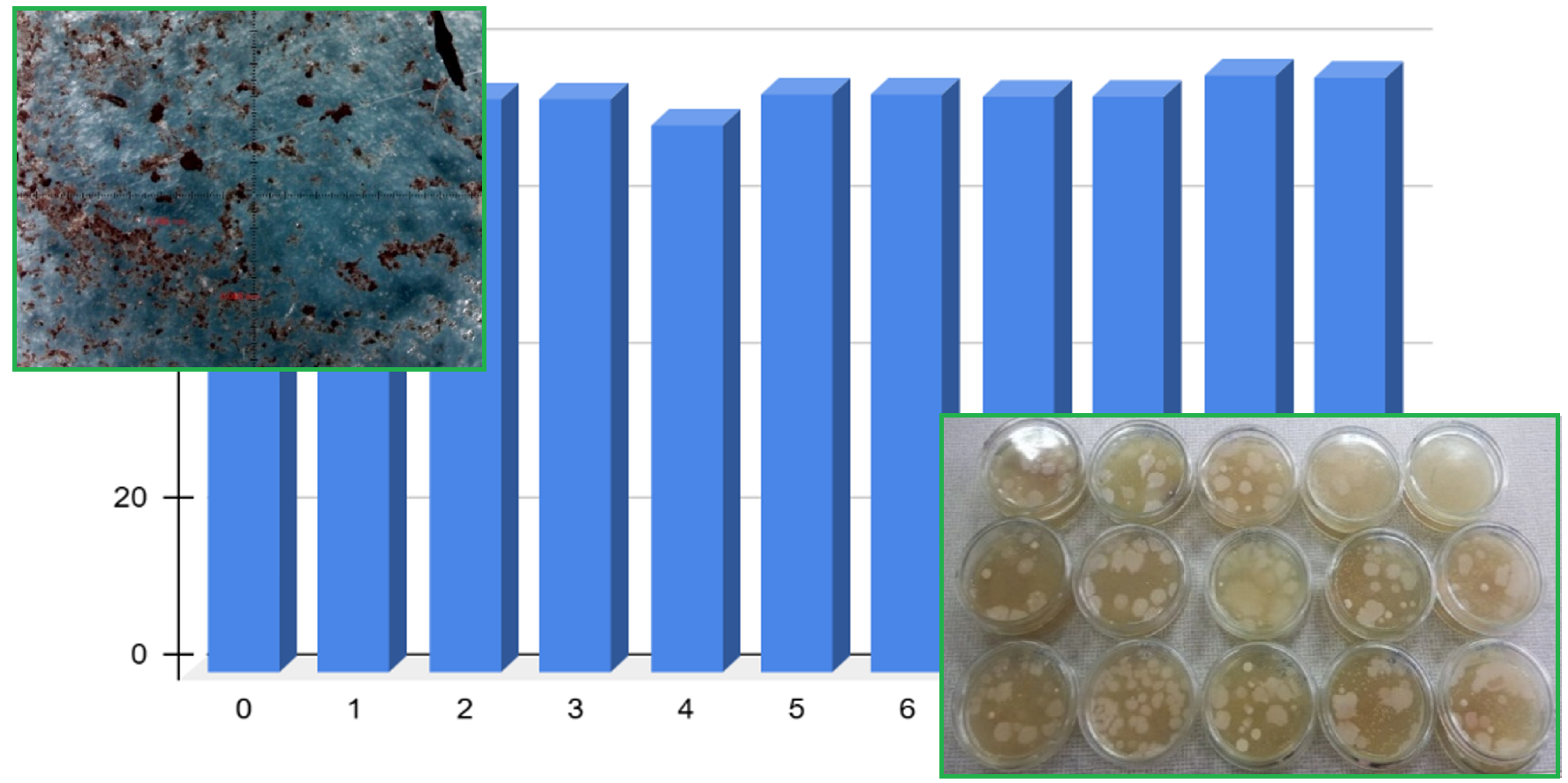
The growing accumulation of polymer waste has become a global environmental challenge, necessitating the development of sustainable mitigation strategies. Bioremediation, based on the use of microorganisms to degrade pollutants in soil and water, is considered a promising approach. This study provides a theoretical analysis of current research on the ability of soil microbiota to decompose synthetic polymers and proposes a method for polymer waste degradation using a combined biological system. The approach involves the joint application of Eisenia foetida culture and bacterial strains of the genus Pseudomonas. Polymer–polymer blends based on corn starch were selected as model materials, specifically ethylene–vinyl acetate copolymer (EVA) and chlorinated polyethylene (CPE). Experimental substrate variants were inoculated with Pseudomonas chlororaphis subsp. aurantiaca UKM-9 and Pseudomonas chlororaphis subsp. aureofaciens UKM B-109 at a concentration of 1.1×10⁷ CFU/g of dry substrate. The results demonstrated that E. foetida significantly enhances microbial development, increasing the total microbial count from 10⁷ to 10⁹ CFU/g. This indicates a high adaptive potential of the microbiota to substrates obtained via vermiculture. The biochemical characteristics and taxonomic affiliation of the bacterial strains were confirmed using the oxidase test. It was established that physicochemical parameters of the substrate, including temperature, moisture, electrical conductivity, and pH, play a key role in regulating microbial activity and growth. Significant changes in electrical conductivity (up to 3999 μS/cm in CPE samples) suggest polymer bond cleavage, ion release, and the formation of soluble degradation products. Optical analysis confirmed substantial biodegradation levels, reaching 72.1 % for CPE and 67 % for EVA. The findings demonstrate the high efficiency of combined biological systems in polymer degradation and underline their potential for developing environmentally safe technologies for the management of synthetic polymer waste.
References
Ayilara, M. S., & Babalola, O. O. (2023). Bioremediation of environmental wastes: The role of microorganisms. Frontiers in Agronomy, 5, 1183691. https://doi.org/10.3389/fagro.2023.1183691
Das, S., & Dash, H. R. (2014). Microbial biodegradation and bioremediation. Elsevier.
Arvind, Mahesh, Jayanth, D. R., Prasad, E., Ahmed, S., & Srinath, S. (2024). Biodegradation of plastic by Pseudomonas aeruginosa. International Journal of Science and Research Archive, 11(2). https://doi.org/10.30574/ijsra.2024.11.2.0507
Najam, M., Javaid, S., Iram, S., Pasertsakoun, K., Oláh, M., Székács, A., & Aleksza, L. (2025). Microbial biodegradation of synthetic polyethylene and polyurethane polymers by pedospheric microbes: Towards sustainable environmental management. Polymers, 17(2), 169. https://doi.org/10.3390/polym17020169
Majeed, H., Iftikhar, T., & Abbas, Q. (2025). Ecofriendly techniques for the sustainable degradation of synthetic plastic polymers using a bacterial hyperproducer. Environment, Development and Sustainability. https://doi.org/10.1007/s10668-025-06247-8
Sitar, V. I., Sukhyi, K. M., Mitina, N. B., Harmash, S. M., & Lysichenko, B. O. (2020). Development of biodegradable composite materials based on polyvinyl alcohol. Problems of Chemistry and Chemical Technology, 128(1), 86–91. https://doi.org/10.32434/0321-4095-2020-128-1-86-91
Vishnu Suresh, R., Shams, R., Dash, K. K., Shaikh, A. M., & Kovács, B. (2025). Comprehensive review on enzymatic polymer degradation: A sustainable solution for plastics. Journal of Agriculture and Food Research, 20, 101788. https://doi.org/10.1016/j.jafr.2025.101788
Dhanasekaran, A., Tiwari, K., Bhange, A., Ghosh, S. S., & Kannabiran, K. (2025). Biodegradation of expanded polystyrene using Pseudomonas aeruginosa Vitark 5. Detritus, 30, 99–108. https://doi.org/10.31025/2611-4135/2025.19475
Bharathiraja, B., Jayamuthunagai, J., Jayakumar, M., Kirubakaran, M. A., Vivek, P., Chandran, M., & Kumar, R. P. (2013). Biodegradation of poly(vinyl alcohol) using Pseudomonas alcaligenes. Asian Journal of Chemistry, 25(15). https://doi.org/10.14233/ajchem.2013.14937
Shimao, M., Tamogami, T., Kishida, S., & Harayama, S. (2000). The gene pvaB encodes oxidized polyvinyl alcohol hydrolase of Pseudomonas sp. strain VM15C and forms an operon with the polyvinyl alcohol dehydrogenase gene pvaA. Microbiology, 146(3), 649–657. https://doi.org/10.1099/00221287-146-3-649
Sangeetha, S., & Krishna, P. H. (2024). Inclusion of Pseudomonas fluorescens into soil-like fraction from municipal solid waste management park to enhance plastic biodegradation. Biodegradation, 35, 789–802. https://doi.org/10.1007/s10532-024-10085-2
Selvakumar, V., Gopalsamy, P., Muthusamy, K., & Sivakumar, V. (2022). Environmental hazard of polypropylene from disposable face masks linked to the COVID-19 pandemic and its possible mitigation techniques through a green approach. Journal of Chemistry, 2022, 9402236. https://doi.org/10.1155/2022/9402236
Mazuryk, A., Lisewska, D., Fiedurek, K., & Janczak, K. (2024). Pseudomonas alloputida and Pseudomonas taiwanensis in a process of degradation of polymer materials. European Journal of Sustainable Development, 13(4), 177. https://doi.org/10.14207/ejsd.2024.v13n4p177
Minina, Y. O., Mitina, N. B., & Tretiakov, A. O. (2024). Study of the conditions of biodegradation of polymer–polymer mixtures in the process of vermiculture. Scientific Notes of V. I. Vernadsky Taurida National University, 35(74), 113–117. https://doi.org/10.32782/2663-5941/2024.1.2/19
Mitina, N.B., Zubareva, I.M., Skliar, T.V., Malinovska, N.V., Sytar, V. I., & Kudriavtsev, A. V. (2024). The influence of microbial-origin growth stimulators on the development of vermiculture. Science Innovations, 20(4), 61–69. https://doi.org/10.15407/scine20.04.061
International Organization for Standardization. (2012). Determination of the ultimate aerobic biodegradability of plastic materials under controlled composting conditions (ISO Standard No. 14855-1:2012).
ASTM International. (2015). Standard test method for determining aerobic biodegradation of plastic materials under controlled composting conditions (ASTM Standard No. D5338-15).
Klimniuk, S. I., Sitynik, I. O., Tvorok, M. S., & Shyrobykov, V. P. (2020). [Practical microbiology]. Ukrmedknyha. (In Ukrainian).
Volkogon, V. V., Nadkernychna, O. V., & Tokmakova, L. M. (2010). [Experimental soil microbiology and others]. Agrarian Science. (In Ukrainian).
American Society for Microbiology. (2019). Methods for the identification of bacteria: Morphological and cultural characteristics. ASM Laboratory Protocols.
Hudz, S. P., Hnatush, S. O., Yavorska, H. V., Bilinska, I. S., & Borsukevych, B. M. (2014). [Microbiology practicum]. Ivan Franko National University of Lviv. (In Ukrainian).
International Organization for Standardization. (2013). Microbiology of the food chain — Horizontal method for the enumeration of microorganisms — Colony count technique (ISO Standard No. 4833-1:2013).
International Organization for Standardization. (1993). Soil quality — Determination of dry matter and water content on a mass basis (ISO Standard No. 11465:1993).
UK Health Security Agency. (2024). UK standards for microbiology investigations: TP 26 — Oxidase test (Issue 3).
Downloads
Published
Issue
Section
License
Copyright (c) 2026 Oles Honchar Dnipro National University

This work is licensed under a Creative Commons Attribution 4.0 International License.
- Authors reserve the right of attribution for the submitted manuscript, while transferring to the Journal the right to publish the article under the Creative Commons Attribution License. This license allows free distribution of the published work under the condition of proper attribution of the original authors and the initial publication source (i.e. the Journal)
- Authors have the right to enter into separate agreements for additional non-exclusive distribution of the work in the form it was published in the Journal (such as publishing the article on the institutional website or as a part of a monograph), provided the original publication in this Journal is properly referenced
- The Journal allows and encourages online publication of the manuscripts (such as on personal web pages), even when such a manuscript is still under editorial consideration, since it allows for a productive scientific discussion and better citation dynamics (see The Effect of Open Access).