SYNTHESIS OF ZEOLITES OF THE CHABAZITE GROUP BASED ON NATURAL MINERALS OF NAKHCHIVAN: THE INFLUENCE OF VARIOUS FACTORS ON THE PROCESS OF THEIR CRYSTALLIZATION
DOI:
https://doi.org/10.15421/jchemtech.v34i2.345095Keywords:
gmelinite, levyne, erionite, crystallization, hydrothermal synthesis, group of chabazite, zeolite, natural minerals.Abstract
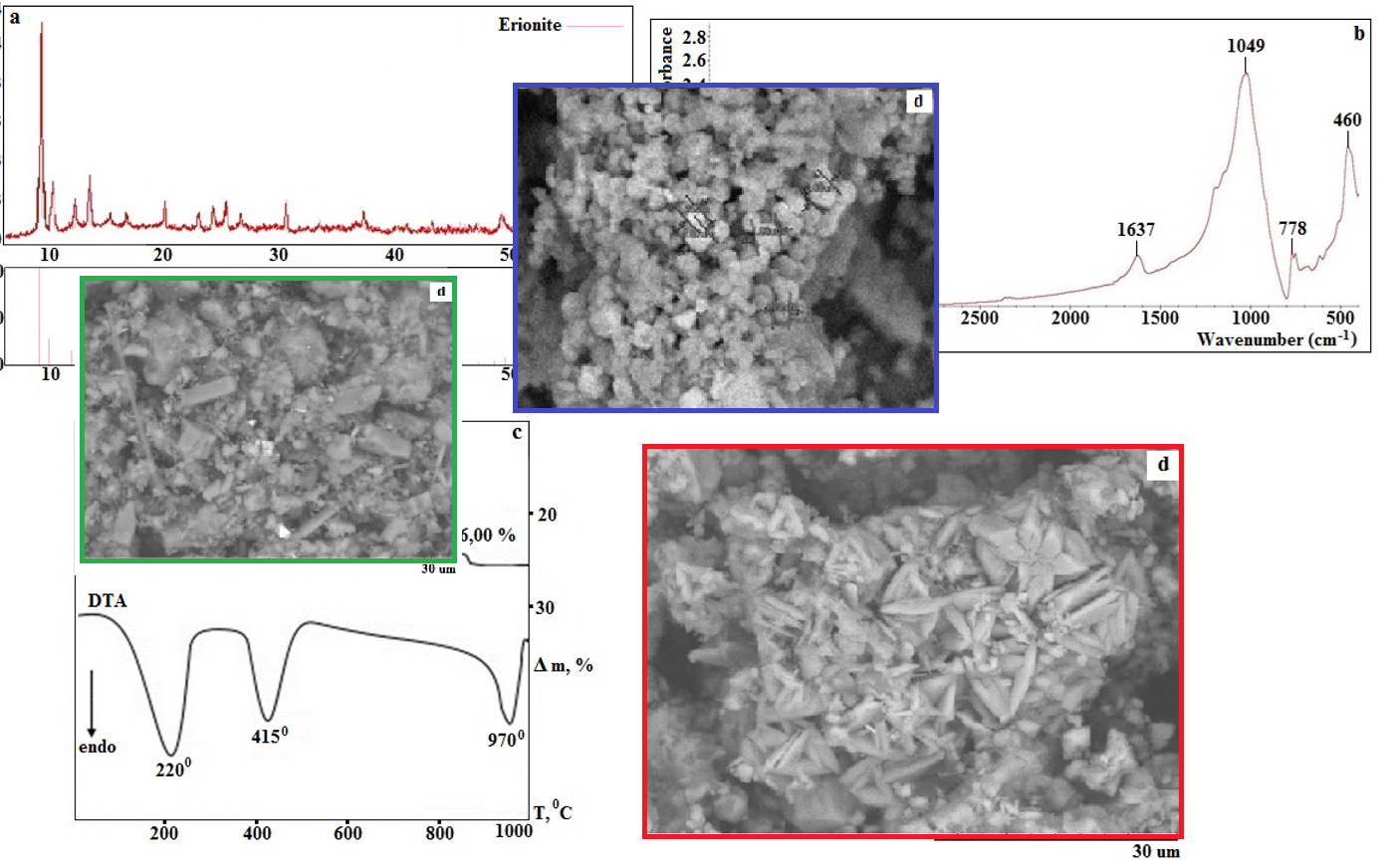
Zeolites of the chabazite group (gmelinite, levyne, and erionite) having practical significance were synthesized on the basis of natural minerals of the Nakhchivan Autonomous Republic in the presence of a structure-directing agent – tetramethylammonium hydroxide. Samples of halloysite from the Pirigol deposit, volcanic glass (obsidian) from the peak of Gapydzhik, and dolomite from the Negram deposit, which were distinguished by phase purity, were used as natural minerals. The influence of temperature, concentration of the thermal solution, and processing time on the crystallization process of gmelinite, levyne, and erionite was studied. It is shown that the hydrothermal synthesis of gmelinite, levyne, and erionite was studied in the temperature range of 100–300 °C, with the concentration of thermal solution NaOH, varying in the range of 10–35 %, for 50–200 hours; 100–300 °C, with the concentration of the NaOH thermal solution varying in the range of 10–35%, for 50–200 hours; 100–300 °C, with a NaOH concentration of 10–35 %, for 50–150 hours; 100–200 °C, with a NaOH concentration of 10–30 %, for 10–20 hours, respectively.
References
Jihong, Y. (2007). Chapter 3 – synthesis of zeolites. Studies in Surface Science and Catalysis, 168, 39-103. https://doi.org/10.1016/S0167-2991(07)80791-9
Mgbemere, H. E., Ekpe, I. C., Lawal, G. (2017). Zeolite synthesis, characterization and application areas: a review. International Research Journal of Environmental Science, 10, 45–59. https://ir.unilag.edu.ng/handle/123456789/10226
Moshoeshoe, M., Nadiye-Tabbiruka, M. S., Obuseng, V. (2017). A review of the chemistry, structure, properties and applications of zeolites. American Journal of Materials Science, 7, 196–221. https://doi.org/10.5923/j.materials.20170705.12
Mielby, J., Hauberg, K., Iltsiou, D., Goodarzi, F., Enemark-Rasmussen, K., Kegnaes, S. (2022). A shortcut to high-quality gmelinite through steam-assisted interzeolite transformation. Microporous and Mesoporous Materials, 330, 111606. https://doi.org/10.1016/j.micromeso.2021.111606
Alberti, A., Parodi, I., Cruciani, G., Dalconi, M. C., Martucci, A. (2010). Dehydration and rehydration processes in gmelinite: An in situ X-ray single-crystal study. American Mineralogist, 95(11-12), 1773–1782. https://doi.org/10.2138/am.2010.3419
Dusselier, M., Kang, J. H., Xie, D., Davis, M. E. (2017). CIT-9: a fault-free gmelinite zeolite. Angewandte Chemie International Edition, 56(43), 13475-13478. https://doi.org/10.1002/anie.201707452
Xie, D., Lacheen, H. S. (2016). Separation of Gases Using GME Framework Type Zeolites. US Patent 9364782.
Parsons, D. S., Ingram, A., Hriljac, J. A. (2023). The synthesis of gmelinite microspheres and their post-synthetic modification for improved defluoridation. Separation Science and Technology, 58(10), 1851–1862. https://doi.org/10.1080/01496395.2023.2212853
Chatterjee, M., Ganguli, D., Saha, P. (2014). Synthesis and characterization of gmelinite- and chabazite-type molecular sieve zeolites. Transactions of the Indian Ceramic Society, 35(5), 99–105. https://doi.org/10.1080/0371750X.1976.10840871
Chiyoda, O., Davis, M. E. (2000). Adsorption studies with gmelinite zeolites containing mono-, di- and trivalent cations. Microporous and Mesoporous Materials, 38(2–3), 143-149.
https://doi.org/DOI:10.1016/S1387-1811(99)00287-5
Arletti, R., Vezzalini, G., Quartieri, S., et al. (2013). A new framework topology in the dehydrated form of zeolite levyne. American Mineralogist, 98(11-12), 2063–2074. https://doi.org/10.2138/am.2013.4583
Ballirano, P., Cametti, G. (2013). Crystal chemical and structural investigation of levyne-Na. Mineralogical Magazine, 77(7), 2887–2899. https://doi.org/10.1180/minmag.2013.077.7.01
Cametti, G., Scheinost, A., Churakov, S. (2021). Cd2+ incorporation in small-pore LEV/ERI intergrown zeolites: A multi-methodological study. Microporous and Mesoporous Materials, 313, 110835. https://doi.org/10.1016/j.micromeso.2020.110835
Al Atrach, J., Aitblal, A., Amedlous, A., et al. (2025). Exploring a novel adsorbent for CO2 capture and gas separation. ACS Applied Materials & Interfaces, 17(4), 7119–7130. https://doi.org/10.1021/acsami.4c18745
Min, J. G., Kemp, K. C., Hong, S. B. (2020). Propylene/propane separation on a ferroaluminosilicate levyne zeolite. Microporous and Mesoporous Materials, 294, 109833. https://doi.org/10.1016/j.micromeso.2019.109833
Venkatathri, N., Yoo, J. W. (2008). Synthesis, characterization and catalytic properties of a LEV type silicoaluminophosphate molecular sieve, SAPO-35 from aqueous media using aluminium isopropoxide and hexamethyleneimine template. Applied Catalysis A: General, 340(2), 265–270. https://doi.org/10.1016/j.apcata.2008.02.026
Jeon, H. Y., Shin, C. H., Jung, H. J., et al. (2006). Catalytic evaluation of small-pore molecular sieves with different framework topologies for the synthesis of methylamines. Applied Catalysis A: General, 305(1), 70-78. https://doi.org/10.1016/j.apcata.2006.02.044
Mgbemere, H. E., Ekpe, I. C. (2017). Zeolite synthesis, characterization and application areas: a review. International Journal of Environmental Science, 6(10), 45–59. https://ir.unilag.edu.ng/handle/123456789/10226
Lee, J. H., Park, M. B., Lee, J. K., Min, H. K., Song, M. K., Hong, S. B. (2010). Synthesis and characterization of ERI-type UZM-12 zeolites and their methanol-to-olefin performance. Journal of the American Chemical Society, 132(37), 12971–12982. https://doi.org/10.1021/ja105185r
Seo, S., Ahn, N. H., Lee, J. H., Knight, L. M., Moscoso, J. G., Sinkler, W. A., Prabhakar, S., Nicholas, C. P., Hong, S. B., Lewis, G. J. (2019). Combined alkali-organoammonium structure direction of high-charge-density heteroatom-containing aluminophosphate molecular sieves. Angewandte Chemie International Edition, 58(27), 9032–9037. https://doi.org/10.1002/anie.201902623
Passaglia, E., Artioli, G., Gualtieri, A. (1998). Crystal chemistry of the zeolites erionite and offretite. American Mineralogist, 83, 577-589. DOI:10.2138/am-1998-5-618
Zhu, J., Muraoka, K., Ohnishi, T., Yanaba, Y., Ogura, M., Nakayama, A., Wakihara, T., Liu, Z., Okubo, T. (2024). Synthesis and structural analysis of high-silica ERI zeolite with spatially-biased Al distribution as a promising NH3-SCR catalyst. Advanced Science, 11(14), 2307674. https://doi.org/10.1002/advs.202307674
Khanday, W. A., Khanday, S. A., Danish, M. (2020). Application of erionite as an adsorbent for Cd2+, Cu2+, and Pb2+ ions in water. Desalination and Water Treatment, 205, 328–335. https://doi.org/10.5004/dwt.2020.26309
Rayalu, S., Udhoji, J., Meshram, S., Naidu, R., Devotta, S. (2005). Estimation of crystallinity in flyash-based zeolite-A using XRD and IR spectroscopy. Current Science, 89(12), 2147.
Ayoola, A. A., Hymore, F. K., Omodara, J. O., Oyeniyi, A. E., Ojo, S. F., Chisom, U. (2017). Effect of crystallization time on the synthesis of zeolite Y from Elefun kaolinite clay. International Journal of Applied Engineering Research, 12(21), 10981.
Simancas, R., Dari, D., Navarro, M. T., Velamazan, N. (2010). Modular organic structure-directing agents for the synthesis of zeolites. Science, 330(6008), 1219. https://doi.org/10.1126/science.1196240
Oleksiak, M. D., Rimer, J. D. (2014). Synthesis of zeolites in the absence of organic structure-directing agents: factors governing crystal selection and polymorphism. Reviews in Chemical Engineering, 30(1), 1. https://doi.org/10.1515/revce-2013-0020
Burton, A. W., Zones, S. I. (2007). Chapter 5 Organic molecules in zeolite synthesis: their preparation and structure-directing effects. Studies in Surface Science and Catalysis, 168, 137. https://doi.org/10.1016/S0167-2991(07)80793-2
Pour, Z. A., Sebakhy, Kh. O. (2022). A review on the effects of organic structure-directing agents on the hydrothermal synthesis and physicochemical properties of zeolites. Chemistry, 4(2), 431. https://doi.org/10.3390/chemistry4020032
Treacy, M. M. J., Higgins, J. B. (2001). Collection of simulated XRD powder patterns for zeolites. Elsevier.
Baerlocher, C., McCusker, L. B., Olson, D. H. (2007). Atlas of zeolite framework types (6th ed.). Elsevier Inc.
Byrappa, K., Suresh Kumar, B. V. (2007). Characterization of zeolites by infrared spectroscopy. Asian Journal of Chemistry, 19(6), 4933–4935.
Krol, M., Mozgawa, W., Jastrzbski, W., Barczyk, K. (2012). Application of IR spectra in the studies of zeolites from D4R and D6R structural groups. Microporous and Mesoporous Materials, 156, 181–188. https://doi.org/10.1016/j.micromeso.2012.02.040
Downloads
Published
Issue
Section
License
Copyright (c) 2026 Oles Honchar Dnipro National University

This work is licensed under a Creative Commons Attribution 4.0 International License.
- Authors reserve the right of attribution for the submitted manuscript, while transferring to the Journal the right to publish the article under the Creative Commons Attribution License. This license allows free distribution of the published work under the condition of proper attribution of the original authors and the initial publication source (i.e. the Journal)
- Authors have the right to enter into separate agreements for additional non-exclusive distribution of the work in the form it was published in the Journal (such as publishing the article on the institutional website or as a part of a monograph), provided the original publication in this Journal is properly referenced
- The Journal allows and encourages online publication of the manuscripts (such as on personal web pages), even when such a manuscript is still under editorial consideration, since it allows for a productive scientific discussion and better citation dynamics (see The Effect of Open Access).