O-N-Cl GEMINAL SYSTEMS. STRUCTURE OF N-CHLORO-N-METHOXY-4-TOLUENESULFONAMIDE AND N-METHOXY-4-TOLUENESULFONAMIDE
DOI:
https://doi.org/10.15421/jchemtech.v34i2.346200Keywords:
N-chloro-N-methoxy-4-toluenesulfonamide, a single crystal X-ray diffraction study, anomeric amides.Abstract
Aim. Structural analysis of chemical compounds plays a crucial role in understan
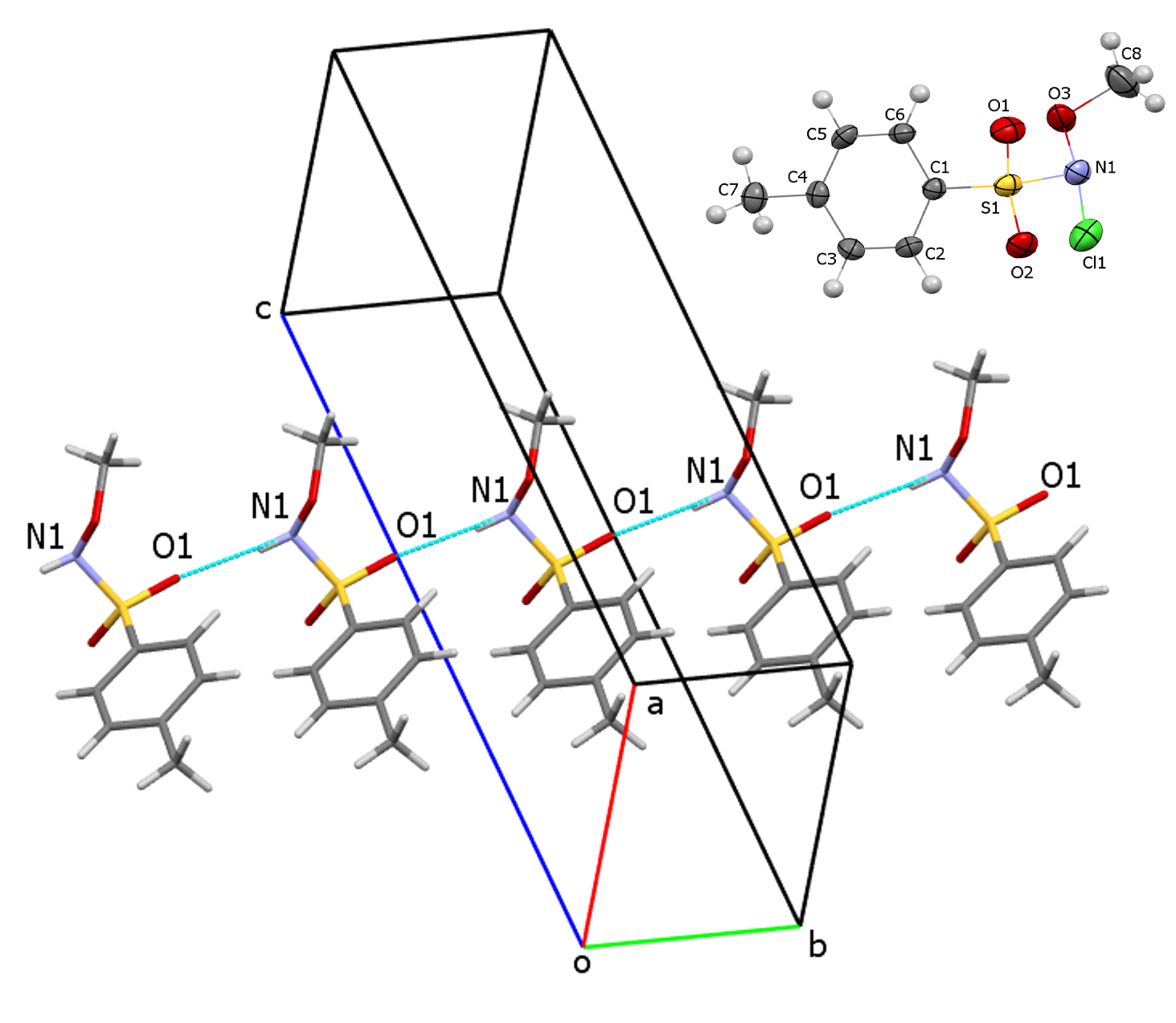
Aim.Structural analysis of chemical compounds plays a crucial role in understanding their properties and chemical behavior. In this study, the aim is to investigate the structure of N-chloro-N-methoxy-4-toluenesulfonamide and to compare it with N-methoxy-4-toluenesulfonamide structure. Methods. 1H, and 13C NMR spectroscopy, mass spectrometry, a single crystal X-ray diffraction study. Results. It was found that in the molecule of N-chloro-N-methoxy-4-toluenesulfonamide the amide nitrogen atom has a strongly pyramidal configuration. The sum of the bond angles centered on thisnitrogen atom is 324.1°. In N-methoxy-4-toluenesulfonamide the degree of pyramidality of the nitrogen atom is significantly lower, the sum of the bond angles centered on thisnitrogen atom is 331.0°. Structural analysis shows two notable features in N-chloro-N-methoxy-4-toluenesulfonamide. First, the N–Cl bond is elongated to 1.767(3) Å, exceeding the corresponding bond lengths in N-chloro-N-methoxyurea and N-chloro-N-methoxy-4-nitrobenzamide. Second, the N(1)–O(3) Me bond is shortened to 1.405(3) Å, relative to the values observed in N-methoxy-4-toluenesulfonamide and in dimethyl N-methoxy-N-(4-toluenesulfonyl)phosphoramidate. The most plausible explanation is that this bonds deformation may be caused by the action of the nO(Me)→ϭ•N-Clanomeric effect. Conclusions. N-Chloro-N-methoxy-4-toluenesulfonamide, together with related N-alkoxy-N-chloro-R-sulfonamides, represents a distinct class of anomeric amides characterized by weakening of the N–Cl bond through an nO(Alk)→ϭ•N-Clanomeric interaction. Thus, this work is important because it establishes a new concept in the chemistry of N-alkoxy-N-chloro-R-sulfonamides.
behavior. In this study, the aim is to investigate the structure of N-chloro-N-methoxy-4-toluenesulfonamide and to compare it with N-methoxy-4-toluenesulfonamide structure. Methods. 1H, and 13C NMR spectroscopy, mass spectrometry, a single crystal X-ray diffraction study. Results. It was found that in the molecule of N-chloro-N-methoxy-4-toluenesulfonamide the amide nitrogen atom has a strongly pyramidal configuration. The sum of the bond angles centered on this nitrogen atom is 324.1°. In N-methoxy-4-toluenesulfonamide the degree of pyramidality of the nitrogen atom is significantly lower, the sum of the bond angles centered on this nitrogen atom is 331.0°. Structural analysis shows two notable features in N-chloro-N-methoxy-4-toluenesulfonamide. First, the N–Cl bond is elongated to 1.767(3) Å, exceeding the corresponding bond lengths in N-chloro-N-methoxyurea and N-chloro-N-methoxy-4-nitrobenzamide. Second, the N(1)–O(3)Me bond is shortened to 1.405(3) Å, relative to the values observed in N-methoxy-4-toluenesulfonamide and in dimethyl N-methoxy-N-(4-toluenesulfonyl)phosphoramidate. The most plausible explanation is that this bonds deformation may be caused by the action of the nO(Me)→ϭ•N-Cl anomeric effect. Conclusions. N-Chloro-N-methoxy-4-toluenesulfonamide, together with related N-alkoxy-N-chloro-R-sulfonamides, represents a distinct class of anomeric amides characterized by weakening of the N–Cl bond through an nO(Alk)→ϭ•N-Cl anomeric interaction. Thus, this work is important because it establishes a new concept in the chemistry of N-alkoxy-N-chloro-R-sulfonamides.
References
Pu, X., Li, Q., Lu, Z., Yang, X. (2016). N-Chloro-N-methoxybenzenesulfonamide: A Chlorinating Reagent. Eur. J. Org. Chem., (36), 5937−5940. https://doi.org/10.1002/ejoc.201601226
Glover, S. A. (1998). Anomeric Amides – Structure, Properties and Reactivity. Tetrahedron, 54(26), 7229–7271. https://doi.org/10.1016/S0040-4020(98)00197-5
Brink, K., Mattes, R. (1985). Mesylhydroxylamine. VII. Chlorierte mesylhydroxylamine. Chem.-Ztg., 109 (1), 10−11.
Shtamburg, V.G., Shishkin, O.V., Zubatyuk, R.I., Kravchenko, S.V., Tsygankov, A.V., Mazepa, A.V., Klots, E.A., Kostyanovsky, R.G. (2006).N-Chloro-N-alkoxyureas: synthesis, structure and properties. Mendeleev Commun., 16(6), 323–325. https://doi.org/10.1070/MC2006v016n06ABEH002382
Shtamburg, V.G., Shishkin, O.V., Zubatyuk R.I., Kravchenko, S.V., Shtamburg, V.V., Distanov, V.B., Tsуgankov A.V., Kostyanovsky, R.G.(2007). Synthesis,structure and properties of N-alkoxy-N-(1-pyridinium)urea salts, N-alkoxy-N-acyloxyureas and N,N-dialkoxyureas.Mendeleev Commun.,17(3), 178–180. https://doi.org/10.1016/j.mencom.2007.05.016
Shishkin, O.V., Shtamburg, V.G., Zubatyuk R.I., Olefir, D.A., Tsygankov, A.V., Prosyanik, A.V., Mazepa, A.V., Kostyanovsky, R.G. (2009). Chiral Ureas with Two Electronegative Substituents at 1-N and Unusual Case of Coexisting a Pyramidal and Almost Planar 1-N in The Same Crystal. Chirality, 21(7). 642–647. https://doi.org/10.1002/chir.20668
Shtamburg, V.G., Tsygankov, A.V., Gerasimenko, M.V., Shishkin, O.V., Zubatyuk, R.I., Mazepa, A.V.; Kostyanovsky, R.G. (2011).New approach to N,N-dialkoxy-N'-arylureas and N,N-dialkoxycarbamates. Mendeleev Commun., 21(12), 50−32. https://doi.org/10.1016/j.mencom.2011.01.021
Shtamburg, V.G., Tsygankov, A.V., Shishkin,O.V., Zubatyuk, R.I., Uspensky, B.V., Shtamburg,V.V., Mazepa, A.V., Kostyanovsky, R.G. (2012).The properties and structure of N-chloro-N-methoxy-4-nitrobenzamide. Mendeleev Commun., 22(3), 164–166. https://doi.org/10.1016/j.mencom.2012.05.019
Glover, S. A., Rosser, A. A. (2018). Heteroatom Substitution at Amide Nitrogen – Resonance Reduction and HERON Reactions of Anomeric Amides. Molecules, 23(11), 2834. https://doi.org/10.3390/molecules23112834
Glover, S. A. (2009). N-Heteroatom-substituted hydroxamic esters, in The Chemistry of Hydroxylamines, Oximes and Hydroxamic Acids. Eds Rappoport, Z., Liebman, J. F., John Wiley and Sons, New York. PATAI’S Chemistry of Funcional Groups, 839–923. https://doi.org/10.1002/9780470682531.pat0470
Wang, Yu., Kawamata, Yu., Grant, L. N., Samp, L., Richardson, P. F., Zhang, S., Harper, K. C., Palkowitz, M.D., Vasilopoulos, A., Collins, M. R., Oderinde, M. S., Tyrol, C.C., Chen, D., LaChapelle, E. A., Bailey, J. B., Qiao, J. X., Baran, P. S. (2024). Discovery of N−X anomeric amides as electrophilic halogenation reagents. Nature Chemistry, 16, 1539−1545. https://doi.org/10.1038/s41557-024-01539-4
Garg, A., Vigier, J., Lebel, H., Besset, T.(2026). Anomeric Amides: Valuable reagents in Synthetic Organic Chemistry. Angew. Chem. Int. Ed. 65(12), e25799. https://doi.org/10.1002/anie.202525799
Kim, M., Obertone, C., Kelly, C., Reiher, S.A., Grosanu, S., Robertson, J.C., Levin M.D.(2025). Accesing Sulfonamides via Formal SO2 Insertion Into C–N Bonds. Nature Chemistry, 17, 1247–1255. https://doi.org/10.1038/s41557-025-01848-2
Kwon, J.-D., Joaquin, D., Davenport, M.T., Olsen, J., Carpio, M., Yousufuddin, M., Ess, D.H., Kurti, L. (2026) Polar-to-Radical Crossover in Catalyst-Free Olefin Halo-Hydroxylamination: Rapid Synthesis of Multifunctional Electrofilic Hydroxylamines. JACS Au, 6(1), 521−523. https://doi.org/10.1021/jacsau.5c01471
Stein, C.,Tyler, J.L., Wiener, J., Boser, F., Daniliuc, C.G., Glorius, F. Anomeric Amide-Enable Alkene-Arene and Alkene-Alkene Aminative Coupling. (2025). Angew. Chem. Int. Ed. 64(5), e202418141. https://doi.org/10.1002/anie.202418141
Kravchenko, S.V. (2013). N-Chloro-N-benzoyloxybenzamide. Bull. Dnipropetrovsk Univ.Ser. Chem., 21(19), 61−65.https://doi.org/10.15421/08132119
Shtamburg, V.G., Klots, EA., Shtamburg, V.V., Anishchenko, A.A., Shishkina, S. V., Kravchenko, S.V. Mazepa, A.V. (2025). Dialkyl N-Alkoxy-N-(4-toluenesulfonyl)phosphoramidates: Synthesis and Structure. Voprosy khimii i khimicheskoi tecknologii – Issues of Chemistry and Chemical Technology, (2), 33−44. http://dx.doi.org/10.32434/0321-4095-2025-159-2-33-44
Shtamburg, V.G., Klots, EA., Shtamburg, V.V., Anishchenko, A.A., Shishkina, S. V., Kravchenko, S.V., Mazepa, A.V. (2024). Structure of N-acetoxy-N-benzyloxyurea. Voprosy khimii i khimicheskoi tecknologii – Issues of Chemistry and Chemical Technology, (2), 88−44. http://dx.doi.org/10.32434/0321-4095-2024-155-4-88-94 10.32434/0321–4095–2024–155–4–88–94
Shtamburg, V.G., Anishchenko A. A., Klots, E.A., Shishkina, S.V., Kravchenko, S.V., Mazepa, A.V., Sokolova L.A., Krishchik O.V. (2024). N-Benzyloxy-N-methoxyurea. Synthesis and Structure. J. of Chemistry and Technologies, 32(1), 56−64. https://doi.org/10.15421/jchemtech.v32i1.292868
Wu, S., Chen, P., Duan, M., Jiang, P.-Y., Zhou, Xiang, Q. S.-H., Houk, K.N., Tan, B. (2025). Controlling pyramidal nitrogen chirality by asymmetric organocatalysis. Nature, 12, Nov. https://www.nature.com/articles/s41586-025-09607-6
Dolomanov, O.B., Bourhis, L.J., Gildea, R.J.,
Howard, J.A.K., Puschmann, H. OLEX2: a complete structure solution, refinement and analysis program. (2009). J. Appl. Crystallogr., 42, 339–341. https://doi.org/10.1107/S0021889808042726
Sheldrick, G. M. SHELXT – Integrated space-group and crystal-structure determination. (2015). Acta Cryst., Sect. A., A 71, P.1, 3−8. https://doi.org/10.1107/S2053273314026370
Sheldrick, G.M. Crystal Structure Refinement with SHELXL. (2015). Acta Crystallogr. Sect. C, 71, 3–8. http://dx.doi.org/10.1107/S2053229614024218
Kanishchev, O.S., Shermolovich, Yu.G. Synthetic Methods and Properties of N-Halogenoazoles. (2011). J. Org. Pharm. Chem., 9(3), 15−35.
Downloads
Published
Issue
Section
License
Copyright (c) 2026 Oles Honchar Dnipro National University

This work is licensed under a Creative Commons Attribution 4.0 International License.
- Authors reserve the right of attribution for the submitted manuscript, while transferring to the Journal the right to publish the article under the Creative Commons Attribution License. This license allows free distribution of the published work under the condition of proper attribution of the original authors and the initial publication source (i.e. the Journal)
- Authors have the right to enter into separate agreements for additional non-exclusive distribution of the work in the form it was published in the Journal (such as publishing the article on the institutional website or as a part of a monograph), provided the original publication in this Journal is properly referenced
- The Journal allows and encourages online publication of the manuscripts (such as on personal web pages), even when such a manuscript is still under editorial consideration, since it allows for a productive scientific discussion and better citation dynamics (see The Effect of Open Access).