ANALYSIS OF THE PHYSICAL AND MECHANICAL PROPERTIES OF THERMOPLASTIC GELATIN FILMS OBTAINED BY VARIOUS METHODS AND THEIR COMPUTER-MODELED STRUCTURE
DOI:
https://doi.org/10.15421/jchemtech.v34i2.346352Keywords:
thermoplastic gelatin; glycerol; water; film; mechanical properties; DFT.Abstract
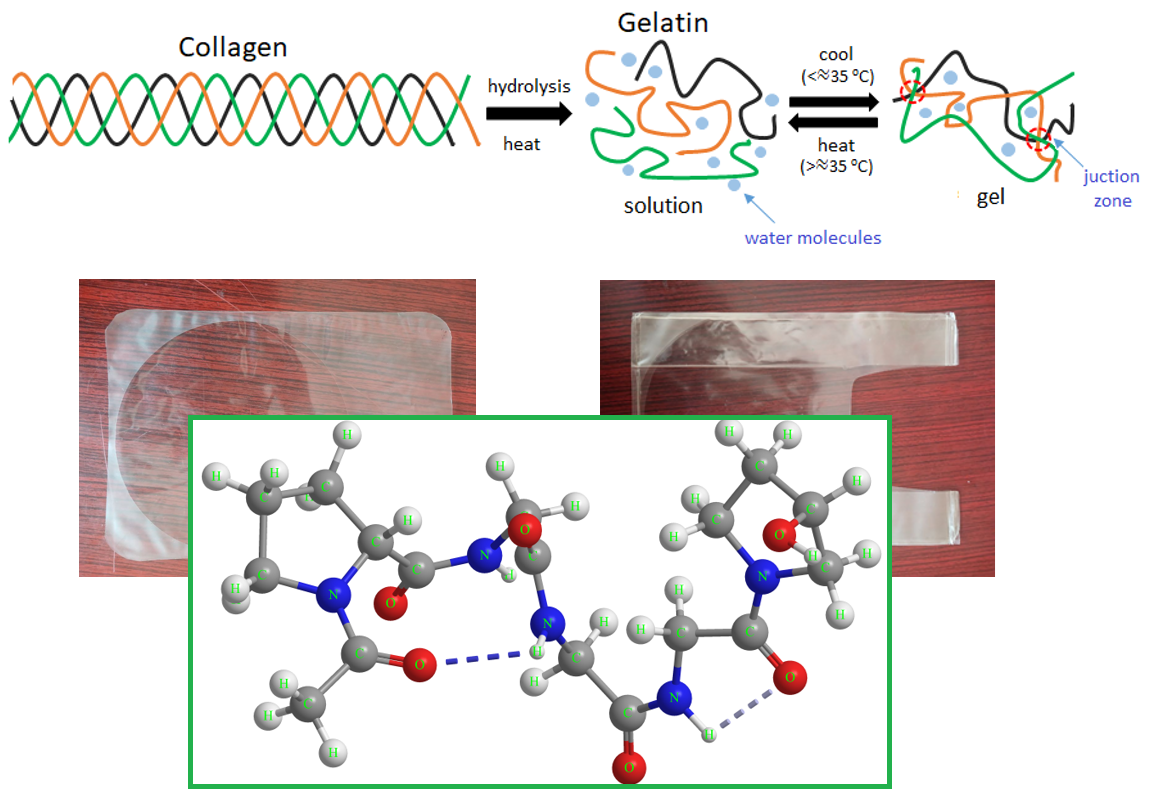
The mixing steps involved in the formation of biodegradable thermoplastic films based on natural polymers limit the ability to achieve the desired properties. The production of thermoplastic gelatin films involves modifying the gelatin matrix with plasticizers to impart thermoplastic properties, allowing it to be processed through traditional plastic manufacturing methods. In this work, water and Glycerol plasticizer were used to modify the bovine gelatin matrix. Plasticizers were added to the gelatin composition in various proportions (from 20 wt% to 100 wt%), and film samples were obtained. Thermoplastic gelatin films were produced by casting a solution onto a defined surface, employing three different methods: by altering the stages of introducing the plasticizer into the gelatin matrix (in 2 methods) and by introducing an additional stirring step during the heating of the solution. The resulting thermoplastic gelatin films were subjected to mechanical tests and compared in terms of relative elongation at break and strength. It was found that the mechanical strength and Young's modulus of gelatin films plasticized with glycerol decreased with increasing glycerol content in gelatin, and the relative elongation at break increased. The computer-modeled structure was analyzed using density functional theory (DFT) to study the electronic structures and interactions of the gelatin biopolymer with plasticizers. The electronic characteristics of the HOMO and LUMO orbitals and the frontier orbitals of the system were calculated.
References
Bugarčić, M., Jovanović, A., Petrović, J., Mišić, M., Sokić, M., Milivojević, M. (2024). Advances in biopolymer production and applications: a comprehensive review of key biomaterials. Metal and Mater Data, 2(3), 81–98. https://doi.org/10.30544/MMD37
Balart, R., Garcia-Garcia, D., Fombuena, V., Quiles-Carrillo, L., Arrieta, M. P. (2021). Biopolymers from natural resources. Polymers, 13(15), 2532. https://doi.org/10.3390/polym13152532
Salazar Sandoval, S., Amenábar, A., Toledo, I., Silva, N., Contreras, P. (2024). Advances in the sustainable development of biobased materials using plant and animal waste as raw materials: a review. Sustainability, 16(3), 1073. https://doi.org/10.3390/su16031073
Vasile, C., Baican, M. (2023). Lignins as promising renewable biopolymers and bioactive compounds for high-performance materials. Polymers, 15(15), 3177. https://doi.org/10.3390/polym15153177
Mahajan, P., & Sharma, M. (2024). A comprehensive review on developments and future perspectives of biopolymer‐based materials for energy storage. Energy storage, 6(4), e634. https://doi.org/10.1002/est2.634
Abdullah, Cai, J., Hafeez, M. A., Wang, Q., Farooq, S., Huang, Q., Xiao, J. (2022). Biopolymer-based functional films for packaging applications: A review. Frontiers in Nutrition, 9, 1000116. https://doi.org/10.3389/fnut.2022.1000116
Fabra, M. J., Hambleton, A., Talens, P., Debeaufort, F., Chiralt, A., Voilley, A. (2008). Aroma barrier properties of sodium caseinate-based films. Biomacromolecules, 9, 1406–1410. https://doi.org/10.1021/bm701278n
Riseh, R. S., Vazvani, M. G., Hassanisaadi, M., Thakur, V. K., Kennedy, J. F. (2023). Use of whey protein as a natural polymer for the encapsulation of plant biocontrol bacteria: A review. Inter J of Bio Macromol, 234, 123708. https://doi.org/10.1016/j.ijbiomac.2023.123708
Yarahmadi, A., Dousti, B., Karami-Khorramabadi, M., Afkhami, H. (2024). Materials based on biodegradable polymers chitosan/gelatin: a review of potential applications. Frontiers in Bioengineering and Biotechnology, 12, 1397668. https://doi.org/10.3389/fbioe.2024.1397668
Telezhenko, L. M., Dzyuba, N. A., Oliinyk, M. I., Sheludko, V. M. (2024). Research of factors influenced on foam formation of protein hydrocolloids. Journal of Chemistry and Technologies, 32(1), 223–232 https://doi.org/10.15421/jchemtech.v32i1.288023
Zhang, S., Zhao, D., Yin, L., Wang, R., Jin, Z., Xu, H., Xia, G. (2025). Physicochemical and functional properties of yanbian cattle bone gelatin extracted using acid, alkaline, and enzymatic hydrolysis methods. Gels, 11(3), 186. https://doi.org/10.3390/gels11030186
Tang, C., Xu, Y., Zhou, K., Xie, Y., Ma, Y., Li, C., Xu, B. (2023). Mechanism behind the deterioration in gel properties of collagen gel induced by high-temperature treatments: A molecular perspective. Food Research International, 171, 112985. https://doi.org/10.1016/j.foodres.2023.112985
Chen, Q., Pei, Y., Tang, K., Albu-Kaya, M. G. (2023). Structure, extraction, processing, and applications of collagen as an ideal component for biomaterials-a review. Collagen and Leather, 5(1), 20. https://doi.org/10.1186/s42825-023-00127-5
Shaik, M. I., Rahman, S. H. A., Yusri, A. S., Ismail‐
Fitry, M. R., Kumar, N. S. S., Sarbon, N. M. (2024). A review on the processing technique, physicochemical, and bioactive properties of marine collagen. Journal of Food Science, 89(9), 5205–5229. https://doi.org/10.1111/1750-3841.17273
Said, N. S., Howell, N. K., Sarbon, N. M. (2023). A review on potential use of gelatin-based film as active and smart biodegradable films for food packaging application. Food Reviews International, 39(2), 1063-1085. https://doi.org/10.1080/87559129.2021.1929298
Lu, Y., Luo, Q., Chu, Y., Tao, N., Deng, S., Wang, L., Li, L. (2022). Application of gelatin in food packaging: A review. Polymers, 14(3), 436. https://doi.org/10.3390/polym14030436
Chang, Y. C., Liu, H. J., Lin, K. W., Huang, W. Y., Hsu, Y. L. (2022). A biodegradable gelatin substrate and its application for crack suppression of flexible gelatin resistive memory device. Adv Elec Mater, 8(5), 2101014. https://doi.org/10.1002/aelm.202101014
Byram, P. K., Sunka, K. C., Das, L., Kulkarni, G., Ghosh, D., Vaddi, L., Chakravorty, N. (2025). Exploring Xanthan Gum as a Plasticizer in Silk Fibroin/Gelatin Films: Toward Self‐Assemblies, Robust, and Cytocompatible Structures. Small, 21(33), 2500782. https://doi.org/10.1002/smll.202500782
Tan, S. X., Andriyana, A., Ong, H. C., Lim, S., Pang, Y. L., Ngoh, G. C. (2022). A comprehensive review on the emerging roles of nanofillers and plasticizers towards sustainable starch-based bioplastic fabrication. Polymers, 14(4), 664. https://doi.org/10.3390/polym14040664
Eslami, Z., Elkoun, S., Robert, M., & Adjallé, K. (2023). A review of the effect of plasticizers on the physical and mechanical properties of alginate-based films. Molecules, 28(18), 6637. https://doi.org/10.3390/molecules28186637
Duan, Q., Chen, Y., Yu, L., & Xie, F. (2022). Chitosan–gelatin films: plasticizers/nanofillers affect chain interactions and material properties in different ways. Polymers, 14(18), 3797.
Normurodov, N. F., Berdinazarov, Q. N., Abdurazakov, M., & Ashurov, N. R. (2022). Mechanical and thermal properties of biodegradable composites based on graft copolymer LLDPE-g-MA/gelatin. Bull. Univ. Karaganda Chem., 108(4), 35–45. https://doi.org/10.31489/2022Ch4/4-22-13
Ugli, N. N. F., Rustamovich, A. N. (2024). Morphological and thermal properties of biodegradable graft copolymer LLDPE-g-MA/gelatin composites. In Polyethylene – New Developments and Applications. IntechOpen: London, 97–106. https://doi.org/10.5772/intechopen.1004339
Normurodov, N. F., Ashurov, N. R., Berdinazarov, Q. N., Khakberdiev, E. O. (2022). Mechanical properties of biodegradable composites based on polyethylene and gelatin. Sci. Innov. Dev., 5(5), 5–12. http://dx.doi.org/10.36522/2181-9637-2022-5-1
Ashurov, N. R., Sadikov, S. G., Normurodov, N. F., Berdinazarov, Q. N., Khakberdiev, E. O. (2020). Degradation features of polyethylene and gelatin compositions. Am. J. Appl. Sci., 2(11), 131–138. https://doi.org/10.37547/tajas/Volume02Issue11-24
Ugli, N. N. F., Ugli, N. A. A. (2025). Analysis of the mechanical properties of thermoplastic films obtained from gelatin, in the World of science and education. https://doi.org/10.5281/zenodo.17468652
Dzeikala, O., Prochon, M., Marzec, A., Szczepanik, S. (2023). Preparation and characterization of gelatin-agarose and gelatin-starch blends using alkaline solvent. International Journal of Molecular Sciences, 24(2), 1473. https://doi.org/10.3390/ijms24021473
Restu, W. K., Ghozali, M., Triwulandari, E., Sampora, Y., Septiyanti, M., Meliana, Y., Marlina, A. (2024). Book 1. Biopolymer conjugates industrial applications Chapter 1. Biopolymeric conjugation with thermoplastics and applications. Physical Sciences Reviews, 9(10), 3117-3166.
Zhang, Y., Dai, L., Yang, C., Wei, B., Liao, G. (2025). Spider web-inspired gelatin-based bioplastic enables closed-loop recyclable, biodegradable, and sustainable packaging. Green Chemistry, 27(35), 10875–10888. https://doi.org/10.1039/D5GC02900G
Rech, A., Daugaard, A. E. (2024). Thermoprocessing Biopolymers and Bio-Waste-Based Materials. ACS Sustainable Resource Management, 2(1), 4–28. https://pubs.acs.org/doi/10.1021/acssusresmgt.4c00332
Hazrol, M. D., Sapuan, S. M., Zainudin, E. S., Zuhri, M. Y. M., & Abdul Wahab, N. I. (2021). Corn starch (Zea mays) biopolymer plastic reaction in combination with sorbitol and glycerol. Polymers, 13(2), 242. https://doi.org/10.3390/polym13020242
Surendren, A., Mohanty, A. K., Liu, Q., & Misra, M. (2022). A review of biodegradable thermoplastic starches, their blends and composites: recent developments and opportunities for single-use plastic packaging alternatives. Green Chemistry, 24(22), 8606-8636. https://doi.org/10.1039/d2gc02169b
Rezaei, M., Motamedzadegan, A. (2015). The effect of plasticizers on mechanical properties and water vapor permeability of gelatin-based edible films containing clay nanoparticles. World J. Nano Sci. Eng., 5, 178–193.
Al-Hassan, A. A., Norziah, M. H. (2012). Starch–gelatin edible films: Water vapor permeability and mechanical properties as affected by plasticizers. Food hydrocolloids, 26(1), 108–117.
Etxabide, A., Leceta, I., Cabezudo, S., Guerrero, P., de la Caba, K. (2016). Sustainable fish gelatin films: From food processing waste to compost. ACS Sustain. Chem. Eng., 4(9), 4626–4634. https://doi.org/10.1021/acssuschemeng.6b00750
Pushpadass, H. A., Marx, D. B., Hanna, M. A. (2008). Effect of extrusion temperature and plasticizers on the physical and functional properties of starch films. Starch, 60, 527–538.
Nor, M. M., Nazmi, N. N. M., Sarbon, N. M. (2017). Effect of different hydrophilic plasticizer concentrations on functional properties of chicken skin gelatin films. Int. Food Res. J., 24(5), 1910–1918.
Fakhoury, F. M., Martelli, S. M., Bertan, L. C., Yamashita, F., Mei, L. H. I., Queiroz, F. P. C. (2012). Edible films made from blends of manioc starch and gelatin – Influence of different types of plasticizer and different levels of macromolecules on their properties. LWT-Food Sci. Technol., 49(1), 149–154.
Soo, P. Y., Sarbon, N. M. (2018). Preparation and characterization of edible chicken skin gelatin film incorporated with rice flour. Food Packag. Shelf Life, 1–8.
Said, N. S., Sarbon, N. M. (2022). Physical and mechanical characteristics of gelatin-based films as a potential food packaging material: A review. Membranes, 12(5), 442. https://doi.org/10.3390/membranes12050442
Chen, L., Qiang, T., Chen, X., Ren, W., Zhang, H. J. (2021). Fabrication and evaluation of biodegradable multi-cross-linked mulch film based on waste gelatin. Chem. Eng. J., 419, 129639.
Krzywanski, J., Sosnowski, M., Grabowska, K., Zylka, A., Lasek, L., Kijo-Kleczkowska, A. (2024). Advanced computational methods for modeling, prediction and optimization – a review. Materials, 17(14), 3521. https://doi.org/10.3390/ma17143521
Han, L., Liu, K., Wang, M., Wang, K., Fang, L., Chen, H., Zhou, J., Lu, X. (2018). Mussel-inspired adhesive and conductive hydrogel with long-lasting moisture and extreme temperature tolerance. Adv. Funct. Mater., 28, 1704195. https://doi.org/10.1002/adfm.201704195
Batool, S., Sohail, S., ud Din, F., Alamri, A. H., Alqahtani, A. S., Alshahrani, M. A., Choi, H. G. (2023). A detailed insight of the tumor targeting using nanocarrier drug delivery system. Drug Delivery, 30(1), 2183815. https://doi.org/10.1080/10717544.2023.2183815
Eltaib, L. (2025). Polymeric nanoparticles in targeted drug delivery: unveiling the impact of polymer characterization and fabrication. Polymers, 17(7), 833. https://doi.org/10.3390/polym17070833
Pezron, I., Djabourov, M., Leblond, J. (1991). Conformation of gelatin chains in aqueous solutions: 1. A light and small-angle neutron scattering study. Polymer, 32(17), 3201–3210.
Addali, A. E., Boukili, A. E., Boudad, L., Zouihri, H., Taibi, M. H., Guedira, T. (2024). Study of vanadate units using density functional theory: electronic properties and reactivity. Journal of Chemistry and Technologies, 32(2), 294–303. https://doi.org/10.15421/jchemtech.v32i2.296585
El Addali, A., El Boukili, A., Boudad, L., Taibi, M., Guedira, T. (2023). Theoretical study of the phosphate units stability by the dft b3lyp/6-311g quantum method. Journal of Chemistry and Technologies, 31(3), 477–485. https://doi.org/10.15421/jchemtech.v31i3.285545
Nurgaliev, I., Marasulov, M., Normuradov, N., Usmanova, M., Ashurov, N. (2026). Molecular modeling of gelatin–plasticizer interactions: Insights from DFT and molecular dynamics. J. of Computa Mat Sci and En, 2650004. https://doi.org/10.1142/S2047684126500041
Giannozzi, P., Baroni, S., Bonini, N., Calandra, M., Car, R., Cavazzoni, C., Wentzcovitch. R. (2009). QUANTUM ESPRESSO: A modular and open-source software project for quantum simulations of materials. J. Phys.: Condens. Matter, 21, 395502. https://doi.org/10.1088/0953-8984/21/39/395502
Nazarov, S. I., Ganiev, B. S., Belgibayeva, D. S., Sharipov, M. S., Razzokov, K. K., Khudoev, S. S. (2026). Synthesis and study of an adhesive composition based on oxalic acid, formaldehyde and phthalimide using ir, uv spectroscopy and dft calculations. Journal of Chemistry and Technologies, 34(1), 22–34. https://doi.org/10.15421/jchemtech.v34i1.344276
Perdew, J. P., Chevary, J. A., Vosko, S. H., Jackson, K. A., Pederson, M. R., Singh, D. J., Fiolhais, C. (1992). Atoms, molecules, solids, and surfaces: Applications of the generalized gradient approximation for exchange and correlation. Phys. Rev. B, 46, 6671. https://doi.org/10.1103/PhysRevB.46.6671
Vanderbilt, D. (1990). Soft self-consistent pseudopotentials in a generalized eigenvalue formalism. Phys. Rev. B, 41, 7892. https://doi.org/10.1103/PhysRevB.41.7892
Hanani, Z. A. N., Roos, Y. H., Kerry, J. P. (2014). Use and application of gelatin as potential biodegradable packaging materials for food products. Int. J. Biol. Macromol., 71, 94–102. https://doi.org/10.1016/j.ijbiomac.2014.04.027
Shokuhi Rad, A. (2016). Density functional theory study of the adsorption of MeOH and EtOH on the surface of Pt-decorated graphene. Physica E, 83, 135–140. https://doi.org/10.1016/j.physe.2016.04.030
Shokuhi Rad, A., Zardoost, M. R., Abedini, E. (2015). First-principles study of terpyrrole as a potential hydrogen cyanide sensor: DFT calculations. J. Mol. Model., 21, 273.
Shokuhi Rad, A., Ayub, K. (2016). Coordination of nickel atoms with Al₁₂X₁₂ (X = N, P) nanocages enhances H₂ adsorption: A surface study by DFT. Vacuum, 133, 70–80. https://doi.org/10.1016/j.vacuum.2016.08.017
Rad, A. S., Aghaei, S. M., Poralijan, V., Peyravi, M., Mirzaei, M. (2017). Application of pristine and Ni-decorated B₁₂P₁₂ nanoclusters as superior media for acetylene and ethylene adsorption: DFT calculations. Comput. Theor. Chem., 1109, 1–9. https://doi.org/10.1016/j.comptc.2017.03.030
Shokuhi Rad, A. (2016). Study on the surface interaction of furan with X₁₂Y₁₂ (X = B, Al, and Y = N, P) semiconductors: DFT calculations. Heteroat. Chem., 27, 316–322. https://doi.org/10.1002/hc.21342
Shokuhi Rad, A., Valipour, P. (2015). Interaction of methanol with some aniline and pyrrole derivatives: DFT calculations. Synth. Met., 209, 502–511. https://doi.org/10.1016/j.synthmet.2015.08.021
Gholami, S., Rad, A., Heydarinasab, A., Ardjmand, M. (2016). Adsorption of adenine on the surface of nickel-decorated graphene: A DFT study. J. Alloys Compd., 686, 662–668. https://doi.org/10.1016/j.jallcom.2016.06.097
Downloads
Published
Issue
Section
License
Copyright (c) 2026 Oles Honchar Dnipro National University

This work is licensed under a Creative Commons Attribution 4.0 International License.
- Authors reserve the right of attribution for the submitted manuscript, while transferring to the Journal the right to publish the article under the Creative Commons Attribution License. This license allows free distribution of the published work under the condition of proper attribution of the original authors and the initial publication source (i.e. the Journal)
- Authors have the right to enter into separate agreements for additional non-exclusive distribution of the work in the form it was published in the Journal (such as publishing the article on the institutional website or as a part of a monograph), provided the original publication in this Journal is properly referenced
- The Journal allows and encourages online publication of the manuscripts (such as on personal web pages), even when such a manuscript is still under editorial consideration, since it allows for a productive scientific discussion and better citation dynamics (see The Effect of Open Access).