OPTIMIZATION OF INFRARED-CONVECTIVE DRYING MODES FOR APPLES CONSIDERING MOISTURE REMOVAL KINETICS, ENERGY CONSUMPTION, AND VITAMIN «C» PRESERVATION
DOI:
https://doi.org/10.15421/jchemtech.v34i1.346706Keywords:
infrared drying, apples, moisture removal kinetics and mass transfer parameters, vitamin C degradation kineticAbstract
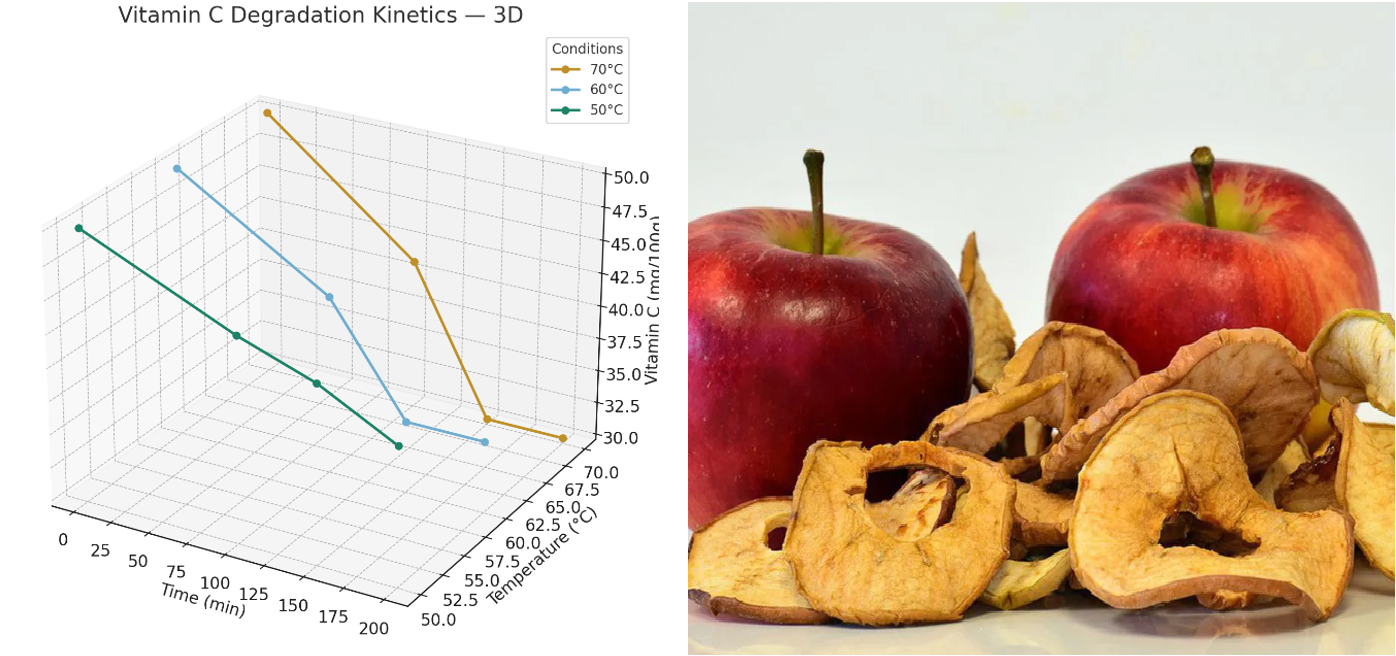
The object of the study is the process of infrared –convective drying of medium-ripeness «Golden Delicious» apples. The relevant problem was to determine the optimal drying modes that ensure efficient moisture removal with minimal energy consumption while preserving bioactive components, particularly vitamin C. The experiment used slices 3.5 mm thick; drying was carried out at temperatures of 50, 60, and 70 °C and an air velocity of 3 m/s, achieving a final moisture content of 10 %. The mass of removed water, specific energy consumption (SEC = 71.78–110.35 kWh/kg water), average system power (2.78 kW), and the characteristic internal diffusion time (τ≈51 min) were determined. The kinetics of vitamin C degradation was modeled as a first-order process: losses amounted to 20 % at 50 °C, 30 % at 60 °C, and 40 % at 70 °C, which allowed calculating the degradation rate constants kvitC. Statistical analysis showed a high correlation between temperature and drying parameters (r≈0.995–0.998), and the constructed regression and exponential models adequately describe the experimental data (R²≈0.998). The obtained results are explained by intensified mass and heat-mass transfer at higher temperatures and the corresponding acceleration of thermolabile component degradation. A distinctive feature of the study is its comprehensive approach, simultaneously accounting for drying kinetics, process energetics, and changes in the biochemical composition of the product, enabling optimization of the mode to obtain high-quality dried fruit. The practical application of the results covers industrial and laboratory infrared drying of apples and similar fruits, where balancing drying rate and vitamin preservation is required, and the developed models allow predicting the energy and quality characteristics of the product.
References
Tridge. (2021). It became known how many apples are grown in Ukraine every year. https://www.tridge.com/news/it-became-known-how-many-apples-are-grown-in-ukrai
Kyiv School of Economics, & Tridge. (2024). The apple leads the top of fruits and berries grown in Ukraine: Report by KSE & Ministry of Agrarian Policy. Kyiv School of Economics. https://kse.ua/wp-content/uploads/2025/03/Report-1.1_Market-Overview_formatted_English-version.pdf
Ukrinform. (2025). Experts: Average Ukrainian eats 12 kg of fresh apples annually. https://surl.li/rdejme
Kosulina, N. H., & Cherenkov, O. D. (2016). Mikrovolnovaya tekhnolohiya v sadovodstve [Microwave technology in horticulture]. Enerhetyka ta kom’p’no-integrovani tekhnolohiyi v APK, 1(4), 67–68.
Kosulina, N. H., Cherenkov, O. D., & Dubyk, V. N. (2016). [Grounding of electromagnetic pulse method of insect pests destruction in gardens]. Enerhetyka ta kom’p’no-integrovani tekhnolohiyi v APK, 2(5), 44–49. (In Ukrainian)
Kosulina, N., Pirotti, Y., Cherenkov, A., Chorna, M., & Sapryka, A. (2020). Justification of the parameters of the dielcometric system of plant gas exchange control. Osterreichisches Multiscience Journal, 1(32), 61–66.
Kosulina, N., Cherenkov, A., Zlepko, S., Chernyshova, T., Shpakova, N., & Omiotek, Z. (2018). Justification of the electromagnetic impulse method destruction of insect pests in gardens. SPIE Proceedings, 10808, 157–166. https://doi.org/10.1117/12.2501665
Mukhaylova, L., Ryd, A., Potapski, P., Kosulina, N., & Cherenkov, A. (2018). Determining the electromagnetic field parameters to kill flies at livestock facilities. Eastern-European Journal of Enterprise Technologies, 4(10), 6–13. https://doi.org/10.15587/1729-4061.2018.137600
ScienceDirect. (2023). A novel infrared drying technique for processing of apple slices: Drying characteristics and quality attributes. https://www.sciencedirect.com
Huang, X., Li, Y., Zhou, X., Wang, J., Zhang, Q., Yang, X., Zhu, L., & Geng, Z. (2022). Prediction of apple slices drying kinetic during infrared-assisted hot air drying by deep neural networks. Foods, 11(21), 3486. https://doi.org/10.3390/foods11213486
Timoumi, S., Mihoubi, D., & Zagrouba, F. (2007). Shrinkage, vitamin C degradation and aroma losses during infra-red drying of apple slices. Journal of Food Engineering, 79(1), 20–28. https://doi.org/10.1016/j.jfoodeng.2006.01.026
IHE NASU. (2024). Intensive drying methods for apple slices with convection and combined energy supply. https://ihe.nas.gov.ua
MDPI. (2021). Research on the process of convective drying of apples and apricots using an original drying installation. https://www.mdpi.com
Dajbych, O., Kabutey, A., Mizera, Č., & Herák, D. (2023). Investigation of the effects of infrared and hot air oven drying methods on drying behaviour and colour parameters of Red Delicious apple slices. Processes, 11(10), 3027. https://doi.org/10.3390/processes11103027
Teymori-Omran, M., Askari Asli-Ardeh, E., Taghinezhad, E., Motevali, A., Szumny, A., & Nowacka, M. (2023). Enhancing energy efficiency and retention of bioactive compounds in apple drying: Comparative analysis of combined hot air–infrared drying strategies. Applied Sciences, 13(13), 7612. https://doi.org/10.3390/app13137612
Uğurlu, S., Yücel, T., Cavidoğlu, İ., & Bakkalbaşı, E. (2024). The impact of pre-drying and different infrared powers on some quality parameters of apple chips fried by vacuum-combined infrared radiation. Grasas y Aceites, 75(2). https://doi.org/10.3989/gya.1077231.2052
Sufitri, E., Emelda, E., Munir, M. A., & Aprilia, V. (2023). Determination of ascorbic acid in citrus fruits using iodometric titration method. Asian Journal of Analytical Chemistry, 1(1). https://doi.org/10.53866/ajac.v1i1.267
Samadi, S. H., & Loghmanieh, I. (2013). Evaluation of energy aspects of apple drying in the hot-air and infrared dryers. Energy Research Journal, 4(1), 30–38. https://doi.org/10.3844/erjsp.2013.30.38
Beigi, M., Tohidi, M., & Torki-Harchegani, M. (2016). Energy efficiency and moisture diffusivity of apple slices during convective drying. Ciência e Tecnologia de Alimentos, 36(1), 145–150. https://doi.org/10.1590/1678-457X.01016
Timoumi, S., Mihoubi, D., & Zagrouba, F. (2007). Shrinkage, vitamin C degradation and aroma losses during infra-red drying of apple slices. Journal of Food Engineering, 79(1), 20–28. https://doi.org/10.1016/j.jfoodeng.2006.01.026
Doymaz, İ. (2014). Effect of temperature on the drying characteristics of purslane (Portulaca oleracea L.). Journal of Food Processing and Preservation, 38(1), 392–400. https://doi.org/10.1111/jfpp.12084
Henderson, S. M., & Pabis, S. (1961). Grain drying theory. I. Temperature effect on drying coefficient. Journal of Agricultural Engineering Research, 6(3), 169–174.
Akpinar, E. K. (2010). Drying of mint leaves in a solar dryer and under open sun: Modelling, performance analyses. Energy Conversion and Management, 51(12), 2407–2418. https://doi.org/10.1016/j.enconman.2010.05.005
Downloads
Published
Issue
Section
License
Copyright (c) 2026 Oles Honchar Dnipro National University

This work is licensed under a Creative Commons Attribution 4.0 International License.
- Authors reserve the right of attribution for the submitted manuscript, while transferring to the Journal the right to publish the article under the Creative Commons Attribution License. This license allows free distribution of the published work under the condition of proper attribution of the original authors and the initial publication source (i.e. the Journal)
- Authors have the right to enter into separate agreements for additional non-exclusive distribution of the work in the form it was published in the Journal (such as publishing the article on the institutional website or as a part of a monograph), provided the original publication in this Journal is properly referenced
- The Journal allows and encourages online publication of the manuscripts (such as on personal web pages), even when such a manuscript is still under editorial consideration, since it allows for a productive scientific discussion and better citation dynamics (see The Effect of Open Access).