SYNTHESIS OF A BIFUNCTIONAL CATALYST BASED ON REGENERATED Al₂O₃ ADSORBENT
DOI:
https://doi.org/10.15421/jchemtech.v34i1.347947Keywords:
regeneration, carrier, catalyst, hydrotreating, aluminum oxide, synthesis, textural properties.Abstract
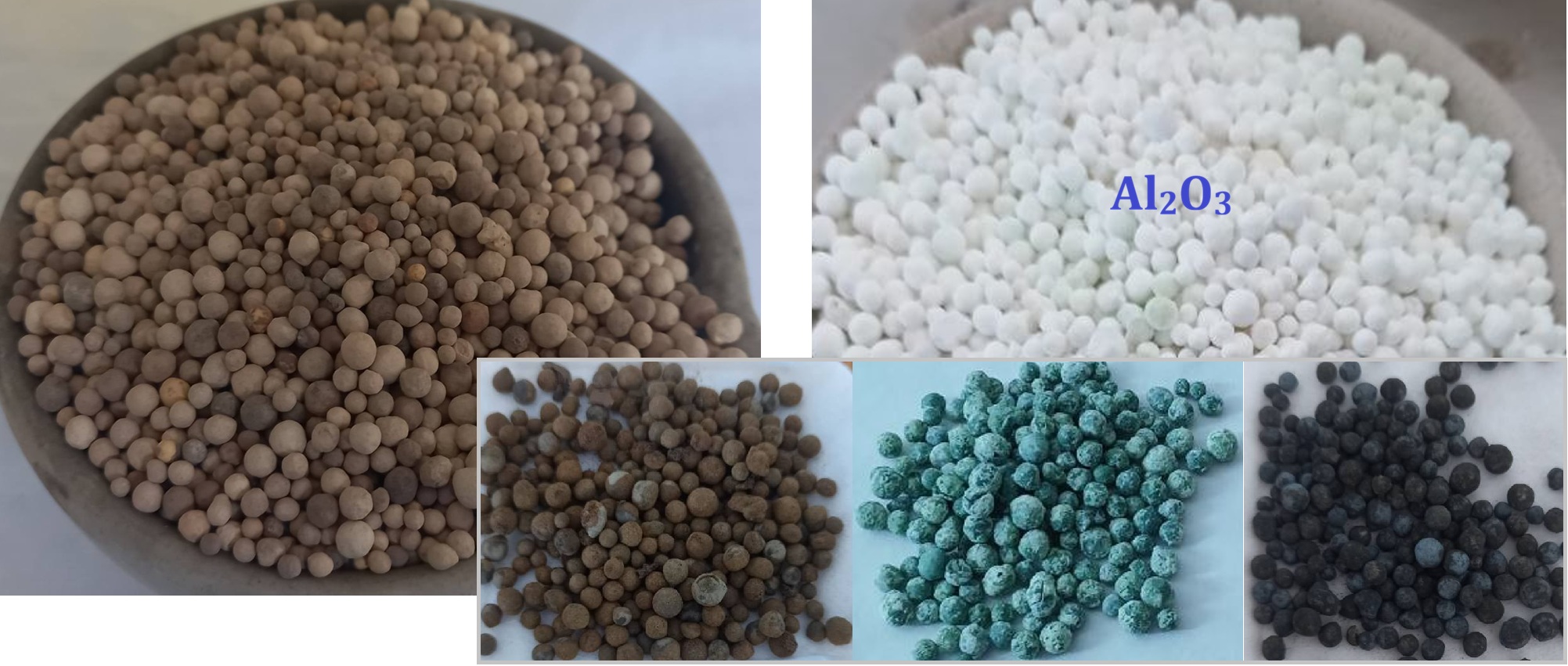
To synthesize a bifunctional catalyst on an Al₂O₃ support, the initially used adsorbent Al2O3 was regenerated at 600 °C for 360 minutes in the absence of atmospheric oxygen. A process model for synthesizing bifunctional catalysts on regenerated Al₂O₃ support was developed using Ni, Co, Mo, and P precursors. According to the elemental composition analysis of the regenerated adsorbent by XRF (X-ray fluorescence) method, it was determined to consist of 81.5 % Al2O3. Using the regenerated Al2O3 as the support, (NH4)6Mo7O24·4H2O, Ni A process model was developed to synthesize a bifunctional catalyst using salts such as Ni(NO3)2·6H2O, Co(NO3)2·6H2O, and H3PO4 acid, and based on this model, three types of catalyst samples were synthesized. To determine the morphological changes and textural properties of the surface of the obtained catalyst samples, analyses were performed using SEM (Scanning Electron Microscope), TEM (Transmission Electron Microscope), and BET (Brunauer-Emmett-Teller) model-based methods. These analyses were applied to evaluate morphological changes and textural characteristics of the prepared catalyst samples.
References
Akhtar, M., Ali, S., & Zaman, W. (2024). Recent advancements in catalysts for petroleum refining. Catalysts, 14(12), 841. https://doi.org/10.3390/catal14120841
Shah, N. K., Li, Z., & Ierapetritou, M. G. (2011). Petroleum refining operations: Key issues, advances, and opportunities. Industrial & Engineering Chemistry Research, 50(3), 1161–1170. https://doi.org/10.1021/ie1010004
Saleh, H. M., & Hassan, A. I. (2023). Green conversion of carbon dioxide and sustainable fuel synthesis. Fire, 6(3), 128. https://doi.org/10.3390/fire6030128
Suganuma, S., & Katada, N. (2020). Innovation of catalytic technology for upgrading of crude oil in petroleum refinery. Fuel Processing Technology, 208, 106518. https://doi.org/10.1016/j.fuproc.2020.106518
Zhou, X., Sun, Z., Yan, H., Feng, X., Zhao, H., Liu, Y., Chen, X., & Yang, C. (2021). Produce petrochemicals directly from crude oil catalytic cracking, a techno-economic analysis and life cycle society-environment assessment. Journal of Cleaner Production, 311, 127283. https://doi.org/10.1016/j.jclepro.2021.127283
Amadou, D., Awali, A., Imrana, C., Zinab, S., Attika, S., & Salam, M. (2025). Study of the role of catalyst in fluidised catalytic cracking (FCC) of atmospheric residue. Asian Journal of Biotechnology and Bioresource Technology, 11(3) 240. https://doi.org/10.9734/ajb2t/2025/v11i3240
Armor, J. N. (2011). A history of industrial catalysis. Catalysis Today, 163(1), 3–9. https://doi.org/10.1016/j.cattod.2009.11.019
Zhou, X., Li, S., Wang, Y., Zhang, J., Zhang, Z., Wu, C., Chen, X., Feng, X., Liu, Y., Zhao, H., Yan, H., & Yang, C. (2022). Crude oil hierarchical catalytic cracking for maximizing chemicals production: Pilot-scale test, process optimization strategy, techno-economic-society-environment assessment. Energy Conversion and Management, 252, 115149. https://doi.org/10.1016/j.enconman.2021.115149
Asadova, D. F. (2024). Technology for obtaining a bifunctional catalyst based on spent Al2O3 adsorbent for the hydrotreating process [Doctoral dissertation abstract, Bukhara State University].
Asadova, D. F., Hayitov, R. R., & Hamroyev, F. B. (2023). [Research of the regeneration process of used Al2O3]. Oil and Gas of Uzbekistan, 2, 59–64. (In Uzbek).
Uzbekneftegaz JSC. (2024). Interim condensed consolidated financial statements (unaudited) for the six months ended 30 June 2024.
Gary, J. H., Handwerk, J. H., Kaiser, M. J., & Geddes, D. (2007). Petroleum refining: Technology and economics (5th ed.). CRC Press.
Asadova, D. F., & Hayitov, R. R. (2023). Synthesis of a new type of bifunctional catalysts based on regenerated Al₂O₃ catalysts and their physical and mechanical properties. In Problems, Innovative Proposals, and Solutions in the Field of Oil and Gas Chemistry and Technology: Proceedings of the International Scientific and Technical Conference. Bukhara, Uzbekistan.
Al‐Attas, T. A., Ali, S., Zahir, M. H., Xiong, Q., Al-Bogami, S. A., Malaibari, Z. O., Razzak, S. A., & Hossain, M. M. (2019). Recent advances in heavy oil upgrading using dispersed catalysts. Energy & Fuels, 33(9), 7917–7949. https://doi.org/10.1021/acs.energyfuels.9b01532
Bogdanov, A., & Khmirov, P. (2023). Raw hydrocarbons base of the republic of Uzbekistan - growth and production structure. SOCAR Proceedings, SI2, 88–97. https://doi.org/10.5510/ogp2023si200887
Asadova, D. F., & Ismoilov, J. (2023). Physical and chemical properties of pyrolysis distillate. Best Journal of Innovation in Science, Research and Development, 2(12), 234–238. https://www.bjisrd.com/index.php/bjisrd/article/view/1335
Wu, D., Zhou, J., & Li, Y. (2009). Effect of the sulfidation process on the mechanical properties of a CoMoP/Al2O3 hydrotreating catalyst. Chemical Engineering Science, 64(2), 198–206. https://doi.org/10.1016/j.ces.2008.10.021
Aitani, A. M. (2002). Catalysts in petroleum refining & petrochemicals. Paper presented at the 12th Annual Saudi-Japanese Symposium, King Fahd University of Petroleum & Minerals (KFUPM), Dhahran, Saudi Arabia.
Emberru, R., Patel, R., Mujtaba, I., & John, Y. (2024). A review of catalyst modification and process factors in the production of light olefins from direct crude oil catalytic cracking. Sci, 6(1), Article 11. https://doi.org/10.3390/sci6010011
Asadova, D. F., & Jangabayev, A. B. (2023). Catalysts used in the hydrogenation process. International Journal of Scientific Researchers, 1(1), 115–117.
Rothenberg, G. (2017). Catalysis: Concepts and green applications (2nd ed.). Wiley-VCH.
Waterman, R. (2025). Transitioning to green discovery‐based catalysis. Chemistry – A European Journal, 31(17), e202404602. https://doi.org/10.1002/chem.202404602
Tursunova, F., Amonov, M., & Mardonov, U. (2025). Physico–chemical analysis of palladium and Al2O3 support after regeneration: SEM, EDS, and XRD studies. International Journal of Materials and Chemistry, 15(4), 77–82. https://doi.org/10.5923/j.ijmc.20251504.02
Asadova, D. F. (2022). Types of catalysts in oil refining. Texas Journal of Engineering and Technology, 14, 64–68.
Khayitov, R. R., & Asadova, D. F. (2021). [Study of the chemical and fractional composition of pyrolysis distillate]. Universum: Technical Sciences, 11(92), 14–19.
Asadova, D. F., Hayitov, R. R., & Mavlonov, S. B. (2024). Synthesis of bifunctional catalysts and research of their physicochemical and textural properties using modern methods. Oil and Gas of Uzbekistan, 2, 45–50.
Nazarov, S., Razzokov, K., Shirinov, G., Niyozov, E., Rashidova, R., Rasulov, M., & Ganiev, B. (2023). Investigation of thermal properties and composition on basalts of the Aydarkul deposit by methods DTA/DTG and X-ray diffraction. E3S Web of Conferences, 389, 01023. https://doi.org/10.1051/e3sconf/202338901023
Reznichenko, I. D., Aliev, R. R., & Tselyutina, M. I. (2013). [Method for preparing a catalyst for hydrotreating oil fractions]. Russian Patent No. RU 2536965. (in Russian)
Asadova, D. F., Hayitov, R. R., & Hamroyev, F. B. (2023). [Research of the regeneration process of used Al2O3]. Oil and Gas of Uzbekistan, 2, 59–64. (In Uzbek).
Ji, J., Bao, Y., Liu, X., Zhang, J., & Xing, M. (2021). Molybdenum‐based heterogeneous catalysts for the control of environmental pollutants. EcoMat, 3(6), e12155. https://doi.org/10.1002/eom2.12155
Premanand, G., Jana, D., Unnikrishnan, P., & Das, S. (2024). Hexagonal Mo Bronze: Single crystal structures, electrocatalytic hydrogen evolution, and proton conductivity. Inorganic Chemistry, 63(20), 9182–9194. https://doi.org/10.1021/acs.inorgchem.4c01151
Downloads
Published
Issue
Section
License
Copyright (c) 2026 Oles Honchar Dnipro National University

This work is licensed under a Creative Commons Attribution 4.0 International License.
- Authors reserve the right of attribution for the submitted manuscript, while transferring to the Journal the right to publish the article under the Creative Commons Attribution License. This license allows free distribution of the published work under the condition of proper attribution of the original authors and the initial publication source (i.e. the Journal)
- Authors have the right to enter into separate agreements for additional non-exclusive distribution of the work in the form it was published in the Journal (such as publishing the article on the institutional website or as a part of a monograph), provided the original publication in this Journal is properly referenced
- The Journal allows and encourages online publication of the manuscripts (such as on personal web pages), even when such a manuscript is still under editorial consideration, since it allows for a productive scientific discussion and better citation dynamics (see The Effect of Open Access).