DEPOLYMERIZATION OF RIGID POLYURETHANE WASTE VIA CATALYTIC GLYCOLYSIS IN THE PRESENCE OF K, Na, AND Ca COMPOUNDS
DOI:
https://doi.org/10.15421/jchemtech.v34i1.349449Keywords:
polyurethane, depolymerization, catalysis, glycolysis, waste, recyclingAbstract
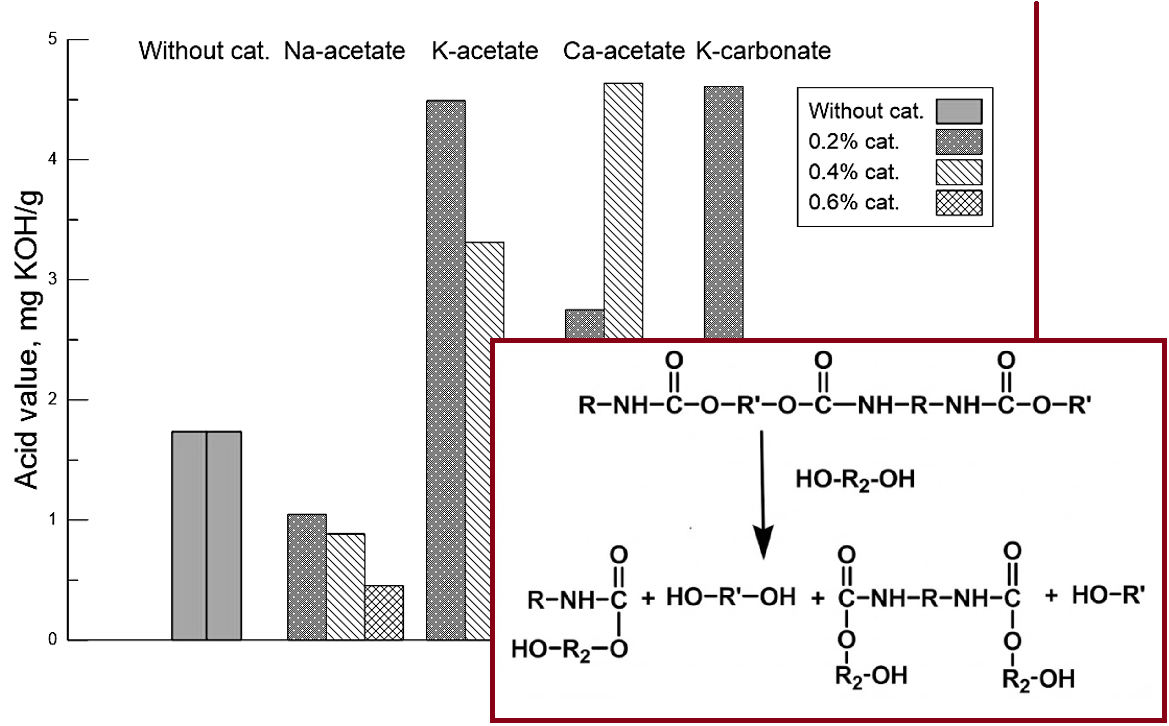
The process of chemical recycling of rigid polyurethane waste via catalytic glycolysis with diethylene glycol (DEG) was investigated. The purpose of this work was to study the influence of the nature of some alkaline earth compounds as homogeneous catalysts on the depolymerization of PU into a so-called recycled polyol with properties suitable for further application. The glycolysis process was carried out at a temperature of 220 °C for 40 min. with a mass ratio of polyurethane (PU) waste to DEG of 1 : 2.5. The K-, Na-, and Ca acetates and K carbonate, as homogeneous catalysts at constant mass concentrations (0.2 %, 0.4 %, and 0.6 %), were used. The effectiveness of depolymerization was evaluated by the physical and chemical properties of the obtained liquid products (i.e., recycled polyol), namely by hydroxyl-, acid-, and amine-number as well as by dynamic viscosity. It was found that the studied catalysts significantly intensify the depolymerization process compared to the non-catalytic reaction. Potassium carbonate at a concentration of 0.4 % allowed to obtain recycled polyol with a high hydroxyl number. The obtained results confirm the feasibility of K and Na acetates and carbonates for controlled depolymerization of solid PU waste.
References
Gama, N. V., Ferreira, A., & Barros-Timmons, A. (2018). Polyurethane foams: Past, present, and future. Materials, 11(10), 1841. https://doi.org/10.3390/ma11101841
Das, A., & P& mahanwar, P. (2020). A brief discussion on advances in polyurethane applications. Advanced Industrial and Engineering Polymer Research, 3(3), 93–101. https://doi.org/10.1016/j.aiepr.2020.07.002
Ionescu, M. (2016). Chemistry and technology of polyols for polyurethanes (2nd ed.). Smithers Rapra Technology.
Zia, K. M., Bhatti, H. N., & Bhatti, I. A. (2007). Methods for polyurethane and polyurethane composites, recycling and recovery: A review. Reactive and Functional Polymers, 67(8), 675–692. https://doi.org/10.1016/j.reactfunctpolym.2007.05.004
Yang, W., Dong, Q., Liu, S., Xie, H., Liu, L., Li, J. (2012). Recycling and disposal methods for polyurethane foam wastes. Procedia Environmental Sciences, 16, 167–175. https://doi.org/10.1016/j.proenv.2012.10.023
Banik, J., Chakraborty, D., Rizwan, M., Shaik, A. H., & Chandan, M. R. (2023). Review on disposal, recycling and management of waste polyurethane foams: A way ahead. Waste Management & Research: The Journal for a Sustainable Circular Economy, 41(6), 1063–1080. https://doi.org/10.1177/0734242X221146082
Deng, Y., Dewil, R., Appels, L., Ansart, R., Baeyens, J., & Kang, Q. (2021). Reviewing the thermo-chemical recycling of waste polyurethane foam. Journal of Environmental Management, 278, 111527. https://doi.org/10.1016/j.jenvman.2020.111527
Rossignolo, G., Malucelli, G., & Lorenzetti, A. (2024). Recycling of polyurethanes: Where we are and where we are going. Green Chemistry, 26(3), 1132–1152. https://doi.org/10.1039/D3GC02091F
Kaur, R., Singh, P., Tanwar, S., Varshney, G., & Yadav, S. (2022). Assessment of bio-based polyurethanes: Perspective on applications and bio-degradation. Macromol, 2(3), 284–314. https://doi.org/10.3390/macromol2030019
Datta, J., & Włoch, M. (2017). Recycling of polyurethanes. In Polyurethane Polymers. Elsevier. https://doi.org/10.1016/B978-0-12-804039-3.00014-2
Suprun, V.Y., Marukha, V. І., & Sylovaniuk, V. P. (2022). Recycling technologies for polyurethane wastes (a survey). Materials Science, 57(6), 755–764. https://doi.org/10.1007/s11003-022-00605-x
Gama, N., Godinho, B., Marques, G., Silva, R., Barros-Timmons, A., & Ferreira, A. (2020). Recycling of polyurethane scraps via acidolysis. Chemical Engineering Journal, 395, 125102. https://doi.org/10.1016/j.cej.2020.125102
Wieczorek, K., Bukowski, P., Stawiński, K., & Ryłko, I. (2024). Recycling of polyurethane foams via glycolysis: A review. Materials, 17(18), 4617. https://doi.org/10.3390/ma17184617
Aguado, A., Martinez, L., Moral, A., Fermoso, J., & Irusta, R. (2011). Chemical recycling of polyurethane foams waste via glycolysis. Chemical Engineering Transactions, 24, 1069–1074. https://doi.org/10.3303/CET1124179
Molero, C., De Lucas, A., & Rodríguez, J. F. (2006). Recovery of polyols from flexible polyurethane foam by "split-phase" glycolysis: Glycol influence. Polymer Degradation and Stability, 91(2), 221–228. https://doi.org/10.1016/j.polymdegradstab.2005.05.008
Wu, C.-H., Chang, C.-Y., Cheng, C.-M., & Huang, H.-C. (2003). Glycolysis of waste flexible polyurethane foam. Polymer Degradation and Stability, 80(1), 103–111. https://doi.org/10.1016/S0141-3910(02)00390-7
Zahedifar, P., Pazdur, L., Vande Velde, C. M. L., & Billen, P. (2021). Multistage chemical recycling of polyurethanes and dicarbamates: A glycolysis–hydrolysis demonstration. Sustainability, 13(6), 3583. https://doi.org/10.3390/su13063583
Miguel-Fernández, R., Ramos, M. J., Lucas, A.D., & Rodríguez, J. F. (2022). Recovery of green polyols from rigid polyurethane waste by catalytic depolymerization. Polymers, 14(14), 2936. https://doi.org/10.3390/polym14142936
Santos, L. M. D., Carone, C. L. P., Dullius, J., Ligabue, R., & Einloft, S. (2013). Using different catalysts in the chemical recycling of waste from flexible polyurethane foams. Polímeros: Ciência e Tecnologia, 23(5), 608–613. https://doi.org/10.4322/polimeros.2013.096
Molero, C., De Lucas, A., & Rodríguez, J. F. (2006). Recovery of polyols from flexible polyurethane foam by "split-phase" glycolysis with new catalysts. Polymer Degradation and Stability, 91(4), 894–901. https://doi.org/10.1016/j.polymdegradstab.2005.06.023
Donadini, R., Brando, G., Bertoldi, G., Caniato, M., Benedetti, A., & Riello, P. (2023). Chemical recycling of polyurethane waste via a microwave-assisted glycolysis process. ACS Omega, 8(5), 4655–4666. https://doi.org/10.1021/acsomega.2c06297
Gu, X., Luo, H., S., L., & Chen, P. (2021). Glycolysis recycling of waste polyurethane rigid foam using different catalysts. Journal of Renewable Materials, 9(7), 1253–1266. https://doi.org/10.32604/jrm.2021.014876
Velasco, F., Morales, G., Ramos, M. J., Rodriguez, J. F., & Lucas, A. (2025). Scalable glycolysis-based depolymerization of polyurethane foam waste enabled by ionic liquids. Green Chemistry, 27(42), 13235–13246. https://doi.org/10.1039/D5GC03643G
Claudia, C., Mariagrazia, I., Luca, G., & Maria, S. (2025). Efficient recycling of polyurethane waste via Fe3O@MgAl magnetic catalyst glycolysis. Chemical Engineering Transactions, 118, 265–270. https://doi.org/10.3303/CET25118045
Ivashchuk, O. S., Suprun, W. Y., Atamanyuk, V. M., Kurhanskyi, V. S., Nahurskyi, A. O., & Chyzhovych, R. A. (2025). Depolymerization of rigid polyurethane waste by catalytic glycolysis with diethylene glycol. South African Journal of Chemical Engineering, 52, 61–67. https://doi.org/10.1016/j.sajce.2025.01.009
Downloads
Published
Issue
Section
License
Copyright (c) 2026 Oles Honchar Dnipro National University

This work is licensed under a Creative Commons Attribution 4.0 International License.
- Authors reserve the right of attribution for the submitted manuscript, while transferring to the Journal the right to publish the article under the Creative Commons Attribution License. This license allows free distribution of the published work under the condition of proper attribution of the original authors and the initial publication source (i.e. the Journal)
- Authors have the right to enter into separate agreements for additional non-exclusive distribution of the work in the form it was published in the Journal (such as publishing the article on the institutional website or as a part of a monograph), provided the original publication in this Journal is properly referenced
- The Journal allows and encourages online publication of the manuscripts (such as on personal web pages), even when such a manuscript is still under editorial consideration, since it allows for a productive scientific discussion and better citation dynamics (see The Effect of Open Access).