QUALIFICATION SYSTEM FOR COMPREHENSIVE IDENTIFICATION OF HOP OIL
DOI:
https://doi.org/10.15421/jchemtech.v34i1.349864Keywords:
ethanol extract; essential oil; hops; spectrophotometry; authentication; terpenes; quality.Abstract
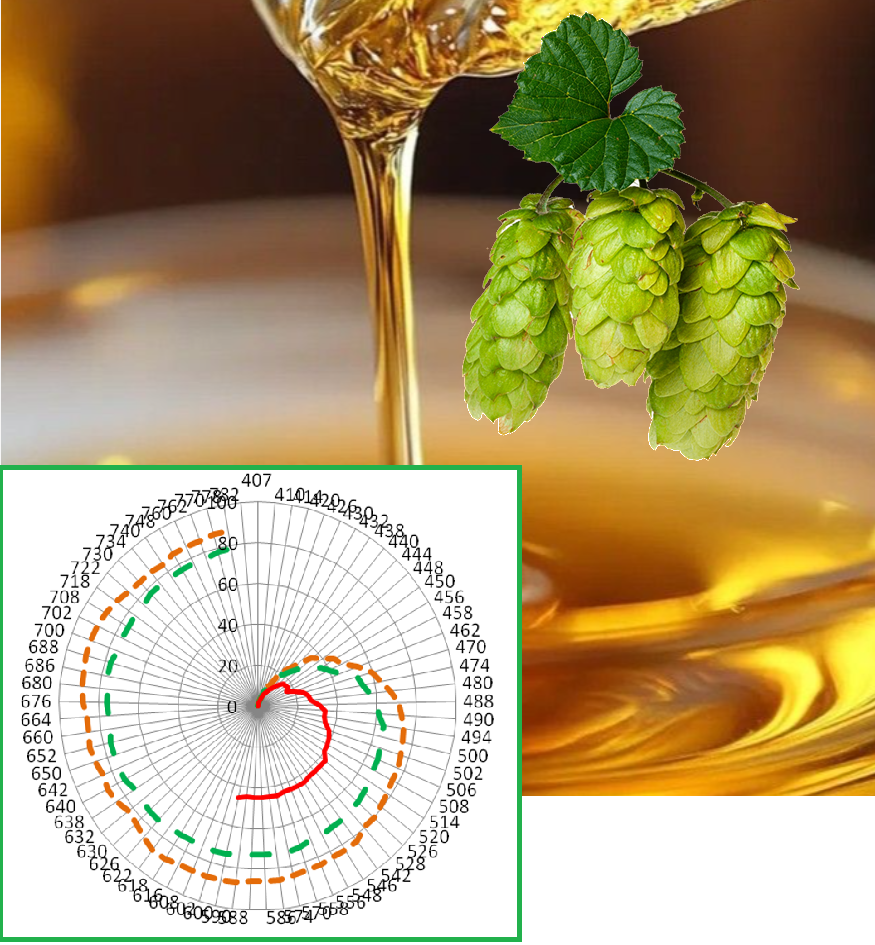
Modern technological capabilities are causing concern due to the creativity of approaches to the falsification of food products and their components, in particular essential oils. The struggle for quality and safety of end products calls on the global scientific community to improve and create more diverse methodologies with mandatory mathematical comparative analysis of the impact on the same system under changing influencing factors. The aim of the research was to create additional criteria for preventing falsification through spectrophotometric analysis of the intensity of light absorption by ethanol solutions of essential oils of bitter hops. Individual graphical-positional anomalies of wavelengths and spectral intervals were determined, and equations of functions of changes in the concentration of terpene complexes in the studied samples were calculated, coefficients were determined, and the error values were experimentally proven. A rational ratio (oil-ethanol) for dissolution without opalescence was empirically established. The spectra and changes in the optical density of hop oil were evaluated in basic units of light absorption and in percentages in the wavelength range from 190 nm to 900 nm discretely, with a wavelength determination step of 0.05–1 nm. Based on the study of known-quality samples, a wavelength range of 456–780 nm was established, at which the fluctuation in the intensity of the absorbing activity of the main terpenoid compounds facilitates the authentication of other samples of ethanol solutions of hop oils. In addition, fluctuations in the coefficients of mathematical systems for monitoring changes in light absorption intensity in ethanol solutions of hop oil provide an opportunity for comparative control of these changes and, accordingly, create additional criteria for preventing counterfeiting.
References
Capetti, F., Marengo, A., Cagliero, C., Liberto, E., Bicchi, C., Rubiolo, P., & Sgorbini, B. (2021). Adulteration of essential oils: A multitask issue for quality control. Three case studies: Lavandula angustifolia Mill., Citrus limon (L.) Osbeck and Melaleuca alternifolia (Maiden & Betche). Molecules, 26(18), 5610. https://doi.org/10.3390/molecules26185610
Mosandl, A. (1995). Enantioselective capillary gas chromatography and stable isotope ratio mass spectrometry in the authenticity control of flavors and essential oils. Food Reviews International, 11(4), 597–664. https://doi.org/10.1080/87559129509541063
Mousa, M., Wang, Y., Antora, S. A., Al-Qurashi, A., Ibrahim, S. M., & Dong, W. (2022). An overview of recent advances and applications of FT-IR spectroscopy for quality, authenticity, and adulteration detection in edible oils. Critical Reviews in Food Science and Nutrition, 62(5), 1–19. https://doi.org/10.1080/10408398.2021.1922872
Yang, H., Huang, X., Yang, M., Zhang, X., & Chen, G. (2024). Advanced analytical techniques for authenticity identification and quality evaluation in essential oils: A review. Food Chemistry, 451, 139340. https://doi.org/10.1016/j.foodchem.2024.139340
Do, T. K. T., Hadji-Minaglou, F., Antoniotti, S., & Fernandez, X. (2015). Authenticity of essential oils. TrAC Trends in Analytical Chemistry, 66, 146–157. https://doi.org/10.1016/j.trac.2014.10.007
Sadgrove, N. J., Padilla-González, G. F., & Phumthum, M. (2022). Fundamental chemistry of essential oils and volatile organic compounds, methods of analysis and authentication. Plants, 11(6), 789. https://doi.org/10.3390/plants11060789
Yadav, S. K. (Ed.). (2022). Physiochemical properties of essential oils and applications. IntechOpen. https://doi.org/10.5772/intechopen.104112
Hussien, E. T., Sara, S. A., Shaban, A., & Ali, O. M. (2021). Chemical profile and antibacterial activity of Mentha viridis L. essential oils and ethanolic extract. Journal of Agricultural and Crop Research, 9(2), 34–39. https://doi.org/10.103495/jacr_v9i2.21.110
Khodabandeloo, B., Kahrizi, F., & Es-haghi, A. (2017). Solubility investigation of ether and ester essential oils in water using spectrometry and GC/MS. Research Journal of Pharmacognosy, 4(1). https://doaj.org/article/88518366d3544d97904ae5e18ca93f0a
Liubchenko, V., Steciuk, O., Ratoshniuk, V., Venger, O., & Shtanko, I. (2023). Innovative features for the recovery of partially polymerized hop oil. Journal of Chemistry and Technologies, 31(2), 289–295. https://doi.org/10.15421/jchemtech.v31i2.277939
Stevanovic, Z. D., Sieniawska, E., Glowniak, K., Obradovic, N., & Pajic-Lijakovic, I. (2020). Natural macromolecules as carriers for essential oils: From extraction to biomedical application. Frontiers in Bioengineering and Biotechnology, 8, 563. https://doi.org/10.3389/fbioe.2020.00563
Silva, S. M., Abe, S. Y., Murakami, F. S., Frensch, G., Marques, F. A., & Nakashima, T. (2011). Essential oils from different plant parts of Eucalyptus cinerea F. Muell. ex Benth. (Myrtaceae) as a source of 1,8-cineole and their bioactivities. Pharmaceuticals, 4(12), 1535–1550. https://doi.org/10.3390/ph4121535
Addo, P. W., Sagili, S., Bilodeau, S. E., Desjardins, V., Vitiele, S., & MacPherson, S. (2022). Cold ethanol extraction of cannabinoids and terpenes from Cannabis using response surface methodology: Optimization and comparative study. Molecules, 27(24), 8780. https://doi.org/10.3390/molecules27248780
Sari, A. P., Amanah, N. L., Wardatullathifah, A., & Nugroho, A. (2022). Comparison of maseration and sonication method on flavonoid extraction from mango leaves: Effect of solvent ratio. ASEAN Journal of Chemical Engineering, 22(2). https://doi.org/10.22146/ajche.74204
Moura, M., Assuncão, E., & Barbosa, S. (2025). Essential oil from the leaves of the dwarf cashew tree (Anacardium occidentale L.) in the Amazon Savannah: Physicochemical and antioxidant properties as a food preservative. Foods, 14(11), 1954. https://doi.org/10.3390/foods14111954
Hasibuan, R., & Gultom, E. E. (2021). The effect of method, type of solvent and extraction time towards the yield of oil on essential oil extraction from lime peel (Citrus aurantifolia). IOP Conference Series: Materials Science and Engineering, 1122(1), 012108. https://doi.org/10.1088/1757-899X/1122/1/012108
Abed, K. M., Kurji, B. M., & Abdul-Majeed, B. A. (2015). Extraction and modelling of oil from Eucalyptus camadulensis by organic solvent. Journal of Materials Science and Chemical Engineering, 3(8), 38–48. https://doi.org/10.4236/msce.2015.38006
Setiawan, S., Nadhilah, A., & Ilhamisari, R. P. (2022). Effects of leaf storage and distillation time on the quality of eucalyptus (Eucalyptus grandis) essential oil. 3bio: Journal of Biology Science, Technology and Management, 4(1), 1–7. https://doi.org/10.5614/3bio.2022.4.1.1
Rowshan, V., Bahmanzadegan, A., & Saharkhiz, M. J. (2013). Influence of storage conditions on the essential oil composition of Thymus daenensis Celak. Industrial Crops and Products, 49, 97–101. https://doi.org/10.1016/j.indcrop.2013.04.029
Moureu, S., Violleau, F., Haimoud-Lekhal, D. A., & Calmon, A. (2015). Influence of storage temperature on the composition and the antibacterial activity of ozonized sunflower oil. Ozone: Science & Engineering, 38(2), 143–149. https://doi.org/10.1080/01919512.2015.1128319
Truzzi, E., Marchetti, L., Benvenuti, S., Righi, V., Graziosi, R., & Rossi, M. C. (2021). A novel qNMR application for the quantification of vegetable oils used as adulterants in essential oils. Molecules, 26(18), 5439. https://doi.org/10.3390/molecules26185439
Rashed, M. M. A., Han, F., Ghaleb, A. D. S., Bao, N., Al-Mulla, A., & Al-Anazi, A. (2025). Traceability, authentication, and quality control of food-grade lavender essential oil: A comprehensive review. Advances in Colloid and Interface Science, 340, 103466. https://doi.org/10.1016/j.cis.2025.103466
Truzzi, E., Marchetti, L., Bertelli, D., & Benvenuti, S. (2021). Attenuated total reflectance-Fourier transform infrared (ATR-FTIR) spectroscopy coupled with chemometric analysis for detection and quantification of adulteration in lavender and citronella essential oils. Phytochemical Analysis, 32(6), 907–920. https://doi.org/10.1002/pca.3034
Truzzi, E., Durante, C., Bertelli, D., & Catellani, B. (2022). Rapid classification and recognition method of the species and chemotypes of essential oils by ATR-FTIR spectroscopy coupled with chemometrics. Molecules, 27(17), 5618. https://doi.org/10.3390/molecules27175618
Tang, J., Wang, Q., Tong, H., Liao, X., & Zhang, Z. F. (2016). Discriminant analysis of lavender essential oil by attenuated total reflectance infrared spectroscopy. Guang Pu Xue Yu Guang Pu Fen Xi, 36(3), 716–719.
Liao, X., Wang, Q., Fu, J. H., & Tang, J. (2015). Main components of Xinjiang lavender essential oil determined by partial least squares and near infrared spectroscopy. Guang pu xue yu guang pu fen xi = Guang pu, 35(9), 2526–2529.
Liubchenko, V., Steciuk, O., Ratoshniuk, V., Ilyinskiy, Y., & Pasichnyk, I. (2025). Spectrophotometric authentication images of hop essential oils. Journal of Chemistry and Technologies, 33(1), 222–227. https://doi.org/10.15421/jchemtech.v33i1.311702
Tedone, L., Staskova, L., Yan, D. D., Whittock, S., Shellie, R. A., & Koutoulis, A. (2020). Hop (Humulus lupulus L.) volatiles variation during storage. Journal of the American Society of Brewing Chemists, 78(2), 1–12. https://doi.org/10.1080/03610470.2019.1704674
Garloff, J., Popova, E., & Smith, A. (2009). Solving linear systems with polynomial parameter dependency in the reliable analysis of structural frames. In Proceedings of the 2nd International Conference on Uncertainty in Structural Dynamics. University of Sheffield.
Zhang, X., Roux, J., & Charnois, T. (2022). Higher-order dependency parsing for arc-polynomial score functions via gradient-based methods and genetic algorithm. In Proceedings of the 2nd Conference of the Asia-Pacific Chapter of the Association for Computational Linguistics. ACL Anthology. https://doi.org/10.18653/v1/2022.aacl-main.85
Downloads
Published
Issue
Section
License
Copyright (c) 2026 Oles Honchar Dnipro National University

This work is licensed under a Creative Commons Attribution 4.0 International License.
- Authors reserve the right of attribution for the submitted manuscript, while transferring to the Journal the right to publish the article under the Creative Commons Attribution License. This license allows free distribution of the published work under the condition of proper attribution of the original authors and the initial publication source (i.e. the Journal)
- Authors have the right to enter into separate agreements for additional non-exclusive distribution of the work in the form it was published in the Journal (such as publishing the article on the institutional website or as a part of a monograph), provided the original publication in this Journal is properly referenced
- The Journal allows and encourages online publication of the manuscripts (such as on personal web pages), even when such a manuscript is still under editorial consideration, since it allows for a productive scientific discussion and better citation dynamics (see The Effect of Open Access).