DEMULSIFICATION BEHAVIOR OF CRUDE OIL EMULSIONS İN THE PRESENCE OF MULTICOMPONENT DEMULSIFIERS
DOI:
https://doi.org/10.15421/jchemtech.v34i2.351331Keywords:
reagent, composition, surface tension, effiency, water-oil emulsionAbstract
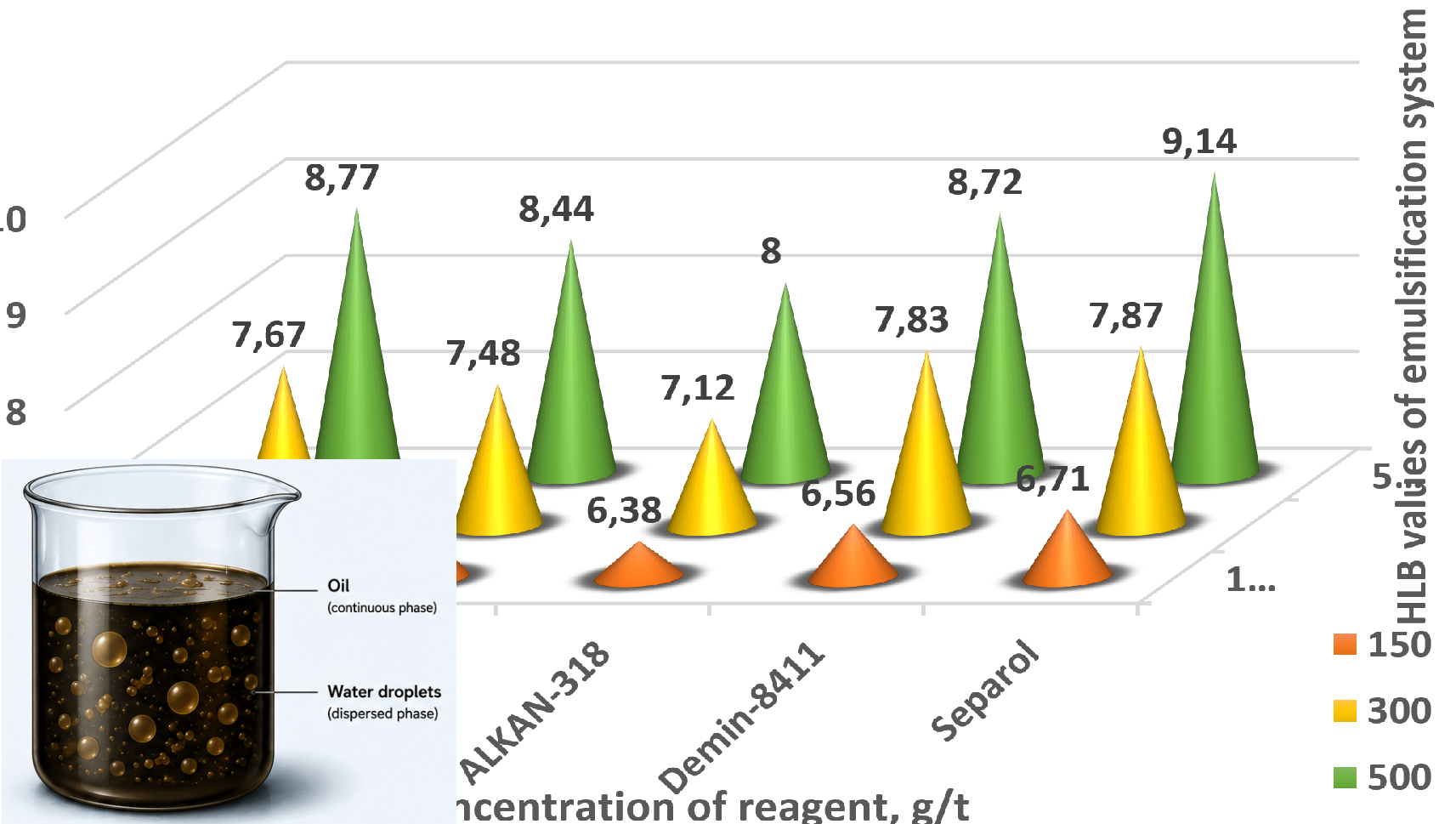
In the present study, the demulsification of 35 % water-in-oil Muradkhanli crude oil emulsions was investigated using both individual reagents and their composite formulations. The individual reagents included ALKAN-318, ALKAN DE-202, Separol, Demin-8411, and Dissolvan-3359. Demulsification experiments were conducted at 40 °C and 50 °C for 2 hours using the bottle-test method. To enhance demulsification efficiency, demulsifier-based composite formulations were developed under laboratory conditions. These compositions consisted of the studied demulsifiers combined with ethanol, which was added to reduce interfacial tension. The optimal dosage for the composites was determined to be 500 g/t; therefore, both the individual reagents and the composites were compared within the concentration range of 150–500 g/t, and the results were presented in graphical and tabular forms. Since the formulations were based on demulsifiers, they were conventionally denoted as deemulsifier compositions (DC), and a total of ten compositions (DC-1 to DC-10) were synthesized. Along with the demulsification of 35 % water-cut Muradkhanli crude oil emulsions, the effects of both the individual reagents and the composite systems on surface tension, interfacial tension, viscosity, HLB index, and salt content were also studied, and the obtained results were comparatively analyzed. Experimental findings revealed that the highest demulsification efficiency was achieved with the DC-5 composition.
References
Arian V., Alireza N. (2021) Role of Asphaltene in Stability of Water-in-Oil Model Emulsions: The Effects of Oil Composition and Size of the Aggregates and Droplets. Energy & Fuels. 35(7), 5941–5954. https://doi.org/10.1021/acs.energyfuels.1c00183
Aga-Zde, A.R., Alsafarov, M.E., Akberova, A.F. (2018) Selection of an effective demulsifier for the destruction of oil-water emulsion and research to determine compatibility with the base demulsifier. Socar Proceedings. 1, 75–82. https://doi.org/10.5510/OGP20180100343
Bourrel, M., Passade-Boupat, N. (2018) Crude oil surface active species: Consequences for enhanced oil recovery and emulsion stability. Energy & Fuels. 32(3), 2642–2652. https://doi.org/10.1021/acs.energyfuels.7b03435
Jennings, D.W. (2005) The effect of shear and temperature on wax deposition: Cold finger investigation with a Gulf of Mexico crude oil. Energy & Fuels. 19(4), 1376–1386. https://doi.org/10.1021/ef049784i
Jorge A. R. M., Ebelia D. A. M., Carlos E. T. A., David S. G. Z., José A. L. P. (2026) Stochastic optimization of a thermodynamic model based on the CPA–EoS for asphaltene stability in an oil extraction system. ournal of Engineering Research. 13. https://doi.org/10.1016/j.jer.2025.12.016
Lee, J., Babadagli, T. (2020) Comprehensive review on heavy-oil emulsions: Colloid science and practical applications. Chemical Engineering Science. 228, 115962. https://doi.org/10.1016/j.ces.2020.115962
Liu, D., Li, C., Zhang, X., Yang, F., Sun, G., Yao, B., Zhang, H. (2020) Polarity effects of asphaltene subfractions on the stability and interfacial properties of water-in-model oil emulsions. Fuel. 269, 117450. https://doi.org/10.1016/j.fuel.2020.117450
Matiev, K.I., Aghazade, A.D., Keldibaeva, S.S. (2016) Removal of asphalt, resin and paraffin deposits from various deposits. Socar Proceedings. 4, 64–68. https://doi.org/10.5510/OGP20160400299
Matiev, K.I., Agha-Zade, A.G., Alsafarova, M.E. (2018) Depressor additive for high-retaining paraffinic oils. Socar Proceedings. 3, 32–37. https://doi.org/10.5510/OGP20180300359
Nadezhda A. P. (2026) Features of oil disperse systems and changes in their properties under low-energy wave action. Fine Chemical Technologies. 21(1), 30-50. doi: https://doi.org/10.32362/2410-6593-2026-21-1-30-50
Thao V. N., Zhuqing Z., Jianxin W., Aparna S., Yogesh K., Tanguy T., Sibani L. B. (2023) Inhibiting Asphaltene Deposition Using Polymer-Functionalized Nanoparticles in Microfluidic Porous Media. Energy & Fuels. 37(24), 19461–19471. https://doi.org/10.1021/acs.energyfuels.3c03060
Wang, Z., Lin, X., Rui, Z., Xu, M., Zhan, S. (2017) The role of shearing energy and interfacial Gibbs free energy in the emulsification mechanism of waxy crude oil. Energies. 10(5), 721. https://doi.org/10.3390/en10050721
Wu Z., Kang L., Sun M., Chen G., Yang Y., Ma X (2026) Deciphering the coordinated strategy between enzymatic aromatic-ring cleavage and metabolic remodeling for efficient petroleum degradation by vagococcus fluvialis LH1. Water Research. 297, 125743. doi: https://doi.org/10.1016/j.watres.2026.125743
Zhao, H., Kang, W., Yang, H., Huang, Z., Zhou, B., Sarsenbekuly, B. (2021) Emulsification and stabilization mechanism of crude oil emulsion by surfactant synergistic amphiphilic polymer system. Colloids and Surfaces A: Physicochemical and Engineering Aspects. 609, 125726. https://doi.org/10.1016/j.colsurfa.2020.125726
Eggers, J. (1997) Nonlinear dynamics and breakup of free-surface flows. Reviews of Modern Physics. 69(3), 865–930. https://doi.org/10.1103/RevModPhys.69.865
Gray, M. R., Yarranton, H. W., Chacón-Patiño, M. L., Rodgers, R. P., Bouyssiere, B., Giusti, P. (2021) Distributed Properties of Asphaltene Nanoaggregates in Crude Oils: A Review. Energy Fuels. 35(22), 18078– 18103. https://doi.org/10.1021/ef301239h
Gasimzade, A., Nurullayev, V. (2026) Evaluation of a new composition for enhanced demulsification and deposit control in resinous heavy oil emulsions. Rudarsko-geološko-Naftni Zbornik. 41(4), Article in Press. doi: https://doi.org/10.17794/rgn.2026.4.15
Gasimzade, A.V. (2024) Study of a multifunctional composition in the preparation and transportation of heavy oils. Voprosy khimii i khimicheskoi tekhnologii, (4), 25–33. doi: http://dx.doi.org/10.32434/0321-4095-2024-155-4-25-33
GOST 51858 (2020) Oil. General technical conditions. Moscow, 13
Downloads
Published
Issue
Section
License
Copyright (c) 2026 Oles Honchar Dnipro National University

This work is licensed under a Creative Commons Attribution 4.0 International License.
- Authors reserve the right of attribution for the submitted manuscript, while transferring to the Journal the right to publish the article under the Creative Commons Attribution License. This license allows free distribution of the published work under the condition of proper attribution of the original authors and the initial publication source (i.e. the Journal)
- Authors have the right to enter into separate agreements for additional non-exclusive distribution of the work in the form it was published in the Journal (such as publishing the article on the institutional website or as a part of a monograph), provided the original publication in this Journal is properly referenced
- The Journal allows and encourages online publication of the manuscripts (such as on personal web pages), even when such a manuscript is still under editorial consideration, since it allows for a productive scientific discussion and better citation dynamics (see The Effect of Open Access).