
USE OF ARTIFICIAL INTELLIGENCE IN FOOD TECHNOLOGIES ON THE EXAMPLE OF OPTIMIZING PARAMETERS OF THE ENZYMATIC PROCESS FOR COCOA BUTTER EQUIVALENT PRODUCTION
DOI:
https://doi.org/10.15421/jchemtech.v34i1.351426Keywords:
artificial intelligence, interesterification, lipase, cocoa butter equivalent, particle swarm optimizationAbstract
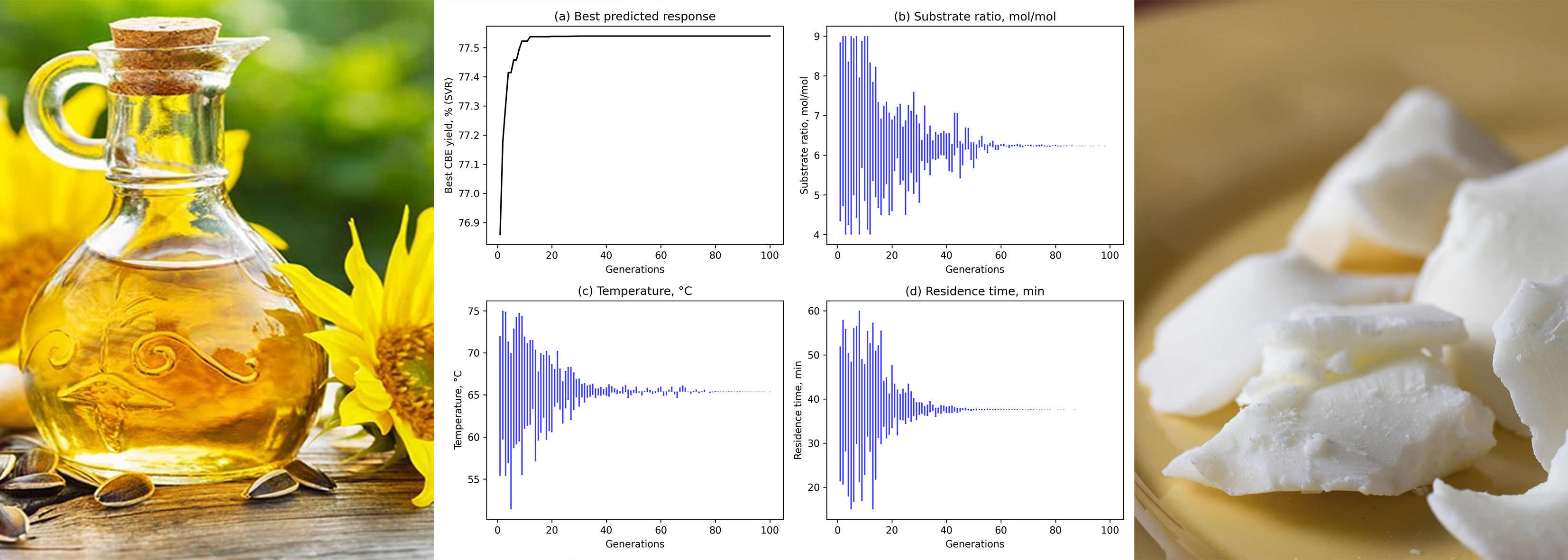
In this study, an approach to intelligent control of biocatalytic processes in food technologies was substantiated and validated using the optimization of enzymatic interesterification for the production of a cocoa butter equivalent in a continuous packed-bed reactor with immobilized lipase. High-oleic sunflower oil and a mixture of ethyl esters of palmitic and stearic acids were used as substrates. The controlled factors were the molar ratio of ethyl esters to oil (4–9 mol/mol), temperature (50–75 °C), and hydrodynamic residence time (15–60 min). The methodological framework was based on integrating artificial intelligence models with an evolutionary optimization method, namely particle swarm optimization. Experimental data were obtained using an orthogonal maximin Latin hypercube design and used to compare nine regression models via nested cross-validation. Support vector regression with a radial basis function kernel provided the highest accuracy and the lowest inter-fold variability. The selected model was used as the fitness function in particle swarm optimization, enabling determination of the optimal enzymatic interesterification conditions: substrate molar ratio of 6 mol/mol, temperature of 65 °C, and residence time of 38 min. A confirmatory experiment verified the adequacy of the model in the vicinity of the optimum: the cocoa butter equivalent yield was 77.0 ± 1.1 %, with a relative deviation of δ = 0.52 %. The results demonstrate the effectiveness of using artificial intelligence to identify optimal parameters of biocatalytic processes in food industry technologies.
References
Dantas, T.E.T., de-Souza, E.D., Destro, I.R., Hammes, G., Rodriguez, C.M.T., Soares, S.R. (2021). How the combination of circular economy and Industry 4.0 can contribute towards achieving the Sustainable Development Goals. Sustain. Prod. Consum., 26, 213–227. https://doi.org/10.1016/j.spc.2020.10.005
Raven, D.B., Chikkula, Y., Patel, K.M., Al Ghazal, A.H., Salloum, H.S., Bakhurji, A.S., Patwardhan, R.S. (2024). Machine learning and conventional approaches to process control and optimization: industrial applications and perspectives. Comput. Chem. Eng., 189, 108789. https://doi.org/10.1016/j.compchemeng.2024.108789
Castro-Amoedo, R., Granacher, J., Maréchal, F. (2024). A combined genetic algorithm and active learning approach to build and test surrogate models in process systems engineering. Comput. Chem. Eng., 181, 108517. https://doi.org/10.1016/j.compchemeng.2023.108517
Hassoun, A., Prieto, M.A., Carpena, M., Bouzembrak, Y., Marvin, H.J.P., Pallarés, N., Barba, F.J., Punia Bangar, S., Chaudhary, V., Ibrahim, S., Bono, G. (2022). Exploring the role of green and Industry 4.0 technologies in achieving sustainable development goals in food sectors. Food Res. Int., 162 (Pt B), 112068. https://doi.org/10.1016/j.foodres.2022.112068
Ghobakhloo, M., Iranmanesh, M., Tseng, M.L., Grybauskas, A., Stefanini, A., Amran, A. (2023). Behind the definition of Industry 5.0: a systematic review of technologies, principles, components, and values. J. Ind. Prod. Eng., 40(6), 432–447. https://doi.org/10.1080/21681015.2023.2216701
Abass, T., Itua, E.O., Bature, T., Eruaga, M.A. (2024). Innovative approaches to food quality control: AI and machine learning for predictive analysis. World Journal of Advanced Research and Reviews, 21 (3), 823–828. https://doi.org/10.30574/wjarr.2024.21.3.0719
Esmaeily, R., Razavi, M.A., Razavi, S.H. (2024). A step forward in food science, technology and industry using artificial intelligence. Trends Food Sci. Technol., 143, 104286. https://doi.org/10.1016/j.tifs.2023.104286
Harris, N., Gonzalez Viejo, C., Barnes, C., Fuentes, S. (2023). Non-invasive digital technologies to assess wine quality traits and provenance through the bottle. Fermentation, 9(1), 10. https://doi.org/10.3390/fermentation9010010
Zhou, Q., Zhang, H., Wang, S. (2022). Artificial intelligence, big data, and blockchain in food safety. Int. J. Food Eng., 18(1), 1–14. https://doi.org/10.1515/ijfe-2021-0299
Barthwal, R., Kathuria, D., Joshi, S., Kaler, R.S.S., Singh, N. (2024). New trends in the development and application of artificial intelligence in food processing. Innov. Food Sci. Emerg. Technol., 92, 103600. https://doi.org/10.1016/j.ifset.2024.103600
Bidyalakshmi, T., Jyoti, B., Mansuri, S.M., Srivastava, A., Mohapatra, D., Kalnar, Y.B., Narsaiah, K., Indore, N. (2025). Application of artificial intelligence in food processing: current status and future prospects. Food Eng. Rev., 17, 27–54. https://doi.org/10.1007/s12393-024-09386-2
Garti, N., Widlak, N.R. (2012). Cocoa butter and related compounds. USA: AOCS Press.
Norazlina, M.R., Hasmadi, M., Jahurul, M.H.A. (2024). Production of cocoa butter alternatives from blending bambangan kernel fat stearin and palm stearin for potential applications. J. Food Meas. Charact., 18, 6900–6911. https://doi.org/10.1007/s11694-024-02701-9
Ramos Ramos, M.R., García Londoño, V.A., Borroni, M.V., Candal, R.J., Herrera, M.L. (2023). Crystallization and polymorphic behaviors of cocoa butter alternatives: A review. J. Am. Oil Chem. Soc., 100(10), 759–773. https://doi.org/10.1002/aocs.12730
Ray, J., Bhattacharya, D. K., Dutta, S. (2022). Crystallization and polymorphism of cocoa butter equivalents from blends of palm mid fraction and hard stearins produced by enzymatic acidolysis of high oleic sunflower oil. Eur. J. Lipid Sci. Technol., 124(9), 2100228. https://doi.org/10.1002/ejlt.202100228
Mutia, T. A., Andarwulan, N., & Hariyadi, P. (2021). Characterization of cocoa butter equivalent from formulated hard palm oil mid-fraction and canola oil blend. IOP Conf. Ser. Earth and Environmental Science, 807(4), 042075. https://doi.org/10.1088/1755-1315/807/4/042075
Sonprasert, K., Kaewprapan, K., Duangmal, K., Danthine, S. (2022). Synthesis of confectionery fat from illipé butter stearin and palm mid‐fraction blend via enzymatic interesterification. Int. J. Food Sci. Technol., 57(6), 3648-3658. https://doi.org/10.1111/ijfs.15648
Remonatto, D., Miotti, R.H., Monti, R., Bassan, J.C., de Paula, A.V. (2022). Applications of immobilized lipases in enzymatic reactors: a review, Proc. Biochem. 114, 1–20, https://doi.org/10.1016/j.procbio.2022.01.004
Freitas, A.N., Remonatto, D., Miotti Junior, R.H., do Nascimento, J.F.C., da Silva Moura, A.C., de Ebinuma, V.C.S. (2024). Adsorption of extracellular lipase in a packed-bed reactor: an alternative immobilization approach, Bioprocess. Biosyst. Eng. 47 1735–1749, https://doi.org/10.1007/s00449-024-03066-5.
Cozentino, I.D.S.C., Rodrigues, M.D.F., Mazziero, V.T., Cerri, M.O., Cavallini, D.C.U., de Paula, A.V. (2022). Enzymatic synthesis of structured lipids from grape seed (Vitis vinifera L.) oil in associated packed bed reactors. Biotechnol. Appl. Biochem., 69(1), 101–109. https://doi.org/10.1002/bab.2085
Pacheco, B.J.S., Andrade, G.S.S., de Paula, A.V. (2024). Lipase from Rhizopus oryzae immobilized on corn cob powder: a new approach for dietetic triglyceride synthesis in a fixed bed reactor. Quim. Nova, 47(7), e-20240025. https://doi.org/10.21577/0100-4042.20240025
Mutia, R., Abang Zaidel, D.N., Muhamad, I.I. (2016). Optimization of cocoa butter equivalent production from formulated hard palm oil mid-fraction and canola oil blends. J. Teknol. (Sci. Eng.), 78(6-12), 127–134. https://doi.org/10.11113/jt.v78.9243
Nekrasov, P.O., Berezka, T.O., Nekrasov, O.P., Gudz, O.M., Molchenko, S.M. (2025). Improving the efficiency of vegetable oil extraction by biocatalytic treatment of oilseed raw materials. Journal of Chemistry and Technologies, 33(1), 146–152. https://doi.org/10.15421/jchemtech.v33i1.322422
Nekrasov, P.O., Berezka, T.O., Nekrasov, O.P., Gudz, O.M., Molchenko, S.M. (2024) Investigation of the basic laws of the kinetics of biocatalytic hydrolysis of vegetable oil. Journal of Chemistry and Technologies, 32(1), 191–197. https://doi.org/10.15421/jchemtech.v32i1.298927
Nekrasov, P.O., Berezka, T.O., Nekrasov, O.P., Gudz, O.M., Molchenko, S.M., Rudneva, S.I. (2023). Optimization of the parameters of biocatalytic hydrolysis of vegetable oil using the methods of neural networks and genetic algorithms. Journal of Chemistry and Technologies, (1), 140–146. https://doi.org/10.15421/jchemtech.v31i1.274704
Nekrasov, P.O., Berezka, T.O., Nekrasov, O.P., Gudz, O.M., Rudneva, S.I., Molchenko, S.M. (2022). Study of biocatalytic synthesis of phytosterol esters as formulation components of nutritional systems for health purposes. Journal of Chemistry and Technologies, 30(3), 404–409. https://doi.org/10.15421/jchemtech.v30i3.265174
Nekrasov, P.O., Tkachenko, N.A., Nekrasov, O.P., Gudz, O.M., Berezka, T.O., Molchenko, S.M. (2021). Oxidization resistance and sorption of oleogels as new-generation fat systems. Voprosy khimii i khimicheskoi technologii – Issues of Chemistry and Chemical Technology, (4), 89–95. https://doi.org/10.32434/0321-4095-2021-137-4-89-95
Nekrasov, P.O., Gudz, O.M., Nekrasov, O.P., Kishchenko, V.A., Holubets, O.V. (2019). [Fatty systems with reduced content of trans-fatty acids]. Voprosy khimii i khimicheskoi technologii – Issues of Chemistry and Chemical Technology, (3), 132–138 (in Ukrainian). https://doi.org/10.32434/0321-4095-2019-124-3-132-138
Senthil, H., Janve, M. (2025). AI technologies shaping the future of the cocoa industry from farm to fork: a comprehensive review. Food Sci. Biotechnol., 34(14), 3127–3151. https://doi.org/10.1007/s10068-025-01848-5
Guru Prasad, M.S., Naveen Kumar, H.N., Jain, A.K., Syed, J., Baig, R.U. (2025). Convergence of improved particle swarm optimization based ensemble model and explainable AI for the accurate detection of food adulteration in red chilli powder. J. Food Compos. Anal., 143, 107577. https://doi.org/10.1016/j.jfca.2025.107577
Yakoubi, S. (2025). Sustainable Revolution: AI-Driven enhancements for composite polymer processing and optimization in intelligent food packaging. Food Bioprocess Technol., 18(1), 82–107. https://doi.org/10.1007/s11947-024-03449-2
Kurtanjek, Ž. (2024). Causal artificial intelligence models of food quality data. Food Technol. Biotechnol., 62(1), 102–109. https://doi.org/10.17113/ftb.62.01.24.8301
Li, W., Yu, J., Ren, N., Huang, L., Dang, Y., Wu, Y., Li, G. (2025). Exploration of the prediction and generation patterns of heterocyclic aromatic amines in roast beef based on Genetic Algorithm combined with Support Vector Regression. Food Chem., 463 (Pt 1), 141059. https://doi.org/10.1016/j.foodchem.2024.141059
Wang, Q., Han, F., Wu, Z., Lan, T., Wu, W. (2020). Estimation of free fatty acids in stored paddy rice using multiple-kernel support vector regression. Appl. Sci. (Basel), 10(18), 6555. https://doi.org/10.3390/app10186555
Long, T., Tang, X., Liang, C., Wu, B., Huang, B., Lan, Y., Xu, H., Liu, S., Long, Y. (2024). Detecting bioactive compound contents in Dancong tea using VNIR-SWIR hyperspectral imaging and KRR model with a refined feature wavelength method. Food Chem., 460, 140579. https://doi.org/10.1016/j.foodchem.2024.140579
Wang, L., Niu, D., Zhao, X., Wang, X., Hao, M., Che, H. (2021). A comparative analysis of novel deep learning and ensemble learning models to predict the allergenicity of food proteins. Foods, 10(4), 809. https://doi.org/10.3390/foods10040809
Moneravilla, V.B., Rodrigo, D., Dharmaratne, G., Purasingha, S., Pushpakumara, A., Abeyasinghe, N., Jayaweera, H., Jayanetti, S., Gunewardene, S. (2026). Random Forest Regression assisted Raman spectroscopy for authenticating the purity of virgin coconut oil. J. Food Compos. Anal., 149, 108784. https://doi.org/10.1016/j.jfca.2025.108784
Lanjewar, M.G., Morajkar, P.P., Parab, J.S. (2023). Hybrid method for accurate starch estimation in adulterated turmeric using Vis-NIR spectroscopy. Food Addit. Contam. A, 40(9), 1131–1146. https://doi.org/10.1080/19440049.2023.2241557
Zheng, R., Jia, Y., Ullagaddi, C., Allen, C., Rausch, K., Singh, V., Schnable, J.C., Kamruzzaman, M. (2024). Optimizing feature selection with gradient boosting machines in PLS regression for predicting moisture and protein in multi-country corn kernels via NIR spectroscopy. Food Chem., 456, 140062. https://doi.org/10.1016/j.foodchem.2024.140062
Zhang, Y., Yu, H., Zhang, H., Tang, X. (2023). Bread staling prediction with a multiobjective particle swarm optimization-based bread constitutive modeling method. J. Texture Stud., 54(4), 498–509. https://doi.org/10.1111/jtxs.12775
Sarkar, T., Salauddin, M., Mukherjee, A., Shariati, M.A., Rebezov, M., Tretyak, L., Pateiro, M., Lorenzo, J.M. (2022). Application of bio-inspired optimization algorithms in food processing. Curr. Res. Food Sci., 5, 432–450. https://doi.org/10.1016/j.crfs.2022.02.006
Downloads
Published
Issue
Section
License
Copyright (c) 2026 Oles Honchar Dnipro National University

This work is licensed under a Creative Commons Attribution 4.0 International License.
- Authors reserve the right of attribution for the submitted manuscript, while transferring to the Journal the right to publish the article under the Creative Commons Attribution License. This license allows free distribution of the published work under the condition of proper attribution of the original authors and the initial publication source (i.e. the Journal)
- Authors have the right to enter into separate agreements for additional non-exclusive distribution of the work in the form it was published in the Journal (such as publishing the article on the institutional website or as a part of a monograph), provided the original publication in this Journal is properly referenced
- The Journal allows and encourages online publication of the manuscripts (such as on personal web pages), even when such a manuscript is still under editorial consideration, since it allows for a productive scientific discussion and better citation dynamics (see The Effect of Open Access).