EXPRESS DETERMINATION OF TOXIC MICROELEMENTS IN BRINE AND MINERAL WATERS 3 USING HIGH FREQUENCY ULTRASOUND DURING HOMOGENIZATION OF EXTRACTS
DOI:
https://doi.org/10.15421/jchemtech.v34i2.352304Keywords:
atomic absorption analysis, lead, copper, cadmium, ultrasound, extraction, homogenization intensification, butyl acetate, acetone, tap water, brines, metrological characteristicsAbstract
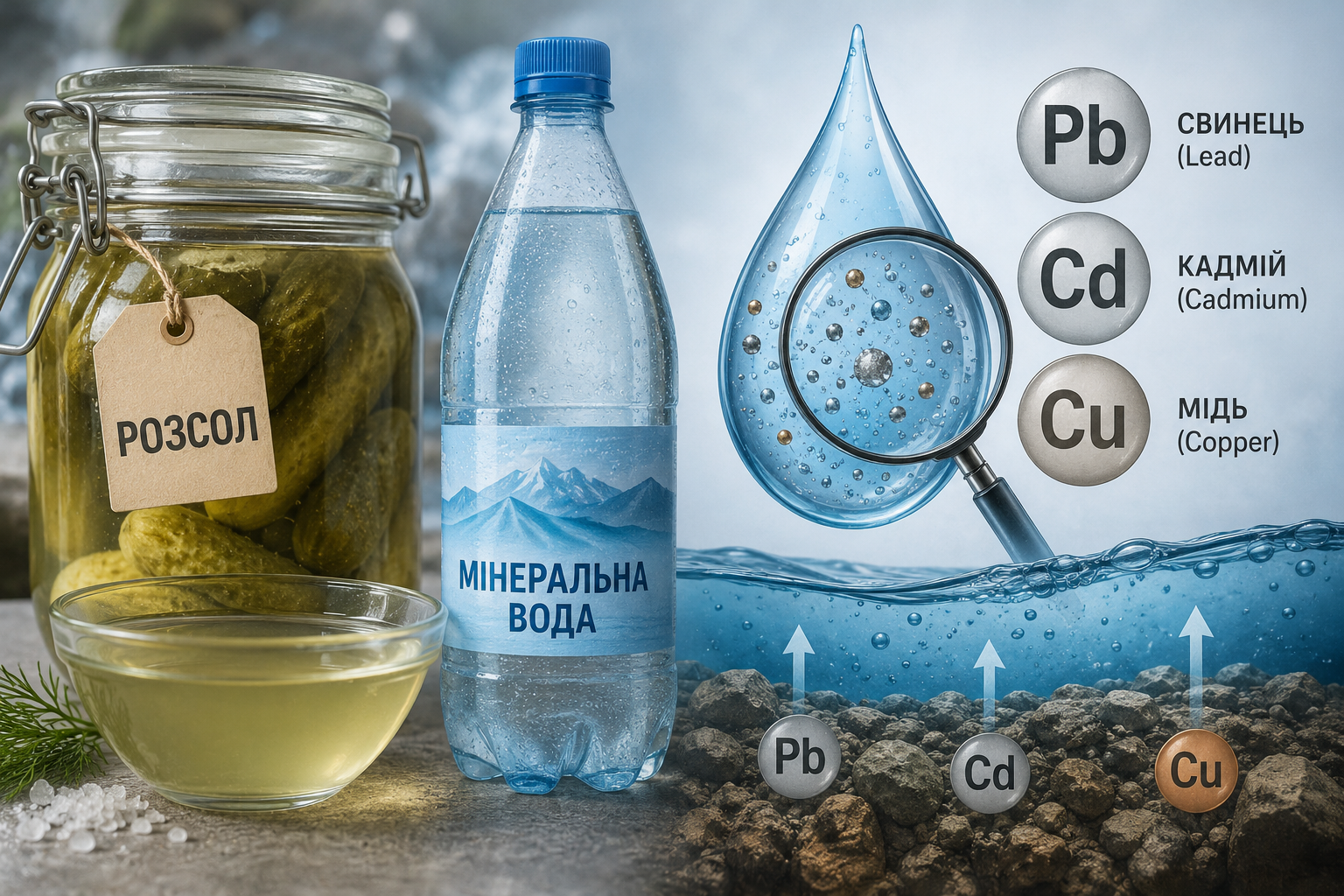
The possibility of using homogenization of chloroform extracts of diethyldithiocarbamates of lead, copper, and cadmium with a mixture of butyl acetate and acetone has been demonstrated. The optimal ratio of extract to homogenizing mixture was experimentally determined to be 1.0 : 1.0. In this case, the homogenizing mixture should consist of butyl acetate and acetone in a ratio of (1 : 0.2–1 : 0.5). The optimal parameters for ultrasound homogenization were defined as follows: frequency 12.0–14.0 MHz, intensity 3.0–4.0 W/cm2, and exposure time 3–4 minutes. A method for atomic absorption determination of lead, copper, and cadmium content in brines and waters was developed. The accuracy of the method was verified by analyzing the same samples using re-extraction (standard method) as well as the "added-found" method. The developed method provides the determination of lead in brines and waters with a Sr range from 0.076 to 0.084, copper with a Sr range from 0.072 to 0.078, and cadmium with a Sr range from 0.081 to 0.089. The method was successfully tested on tap water and brines. The use of ultrasonic homogenization of extracts combined with atomic absorption determination allows for rapid control of lead, copper, and cadmium content in waters and brines at levels equal to or below the maximum allowable maximum permissible concentration.
References
Sanz-Medel, A. (2014). Atomic Absorption Spectrometry: An Introduction. Momentum Press.
Atasoy, M. (2023). Development of a New Sensitive Method for Lead Determination by Platinum-Coated Tungsten-Coil Hydride Generation Atomic Absorption Spectrometry. ACS Omega, 8, 22866−22875. https://pubs.acs.org/doi/full/10.1021/acsomega.3c01856
Zounr, R. A., Tuzen, M., Deligonul, N., Khuhawar, M.Y. (2018). A Highly Selective and Sensitive Ultrasonic Assisted Dispersive Liquid Phase Microextraction Based on Deep Eutectic Solvent for Determination of Cadmium in Food and Water Samples Prior to Electrothermal Atomic Absorption Spectrometry. Food Chemistry, 253, 277–283. https://doi.org/10.1016/j.foodchem.2018.01.167
Şahin, A., Aridaşir, I. (2018). Method for Determination of Lead Ions in Aqueous Samples: Ultrasound-Assisted Dispersive Liquid–Liquid Microextraction Method Based on Solidification of Floating Organic Drop and Back-Extraction Followed by FAAS. Journal of Analytical Methods in Chemistry, 1–7. https://doi.org/10.1155/2018/8951028
Kirsten, W. I., Bertisson, A. (2021). Analytical Methods for Atomic Absorption Spectrometry. Perkin Elmer.
Krawczyk, M., Akbari, S., Jeszka-Skowron, M., Pajootan, E., Fard, F. S. (2016). Application of Dendrimer Modified Halloysite Nanotubes as a New Sorbent for Ultrasound-Assisted Dispersive Micro-Solid Phase Extraction and Sequential Determination of Cadmium and Lead in Water Samples. Journal of Analytical Atomic Spectrometry, 7, 1505–1514. https://doi.org/10.1039/C6JA00096G
Menghwar, P., Yilmaz, E., Sherazi, S.T.H., Soylak, M. A. (2018). Sensitive and Selective Deep Eutectic Solvent-Based Ultrasound-Assisted Liquid Phase Microextraction Procedure for Separation-Preconcentration and Determination of Copper in Olive Oil and Water Samples. Separation Science and Technology, 54, 2431–2439. https://doi.org/10.1080/01496395.2018.1547317
Uslu, H., Büyükpınar, Ç., Unutkan, T., Serbest, H., San, N., Turak, F., Bakırdere, S. (2018). A Novel Analytical Method for Sensitive Determination of Lead: Hydrogen-Assisted T-Shape Slotted Quartz Tube-Atom Trap-Flame Atomic Absorption Spectrometry. Microchemical Journal, 137, 155–159. https://doi.org/10.1016/j.microc.2017.10.015
Welz, B., Sperling, M. (2008). Atomic Absorption Spectrometry. Wiley-VCH.
Doner, G. (2005). Determination of Copper, Cadmium and Lead in Seawater and Mineral Water by Flame Atomic Absorption Spectrometry after Coprecipitation with Aluminum Hydroxide. Analytica Chimica Acta, 547(1), 14–17. https://doi.org/10.1016/j.aca.2005.02.073
Yurchenko, O., Baklanov, A., Chernozhuk, T. (2021). Chemical applications of ultrasound. On the use of ultrasound in the analyses and technology of brains and sodium chloride solutions. Lambert Academic Publishing.
Yurchenko, O. I., Chernozhuk, T. V., Pateleymonov, A. V., Baklanova, L. V., Baklanov, O. M. (2023). Analytical chemistry of table salt, brines and highly mineralized waters. Publishing House of V. N. Karazin Kharkiv National University.
Behbahani, M., Veisi, A., Omidi, F., Esrafili, A., Ebrahimi, M. H. (2017). Application of a Dispersive Micro-Solid-Phase Extraction Method for Pre-Concentration and Ultra-Trace Determination of Cadmium Ions in Water and Biological Samples: Ultrasonic Assisted Dispersive Micro-Solid Phase Extraction. Applied Organometallic Chemistry, 32, 1–10. https://doi.org/10.1002/aoc.4134
Sidorova, L. P., Baklanov, A. М., Vishnikin, A. B., Sydorova, M. G. (2025). Rapid spectrophotometric and visual test determination of arsenic in food and water. Journal of Chemistry and Technologies, 33(3), 633–640. https://doi.org/10.15421/jchemtech.v33i3.325631
Yurchenko, O.I., Chernozhuk, T. V., Kravchenko, O. A., Baklanov, A. N. (2024). [Atomic-absorption determination of cobalt in table salt and brines]. Journal of Chemistry and Technologies, 32(3), 538–543. (In Ukrainian). https://doi.org/10.15421/jchemtech.v32i3.292361
Yebra, M. C. (2012). A Green Analytical Method Using Ultrasound in Sample Preparation for the Flow Injection Determination of Iron, Manganese, and Zinc in Soluble Solid Samples by Flame Atomic Absorption Spectrometry. Journal of Analytical Methods in Chemistry, 2012, 298217. https://doi.org/10.1155/2012/298217
Ghaedi M., Shokrollahi A., Kianfar A.H., Pourfarokhi A., Khanjari N., Mirsadeghi A.S., Soylak M. (2009). Preconcentration and separation of trace amount of heavy metal ions on bis(2-hydroxy acetophenone)ethylendiimine loaded on activated carbon. Journal of Hazardous Materials, 162(2-3), 1408–1414. https://doi.org/10.1016/j.jhazmat.2008.06.057
Skok, A., Bazel, Y., Vishnikin, A. (2023). A new miniaturized microextraction HS-LPME-OIP procedure for ammonium determination based on Nessler's method. Chemical Papers, 77, 7303–7309. https://doi.org/10.1007/s11696-023-02903-3
Shirsath, S. R., Sonawane, S. H., Gavin, P. R. (2012). Intensification of extraction of natural products using ultrasonic irradiations—A review of current status. Chemical Engineering and Processing: Process Intensification, 53, 10–23. https://doi.org/10.1016/j.cep.2012.01.003
Neetu, S., Kumar, S., Patle, D. S. (2025). Intensification of extraction of bioactive compounds from pomegranate peel using an ultrasound-microwave assisted extraction approach: Parametric optimization, kinetics and thermodynamics. Separation and Purification Technology, 359(2), 130681. https://doi.org/10.1016/j.seppur.2024.130681
Yurchenko, O.I., Chernozhuk, T. V., Kravchenko, O. A., Baklanov, A. N. (2024). Atomic-absorption determination of chromium in table salt using matrix extraction separation and ultrasound action. Journal of Chemistry and Technologies, 32(1), 75–82. (In Ukrainian). https://doi.org/10.15421/jchemtech.v32i1.285484
Yurchenko, O. I., Gubskii, S. M., Chernozhuk, T. V., Baklanov, A. N., Kravchenko, O. A. (2020). Monitoring of content of sodium, potassium, calcium and magnesium in whey processed products. Journal of Chemistry and Technologies, 28(1), 27–33. https://doi.org/10.15421/082004
Sydorova, M., Baybuz, O., Verba, O., Pidhornyi, P. (2021). Information technology for trajectory data mining. Science and Innovation, 17(3), 78–86. https://doi.org/10.15407/scine17.03.078
Baybuz, O. G., Sidorova, M. G. (2014). Information technology of the multivariate time series fuzzy clustering on the example of the samara river hydrochemical monitoring. Naukovyi Visnyk Natsionalnoho Hirnychoho Universytetu, (5), 114–122.
Margulis, M. A. (2004). Mechanism of Sonochemical Reactions and Sonoluminescence. High Energy Chemistry, 38(5), 285–294. https://doi.org/10.1023/B:HIEC.0000041338.11770.74
Downloads
Published
Issue
Section
License
Copyright (c) 2026 Oles Honchar Dnipro National University

This work is licensed under a Creative Commons Attribution 4.0 International License.
- Authors reserve the right of attribution for the submitted manuscript, while transferring to the Journal the right to publish the article under the Creative Commons Attribution License. This license allows free distribution of the published work under the condition of proper attribution of the original authors and the initial publication source (i.e. the Journal)
- Authors have the right to enter into separate agreements for additional non-exclusive distribution of the work in the form it was published in the Journal (such as publishing the article on the institutional website or as a part of a monograph), provided the original publication in this Journal is properly referenced
- The Journal allows and encourages online publication of the manuscripts (such as on personal web pages), even when such a manuscript is still under editorial consideration, since it allows for a productive scientific discussion and better citation dynamics (see The Effect of Open Access).