HIGHLY ACTIVE SILICA FILLER OBTAINING PROCESS BY SULPHURIC ACID PRECIPITATION
DOI:
https://doi.org/10.15421/jchemtech.v34i2.352549Keywords:
silicon dioxide; precipitated silica; liquid glass; sulfuric acid; specific surface area; rubber compoundsAbstract
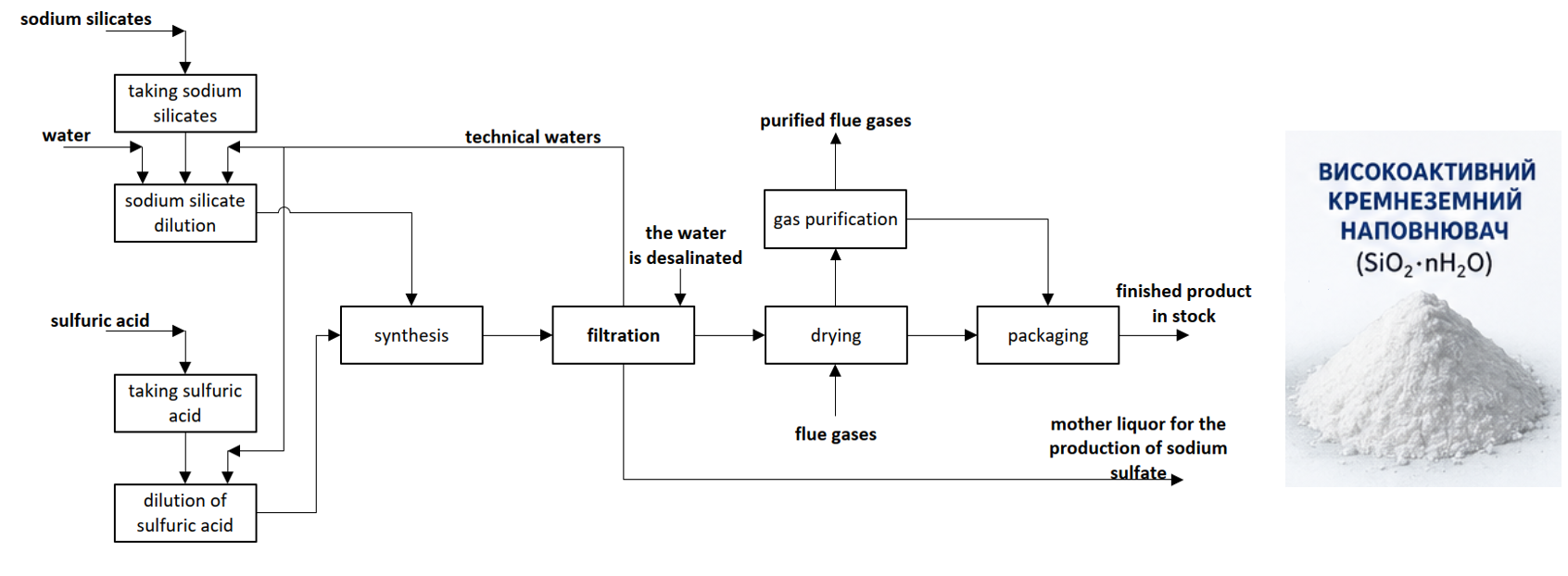
The article scientifically substantiates and practically implements an improved three-stage technology for the synthesis of highly active precipitated silicon dioxide (white carbon black), which serves as a domestic analogue to the international standard ULTRASIL® VN 3. The study investigates the influence of «mild» precipitation conditions, including temperature (90–92 °C), sodium silicate density (1.07–1.09 g/cm3), and controlled technological pauses, on the physicochemical properties of the product. It was established that a clear separation of the nucleation (pH 11.0) and structuring (pH 10.0) stages allows for precise control of the specific surface area within the range of 150–200 m2/g. Process scaling results on a bench-scale unit with a 400-liter reactor confirmed the stability of quality characteristics: SiO2 content ≥ 97 %, pH 6.2, and moisture content ≤ 6 %. Product testing at consumer enterprises confirmed its high reinforcing capacity in tire and rubber compounds.
References
EFSA Panel on Food Additives and Flavourings (FAF) (2024). Re-evaluation of silicon dioxide (E 551) as a food additive in foods for infants below 16 weeks of age and follow-up of its re-evaluation as a food additive for uses in foods for all population groups. EFSA Journal, 22(10), e8880. https://doi.org/10.2903/j.efsa.2024.8880.
Brzozowski, P., Strzałkowski, J., Rychtowski, P., Wróbel, R., Tryba, B., & Horszczaruk, E. (2021). Effect of nano-SiO2 on the microstructure and mechanical properties of concrete under high temperature conditions. Materials, 15(1), Article 166. https://doi.org/10.3390/ma15010166.
Yuqing Yan, Fang Qin (2024) Effects of nano-silica on mechanical properties of recycled concrete: a review, Functional Materials, 31(2), 215–224. http://dx.doi.org/10.15407/fm31.02.215.
Q. Tang, Z.M. Ma, H.X. Wu, W. Wang. (2020) The utilization of eco-friendly recycled powder from concrete and brick waste in new concrete: A critical review, Cement and Concrete Composites, 114, 103807. https://doi.org/10.1016/j.cemconcomp.2020.103807.
X. Jiang, G. Zhu, J. Ai, B. Zhang, and Y. Yan, (2025) Mechanical properties of nano-SiO2 modified ultra-high-performance concrete,” Vibroengineering Procedia, Vol. 58, pp. 229–234, https://doi.org/10.21595/vp.2025.24781.
Gao, D., Zhou, Z. (2022). Silicon-based optoelectronics: progress towards large scale optoelectronic integration and applications. Frontiers of Optoelectronics, 15(1), 2–3. https://doi.org/10.1007/s12200-022-00030-7.
Mahamoud, M. M., Kuwahara, Y., Ihara, H., Takafuji, M. (2025). Impact of Silica Nanoparticles on Mechanical Properties and Self-Healing Performance of PVA Hydrogels. Polymers, 17(21), 2883. https://doi.org/10.3390/polym17212883.
Zakani, B., Ansari, M. Grecov, D. (2018) Dynamic rheological properties of a fumed silica grease. Rheol Acta 57, 83–94. https://doi.org/10.1007/s00397-017-1064-6.
Zhuang, C. & Chen, Y. (2019). The effect of nano-SiO2 on concrete properties: a review. Nanotechnology Reviews, 8(1), 562-572. https://doi.org/10.1515/ntrev-2019-0050
Zou, M., Gao, W., Li, Z., Liu, B., Li, B., Liu, K., Liu, J. (2024). Hybrid Carbon Black/Silica Reinforcing System for High-Performance Green Tread Rubber. Polymers, 16(19), 2762. https://doi.org/10.3390/polym16192762.
Jung, U., & Choi, S.-S. (2023). Carbon black effect on the pyrolysis behavior of natural rubber in tire wear particles. Polymer Testing, 127, Article 108184. https://doi.org/10.1016/j.polymertesting.2023.108184.
Lutsyuk, I., Vakhula, Ya., Tupis, I., Iliuchok, I. (2021). Catalytic action of nitric acid on the hydrolysis of ETS-40 ethyl silicate. Chemistry & Chemical Technology, 15(4), 475–478. https://doi.org/10.23939/chcht15.04.475
Lutsyuk, I., Gavryshkevych, Ya., Vakhula, Ya. (2023). Peculiarities of phase formation in sol-gel powders of the СaО–ZrO2–Nb2O5–SiO2 system. Chemistry & Chemical Technology, 17(3), 495–502. https://doi.org/10.23939/chcht17.03.495
Vakhula, Ya. I., Lutsyuk, I. V. (2025). Structural and mechanical properties of composites for glass ionomer cements based on sol-gel powders. Voprosy Khimii i Khimicheskoi Tekhnologii – Issues of Chemistry and Chemical Technology, (3), 157–163. https://doi.org/10.32434/0321-4095-2025-160-3-157-163
He, T., Zhang, L., Wu, Q. (2024). Controlling the particle size and morphology of precipitated silica: A review of chemical and physical factors. Journal of Materials Science, 59(12), 4310–4335. https://doi.org/10.1007/s10853-024-09512-4.
Li, J., Wang, Y., Chen, X. (2021). Mechanism of silica aggregation during acid neutralization of sodium silicate solutions. Colloids and Surfaces A: Physicochemical and Engineering Aspects, 615, 126284. https://doi.org/10.1016/j.colsurfa.2021.126284.
Ryshchenko, I. M., Semchenko, H. D., Bilohur, I. S., Savenkov, A. S. (2014). Sposib oderzhannia biloi sazhi [Method of obtaining white soot] (Patent of Ukraine No. 92505). Derzhavna sluzhba intelektualnoi vlasnosti Ukrainy. (In Ukrainian).
Yongqing, W., Weidong, Q. (2013). Preparation method of high-dispersity silicon dioxide (Patent No. CN103468030A). China National Intellectual Property Administration.
Zhou, C., Wang, Y., Du, L., Yao, H. (2017). Preparation of highly dispersed SiO2 nanoparticles using continuous gas-based impinging streams. Chemical Engineering Journal, 327, 734–742. https://doi.org/10.1016/j.cej.2017.06.133.
Zhang, T., Wang, Y., Luo, G., & Bai, S. (2014). Preparation of highly dispersed precipitated nanosilica in a membrane dispersion microreactor. Chemical Engineering Journal, 258, 327–333. https://doi.org/10.1016/j.cej.2014.07.027.
Mujkanović, A., & Jovanović, M. (2021). Synthesis of precipitated silica from sodium silicate solution by carbonation method. Periodicals of Engineering and Natural Sciences, 9, 808–819. https://doi.org/10.21533/pen.v9.i2.785.
Sknar, Y. E., Hrydnieva, T. V., Sknar, I. V., Riabik, P. V., & Demchyshyna, O. V. (2022). Characteristics of silicon dioxide produced from rice husk. Journal of Chemistry and Technologies, 30(1), 103–109. https://doi.org/10.15421/jchemtech.v30i1.251588.
Degussa, A.G. (1988). Verfahren zur Herstellung von Fällungskieselsäuren mit verbesserter Struktur [Process for the preparation of precipitated silicas with improved structure] (German Patent No. DE2051653C3). German Patent and Trade Mark Office. (In German).
Degussa, A.G. (1992). Verfahren zur Herstellung von Fällungskieselsäuren [Process for the preparation of precipitated silicas] (German Patent No. DE1767332C3). German Patent and Trade Mark Office. (In German).
Evonik Operations GmbH. Product information: ULTRASIL® VN 3. Precipitated silica as a reinforcing filler for rubber. https://products.evonik.com/assets/75/48/ULTRASIL_VN_3_EN_EN_137548.pdf
ISO 9277:2010. Determination of the specific surface area of solids by gas adsorption - BET method.
ISO 787-2:1981. General methods of test for pigments and extenders - Part 2: Determination of matter volatile at 105 °C.
ISO 787-9:1981. General methods of test for pigments and extenders - Part 9: Determination of pH value of an aqueous suspension.
ISO 3262-19:2021. Extenders for paints - Specifications and methods of test - Part 19: Precipitated silica.
ISO 5794-1:2022 Rubber compounding ingredients - Silica, precipitated, hydrated - Part 1: Non-rubber tests.
ISO 19242:2015 Rubber compounding ingredients - Silica, precipitated, hydrated - Determination of compressed sample oil absorption number (COAN).
Schumacher, K., Kerner, D., Schilling, R., Flesch, J., Schiener, T. (2009). U.S. Patent No. 7, 491, 375 B2. Washington, DC: U.S. Patent and Trademark Office.
AEROSIL 200 (AÉROSYL 200). Evonik Industries AG. [Hydrophilic pyrogenic silicon dioxide. Evonik Industries AG]. (In Ukrainian) http://www.evonik.com/en/products/ca/pr_52043839.html
Downloads
Published
Issue
Section
License
Copyright (c) 2026 Oles Honchar Dnipro National University

This work is licensed under a Creative Commons Attribution 4.0 International License.
- Authors reserve the right of attribution for the submitted manuscript, while transferring to the Journal the right to publish the article under the Creative Commons Attribution License. This license allows free distribution of the published work under the condition of proper attribution of the original authors and the initial publication source (i.e. the Journal)
- Authors have the right to enter into separate agreements for additional non-exclusive distribution of the work in the form it was published in the Journal (such as publishing the article on the institutional website or as a part of a monograph), provided the original publication in this Journal is properly referenced
- The Journal allows and encourages online publication of the manuscripts (such as on personal web pages), even when such a manuscript is still under editorial consideration, since it allows for a productive scientific discussion and better citation dynamics (see The Effect of Open Access).