FORMATION AND EVALUATION OF THE QUALITY OF UNFASTENED WINE MATERIALS AND WINES FROM BLACKBERRIES
DOI:
https://doi.org/10.15421/jchemtech.v34i2.352746Keywords:
blackberry, must, unfortified wine materials, blackberry wines, quality, phenolic substances, ascorbic acidAbstract
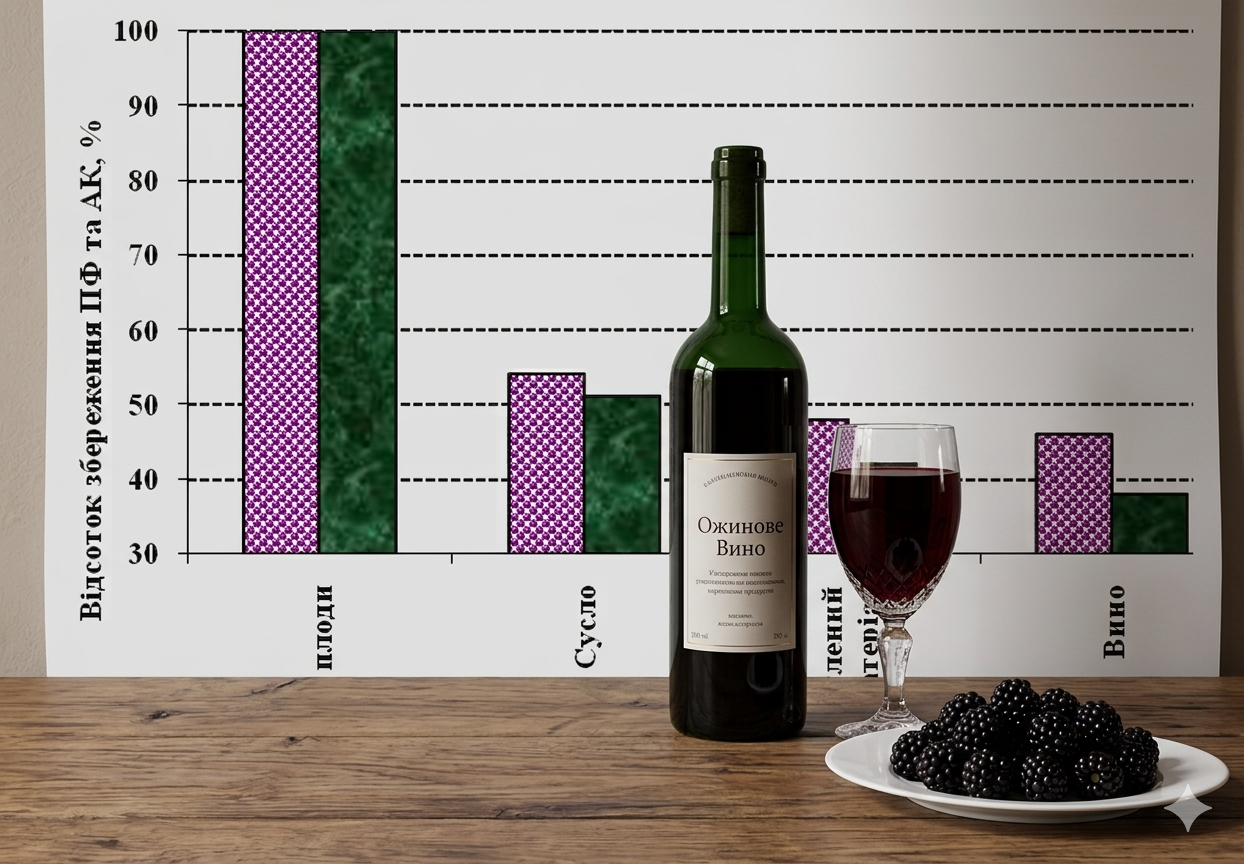
Blackberry is one of the promising berry crops in Ukraine, suitable for both fresh consumption and industrial processing. Blackberry fruits of the Thornfree variety, grown in the conditions of the Central Forest-Steppe of Ukraine, are capable of forming a complex of natural biologically valuable nutrients, which are largely preserved in processed products. The purpose of this work was to experimentally confirm the possibility of preparing high-quality and biologically valuable unfortified wines from blackberries. The juice yield in laboratory conditions with heat treatment of berries was 69.6 dal/ton. Blackberry wort was prepared by adding the calculated amount of drinking water and sugar. The initial sugar content in the wort was 258 g/dm3, titrated acidity 7.0 g/dm3. The wort was pasteurized at a temperature of 85 °C for 5 min, after cooling, regenerated ASD (active dry yeast) of the EC-1118 race of the Saccharomyces bayanus genus was added to the wort. The duration of wort fermentation was 42–58 days. The obtained unfortified blackberry wine materials had the following physicochemical indicators: volume fraction of ethyl alcohol 14.9 %, mass concentration of titrated acids – 6.7–7.0 g/dm3, volatile acids – 0.4–0.6, residual extract – 21.9–28.1 g/dm3, phenolic substances – 1850–2150 mg/dm3, ascorbic acid – 143–180 mg/dm3. Such unfortified wine materials are suitable for the preparation of unfortified strong wines with the addition of sugar, fructose or natural honey.. The organoleptic assessment of wines with the addition of white sugar is 8.5 points, with fructose – 8.8, and with natural honey – 9.1 points. In the process of making unfortified blackberry wines, the content of phenolic substances and ascorbic acid decreases due to dilution with water and sugar and losses during fermentation. The finished wines retain up to 46 % of phenolic substances and 38% of ascorbic acid in relation to their content in fresh fruits.
References
Yoo, Y., Saliba, A.J., Prenzler, P.D. (2010). Should red wine be considered a functional food? Comp. Rev. Food Sci. Food Saf., 9, 530–551. doi: 10.1111/j.1541-4337.2010.00125.x
Kovalchuk, S., Mezhenskyj, V. (2025). Biochemical composition and nutritional value of rowan-chockeberry hybrids (×Sorbaronia fallax (C.K. Schneid.) C.K. Schneid.) developed in Ukraine. Plant and Soil Science, 16(4), 34–46. doi: 10.31548/plant4.2025.34.
Petrenko, O.D., Gulich, M.P. (2024). Retrospective analysis of the consumption of the main groups of food products by the population of Ukraine. Environment & Health. 2, 48–53. https://doi.org/10.32402/dovkil2024.02.048
Havryliuk, O., Kondratenko, T., Mazur, B. (2022). Commodity quality of apple fruits of columnar type. Scientific reports of NULES of Ukraine, 2 (96). http://dx.doi.org/10.31548/dopovidi2022.02.002 (in Ukrainian)
Myhrvold, N., Young, C, Bilet, M. (2011). Modernist Cuisine: The Art and Science of Cooking, Cooking Lab.: Port Washington, NY, USA.
De Beer, D., Beelders, T., Human, C., Joubert, E. (2022). Assessment of the stability of compounds belonging to neglected phenolic classes and flavonoid sub classes using reaction kinetic modeling. Crit. Rev. Food Sci. Nutr., 63, 11802–11829. doi:10.1080/10408398.2022.2096561
Frolova, N., Uktainets, A., Korablova, O., Voitsekhivskyi, V. (2019). Plants of Nepeta cataria var. Citriodora Beck. And essential oils from them for food industry. Potravinarstvo Slovak J. of Food Sciences, 13(1), 449–455. doi 10.5219/1109
Lytovchenko, O. (2018). [Directions for the development of the fruit processing industry and prospects for increasing the profitability of horticulture]. ISSC “Horticulture”, 73, 181–192. (in Ukrainian)
Verkhovna Rada of Ukraine. (2018). [Amendments №2360-VIII on the development of the production of terroir wines and honey drinks to the Law of Ukraine “On State Regulation of the Production and Circulation of Ethyl, Cognac and Fruit Alcohol, Alcoholic Beverages and Tobacco Products” №46, art. 345, from 1995]. Vedomosti Verkhovna Rada, 1(7), 151. (in Ukrainian)
Pruteanu, A., Alexandru, G., Vanghele, N., Vlăduț, V. (2025). Evaluation of Growth and Production Parameters of Raspberries and Blackberries Cultivated in Romania. Horticulturae, 11(4), 369, https://doi.org/10.3390/horticulturae11040369
Andrusyk, H., Andrusyk, Y., Voitsekhivskyi, V. (2025). Phenology of red and white currants in the climate of Kyiv, Ukraine. Acta Horticulturae. Conference Paper. doi: 10.17660/ActaHortic.2025.1444.19
Yareshchenko, O. (2016). The most generous berry is blackberry. Trellis - know-how. Sun Garden, 2(18), 14–15. (in Ukrainian)
Telepenko, Yu. (2019). [Adaptive potential and productivity of blackberries under the conditions of the right-bank part of the western Forest-Steppe of Ukraine]. (Unpublished doctoral dissertation). (in Ukrainian)
Mariod, A., Salama, S., Elrasheid, T.H., Abd Elgadir M. (2024). Effect of processing techniques on vitamin C of processed fruit and vegetable products. Intech Open. doi: 10.5772/intechopen.1007665
Toffalini, A., Vigolo, N., Rolli, N. (2025). Association of low vitamin C concentrations and low consumption of fresh fruit and vegetables with cardiovascular disease in type 2 diabetes. BMC Nutr., 11(68). https://doi.org/10.1186/s40795-025-01049-7
Zoriţa, D., Florica, R., Rugină, D., Lucian, C., Socaciu, C. (2014). HPLC/PDA–ESI/MS Identification of Phenolic Acids, Flavonol Glycosides and Antioxidant Potential in Blueberry, Blackberry, Raspberries and Cranberries. J. Food Nutr. Res., 2, 781–785. doi: 10.12691/jfnr-2-11-4
Martins, M.S., Gonçalves, A.C., Alves, G., Silva, L.R. (2023). Blackberries and Mulberries: Berries with Significant Health-Promoting Properties. Int. J. Mol. Sci., 24(15), 12024. https://doi.org/10.3390/ijms241512024
Skrovankova, S., Sumczynski, D., Mlcek, J., Jurikova, T., Sochor, J. (2015). Bioactive compounds and antioxidant activity in different types of berries. Int. J. Mol. Sci.,16:24673–24706. doi: 10.3390/ijms161024673
Moskalets, T. Z., Frantsishko, V.S., Knyazyuk, O.V., Pelekhatyi, V.M., Pelekhata, N.P., Moskalets, V.V., Vovkohon, A.H., Sliusarenko, S.V., Morgun, B.V., Gunko, S.M., Podpriatov, H.I., Voitsekhivskyi, V.I., Voitsekhivska, O.V. (2019). Morphological variability, biochemical parameters of Hippophae rhamnoides L. berries and implications for their targeted use in the food-processing industry. Ukrainian J. of Ecology, 9(4), 749–764. doi:10.15421/2019_822
Mikulic-Petkovsek, M., Veberic, R., Hudina, M., Zorenc, Z., Koron, D., Senica, M. (2021). Fruit quality characteristics and biochemical composition of fully ripe blackberries harvested at different times. Foods, 10, 1581. https://doi.org/10.3390/foods10071581
Wenzhong Hu, Sarengaowa, Yuge Guan, Ke Feng. (2022). Biosynthesis of phenolic compounds and antioxidant activity in fresh-cut fruits and vegetables. Front. Microbiol., 13, 906069. doi: 10.3389/fmicb.2022.906069
Kapreliants, L.V., Petrosiants, A.P. (2011). [Therapeutic and prophylactic properties of food products and the basics of dietetics]. Odesa: Druk, 269. (in Ukrainian).
Zakharchuk, V.H., Kundilovska, T.A., Haidukovych, H.Ie. (2016). [Technology of restaurant industry products]. Odesa: ONEU, Atlant VOI SOIU. 479 p. (in Ukrainian).
Trifunschi, S., Zugravu, C. A., Munteanu, M. F., Borcan, F., Pogurschi, N. E., (2022). Determination of the ascorbic acid content and the antioxidant activity of different varieties of vegetables Consumed in Romania, from Farmers and Supermarkets. Sustainability, 14(21), 13749. https://doi.org/10.3390/su142113749
Rozhnov, E.D., Shkolnikova, M.N., Kazarskikh, A.O., Chernova, E. V., Voitsekhivskyi, V.I., Nurymkhan, G.N. (2020). Formation of rheological characteristics of vegetable and fruit smoothies to ensure their quality. IOP Conference Series: Earth and Environmental Science, 613(1), 012125. doi 10.1088/1755-1315/613/1/012125
Karpenko, V., Slobodyanyk, G., Ulianych, O., Schetyna, S., Voitsekhovskyi, V. (2020). Combined application of microbial preparation, mineral fertilizer and bioadhesive in production of leek. Agronomy Research, 18(1), 148–162. doi.org/10.15159/AR.20.014
Syrokhman, I.V., Zavgorodnya V.M. (2022). [Commodity science of functional food products: textbook], Center for Educational Literature. (in Ukrainian).
Lytovchenko, O.M., Tokar, A.Yu. (2025). [Industrial and farm winemaking (craft technologies): teaching-practical manual]. Uman: "Sochinsky M.M.". (in Ukrainian).
Shevchuk, L., Hrynyk, R. (2025). The influence of genetic traits of the variety on the preservation of bioactive compounds in blue honeysuckle (Lonícera caeruléa L.) fruits during sublimation and drying. Plant and Soil Science, 16(2), 37–47. https://doi.org/10.31548/plant2.2025.37
Heinonen, I.M., Lehtonen, P.J., Hopia, A.I. (1998). Antioxidant Activity of Berry and Fruit Wines and Liquors. J. Agric. Food Chem., 46, 25–31. https://doi.org/10.1021/JF970489O
Bilko, M., Gunko, S., Babych, I., Naumenko, O., Mukoid, R., Ischenko, M., Doboniy, I., Danylenko, S., Bovkun, A., Stotska, O. (2022). Investigation of the appearance and elimination of pinking coloration in white wines. Eastern-European Journal of Enterprise Technologies, 1(11(115), 56–62. https://doi.org/10.15587/1729-4061.2022.252472
Seо, S.H., Yoo, S.A., Park, S.E., Son, H.S. (2014). Effectiveness of Yeast Nutrients on Stuck Fermentation of Blueberry Wine. Korean J. of Food Science and Technology, 46(2)? 143–147. doi:10.9721/KJFST.2014.46.2.143
Hjelmeland, A.K., Ebeler, S.E. (2015). Glycosidically bound volatile aroma compounds in grapes and wine: A review. American J. of Enology and Viticulture, 66(1), 1-11. DOI: 10.5344/ajev.2014.14104
Manzanares, P. (2016). Past and future of non-Saccharomyces yeasts: From spoilage microorganisms to biotechnological tools for improving wine aroma complexity. Frontiers in Microbiology, 7. DOI: 10.3389/fmicb.2016.00411
Tokar, A. Yu., Machushenko, O. G., Ruda, N. S., Voitsekhivskyi, V. I. (2011). [Formation of quality, price and competitiveness of strawberry wines]. Scientific report of NUBiP of Ukraine, 7(23). (in Ukrainian).
Rozhnov, E., Shkolnikova, M., Maksimiuk, N., Voitsekhivskyi, V., Tikhomirov, E., Bobkova, E. (2020). Optical properties of sea buckthorn drinks as the main physical characteristic of their quality. IOP Conference Series: Earth and Environmental Science, 613(1), 012126. doi 10.1088/1755-1315/613/1/012126
Zeng, Q., Ha, S., Chen, M., Zhang, C., Yang, H.. (2025). Common organic acids in fruit wine and the deacidification strategies. Systems Microbiology and Biomanufacturing, 5(2), 489–499. DOI: 10.1007/s43393-025-00333-8
Tokar A., Haidai I., Yushyna O., Bilko M., Zahorko N., Voitsekhivskyi V. (2023). The formation of natural fruit and berry wine from jostaberries. Acta Sci. Pol. Technol. Aliment., 22(4), 375-384. http://dx.doi.org/10.17306/J.AFS.2023.1161
Rozhnov E., Kazarskikh A., Shkolnikova M., Tretyak, L., Voitsekhivskyi, V. I., Maksimiuk, N., Khayrullin, M., Rebezov, M., Yessimbekov, Zh. (2019). Investigation of the conditions for the formation of 5-hydroxymethylfurfurol in the production of honey wines and sea-buckthorn wine drinks. Research J. of Pharmacy and Technology, 12(7), 3501-3506. doi:10.5958/0974-360X.2019.00595.X
Landrault, N., Poucheret, P., Ravel, P., Gasc, F., Cros, G., Teissedre, P.-L. (2001). Antioxidant capacities and phenolics levels of French wines from different varieties and vintages. J. agr. Food Chem., 49(7). 3341–3348. doi: 10.1021/jf010128f
Tokar, A., Haidai, I., Voitsekhivskyi, V. I., Lytovchenko, O. M., Karychkovskyi, V. D. (2024). Evaluation of the quality of fruit and berry red wines. Collection of scientific works of the Uman National University of Horticulture, 2(1), 297–309. (in Ukrainian). doi: 10.32782/2415-8240-2024-104-1-297-309.
Lytovchenko, O.M., Tokar, A.Yu. (2025). [Industrial and farm winemaking (craft technologies): teaching-practical manual]. Uman: "Sochinsky M.M.". (in Ukrainian).
Lytovchenko O.M. (2010). [Health Drinks by Lytovchenko O.M.], Uman: Uman Municipal Publishing and Printing Enterprise. (in Ukrainian).
Cosme, F., Pinto, T., Anjos, A., Aires, A., Ferreira-Cardoso, J., Morais, M.C., Bacelar, E., Oliveira, I., Vilela, A., Gonçalves, B. (2022). Red fruits composition and their health benefits-A review. Foods, 11(5), 644. doi: 10.3390/foods11050644
Koroliuk, T. A., Usatiuk, S. I., Kostinova, T. A., Filipchenko, I. M. (2017). [Methods of food control: a manual]. Kyiv: NUFT. (in Ukrainian).
(2009). [Methods of technochemical control in winemaking]. Eds. V. H. Herzhykova. Simferopol: Tavrida. (in Ukrainian).
Kuldeep, K., Ajay, S., Sanjeev, P., Rohit, M. (2025). A Practical Manual on Fundamentals of Agronomy. BHUMI PUBLISHING Nigave Khalasa.
France, J., Thornley, J.H.M. (2007). Mathematical Models in Agriculture: Quantitative Methods for the Plant, Animal and Ecological Sciences. CABI, 906. doi:10.1017/S0014479707005893
Downloads
Published
Issue
Section
License
Copyright (c) 2026 Oles Honchar Dnipro National University

This work is licensed under a Creative Commons Attribution 4.0 International License.
- Authors reserve the right of attribution for the submitted manuscript, while transferring to the Journal the right to publish the article under the Creative Commons Attribution License. This license allows free distribution of the published work under the condition of proper attribution of the original authors and the initial publication source (i.e. the Journal)
- Authors have the right to enter into separate agreements for additional non-exclusive distribution of the work in the form it was published in the Journal (such as publishing the article on the institutional website or as a part of a monograph), provided the original publication in this Journal is properly referenced
- The Journal allows and encourages online publication of the manuscripts (such as on personal web pages), even when such a manuscript is still under editorial consideration, since it allows for a productive scientific discussion and better citation dynamics (see The Effect of Open Access).