IMPROVING THE QUALITY OF FINISHING CREAMS BASED ON LOW-FAT CREAM BY OPTIMIZING STRUCTURAL AND MECHANICAL PROPERTIES
DOI:
https://doi.org/10.15421/jchemtech.v34i2.353044Keywords:
butter cream, low-fat cream, hydrocolloids, sodium caseinate, rheology, syneresis, dimensional stability, whipping, food emulsions, food foamsAbstract
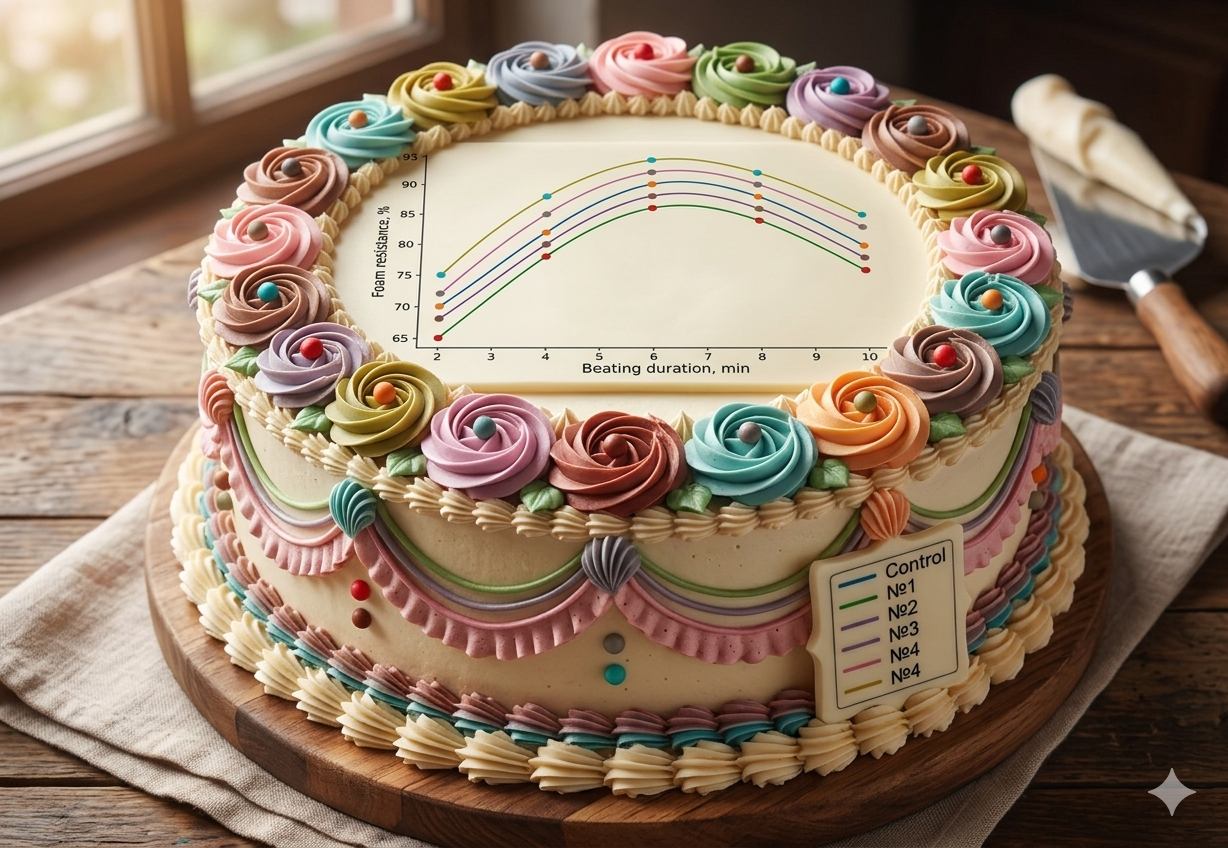
Reducing the mass fraction of fat in creamy finishing creams is a relevant direction for the development of healthier confectionery products. However, it is accompanied by a deterioration in rheological characteristics, a decrease in dimensional stability and an increase in syneresis. The aim of the work was to improve the quality of finishing creams based on low-fat cream by optimizing structural and mechanical properties through improving the recipe and mechanical processing modes. The effect of hydrocolloids, namely gelatin, xanthan gum, guar gum and high-methoxyl pectin, as well as milk protein ingredients, including sodium caseinate and skimmed milk powder, on viscosity, dimensional stability, syneresis and the stability of the emulsion-foam structure of the cream was studied. It was shown that reducing fat from 30 % to 12 % without stabilization leads to a significant decrease in viscosity and an increase in the tendency to whey separation. The best technological effect is provided by the combined system "gelatin + guar gum + sodium caseinate", which brings the structural parameters closer to the control sample and reduces syneresis to 1.3 % after 72 h of storage at (4±2)°C. The optimal whipping mode is set to 6 min at 1200–1400 rpm, which provides a balance between overrun and foam stability. The results can be used in confectionery production to create low-calorie creams without losing the organoleptic profile of the product.
References
Xie, P., Ji, G., Jin, J., Xu, H., Zhang, L., Gao, Z., Fan, Q., Chen, Y., Jin, Q., Wang, X. (2023). Partial coalescence and whipping capabilities of dairy aerated emulsions as affected by inclusion of monoglycerides with different fatty acid species. International Journal of Dairy Technology, 76(1), 81–92. https://doi.org/10.1111/1471-0307.12921.
Dabo, K. F., Chèné, C., Fameau, A.-L., Karoui, R. (2024). Whipping Creams: Advances in Molecular Composition and Nutritional Chemistry. Molecules, 29(24), 5933. https://doi.org/10.3390/molecules29245933.
Chen, W., Deng, Z., Shen, Q., Ye, S., Li, J., Li, B., Liang, H. (2025). Formation mechanism of whipped cream without low-molecular-weight emulsifiers: Fat partial coalescence dynamics and interfacial protein profiling. Food Hydrocolloids, 112135. https://doi.org/10.1016/j.foodhyd.2025.112135.
Murray, B. S. (2020). Recent developments in food foams. Current Opinion in Colloid & Interface Science, 50, 101394. https://doi.org/10.1016/j.cocis.2020.101394.
Gao, Z., Xu, H., Fan, Q., Xie, P., Jin, Q., Wang, X., Jin, J. (2024). Effects of fat unsaturation degree on whipping performance and foam stability of fat‐reduced aerated emulsions. International Journal of Food Science & Technology. 59(5), 3114–3125. https://doi.org/10.1111/ijfs.17054.
Gafour, W., Aly, E. (2020). Organoleptic, textural and whipping properties of whipped cream with different stabilizer blends [pdf]. Acta Scientiarum Polonorum Technologia Alimentaria, 19(4), 425–433. https://doi.org/10.17306/j.afs.2020.0784.
Chai, X., Su, Y., Liu, Y. (2025). Tailoring whipped cream properties through fat composition design: Crystallization behavior and emulsion stability. Food Chemistry, 146035. https://doi.org/10.1016/j.foodchem.2025.146035.
Rezvani, F., Abbasi, H., Nourani, M. (2020). Effects of protein–polysaccharide interactions on the physical and textural characteristics of low‐fat whipped cream. Journal of Food Processing and Preservation, 44(10). https://doi.org/10.1111/jfpp.14743.
Athari, B., Nasirpour, A., Saeidy, S., & Esehaghbeygi, A. (2021). Physicochemical properties of whipped cream stabilized with electrohydrodynamic modified cellulose. Journal of Food Processing and Preservation, 45(9). https://doi.org/10.1111/jfpp.15688.
WO2019122135A1. Whipped cream and manufacturing method. Brookfield viscosity method and repeats. https://patents.google.com/patent/WO2019122135A1/en.
Zhao, Y., Khalesi, H., He, J., Fang, Y. (2023). Application of different hydrocolloids as fat replacer in low-fat dairy products: Ice cream, yogurt and cheese. Food Hydrocolloids, 138, 108493. https://doi.org/10.1016/j.foodhyd.2023.108493.
Zhang, S., Ren, C., Wang, C., Han, R., Xie, S. (2024). Effects of hydrocolloids and oleogel on techno-functional properties of dairy foods. Food Chemistry: X, 21, 101215. https://doi.org/10.1016/j.fochx.2024.101215.
Alam, M., Kaur, S., Dar, B. N., Nanda, V. (2025). Classification, techno‐functional properties, and applications of diverse hydrocolloids in fruits‐based products: A concise review. Journal of Food Science, 90(3). https://doi.org/10.1111/1750-3841.70119.
Gao, Y., Liu, R., Liang, H. (2024). Food Hydrocolloids: Structure, Properties, and Applications. Foods (Basel, Switzerland), 13(7), 1077. https://doi.org/10.3390/foods13071077.
Briceño-Ahumada, Z., Mikhailovskaya, A., Staton, J. A. (2022). The role of continuous phase rheology on the stabilization of edible foams: A review. Physics of Fluids, 34(3), 031302. https://doi.org/10.1063/5.0078851.
Liu, Y., Liang, Q., Liu, Y., Rashid, A., Qayum, A., Tuly, J. A., Ma, H., Miao, S., Ren, X. (2024). Sodium caseinate/pectin complex-stabilized emulsion: multi-frequency ultrasound regulation, characterization and its application in quercetin delivery. Food Hydrocolloids, 110316. https://doi.org/10.1016/j.foodhyd.2024.110316.
Rudakova, T., Minorova, A., Moiseeva, L., Krushelnytska, N., Narizhnyy, S. (2023). [Scientific approaches to the creation of technology structured milk desserts with a combined composition of raw materials]. Tehnologìâ virobnictva ì pererobki produktìv tvarinnictva, (2 (182)), 128–136. (In Ukrainian). https://doi.org/10.33245/2310-9289-2023-182-2-128-136.
Telezhenko, L. M., Dzyuba, N. A., Oliinyk, M. I., Sheludko, V. M. (2024). Research of factors influenced on foam formation of protein hydrocolloids. Journal of Chemistry and Technologies, 32(1), 223–232. https://doi.org/10.15421/jchemtech.v32i1.288023.
McClements, D.J. (2015). Food Emulsions: Principles, Practices, and Techniques, Third Edition (3rd ed.). CRC Press. https://doi.org/10.1201/b18868.
Dickinson E. (2013). Stabilising emulsion-based colloidal structures with mixed food ingredients. Journal of the science of food and agriculture, 93(4), 710–721. https://doi.org/10.1002/jsfa.6013.
Mykhalevych, A., Polishchuk, G., Bandura, U., Osmak, T., Bass, O. (2024). Determining the influence of plant-based proteins on the characteristics of dairy ice cream. Eastern-European Journal of Enterprise Technologies, 4(11(130)), 6–15. https://doi.org/10.15587/1729-4061.2024.308635.
Nooshkam, M., Varidi, M., Zareie, Z., Alkobeisi, F. (2023). Behavior of protein-polysaccharide conjugate-stabilized food emulsions under various destabilization conditions. Food Chemistry: X, 100725. https://doi.org/10.1016/j.fochx.2023.100725
Pu, X., Yu, S., Cui, Y., Tong, Z., Wang, C., Wang, L., Han, J., Zhu, H., Wang, S. (2024). Stability of electrostatically stabilized emulsions and its encapsulation of astaxanthin against environmental stresses: effect of sodium caseinate-sugar beet pectin addition order. Current Research in Food Science, 100821. https://doi.org/10.1016/j.crfs.2024.100821.
ISO/IDF. (2022). Dried milk and dried milk products — Determination of moisture content (Reference method) (ISO 5537:2004, IDF 26:2004, identically adopted as DСТU EN ISO 5537:2022). Kyiv, Ukraine: UkrNDNC. (In Ukrainian).
State Enterprise “Ukrainian Research and Training Center for Standardization, Certification and Quality”. (2010). Milk and milk products — Determination of titratable acidity (DSTU ISO 6091:2010, identical to ISO 6091:2010 | IDF 86:2010). Kyiv, Ukraine: UkrNDNC. (In Ukrainian).
Yin, M., Yang, D., Lai, S., Yang, H. (2021). Rheological properties of xanthan-modified fish gelatin and its potential to replace mammalian gelatin in low-fat stirred yogurt. LWT, 147, 111643. https://doi.org/10.1016/j.lwt.2021.111643.
Kang, M., Luo, D., Zhang, L., Zang, J., Li, L., Xu, W. (2025). Physical and Gastrointestinal Digestive Properties of Sodium Caseinate Emulsions Regulated by Four Different Polysaccharides. Gels, 11(12), 968. https://doi.org/10.3390/gels11120968.
Walstra, P., Walstra, P., Wouters, J.T.M., Geurts, T.J. (2005). Dairy Science and Technology (2nd ed.). CRC Press. https://doi.org/10.1201/9781420028010.
Brookfield Engineering. Technical references on viscosity measurement (application note). 2017/2023. https://www.brookfieldengineering.com/-/media/ametekbrookfield/tech-sheets/more-solutions-2017.pdf.
Downloads
Published
Issue
Section
License
Copyright (c) 2026 Oles Honchar Dnipro National University

This work is licensed under a Creative Commons Attribution 4.0 International License.
- Authors reserve the right of attribution for the submitted manuscript, while transferring to the Journal the right to publish the article under the Creative Commons Attribution License. This license allows free distribution of the published work under the condition of proper attribution of the original authors and the initial publication source (i.e. the Journal)
- Authors have the right to enter into separate agreements for additional non-exclusive distribution of the work in the form it was published in the Journal (such as publishing the article on the institutional website or as a part of a monograph), provided the original publication in this Journal is properly referenced
- The Journal allows and encourages online publication of the manuscripts (such as on personal web pages), even when such a manuscript is still under editorial consideration, since it allows for a productive scientific discussion and better citation dynamics (see The Effect of Open Access).