RESEARCH ON THE EXTRACTION OF ALUMINA FROM ASH AND SLAG WASTE FROM THERMAL POWER PLANTS
DOI:
https://doi.org/10.15421/jchemtech.v34i2.353351Keywords:
Keywords: ash waste, alumina, enrichment, fractions, magnetic, non-magnetic, processing.Abstract
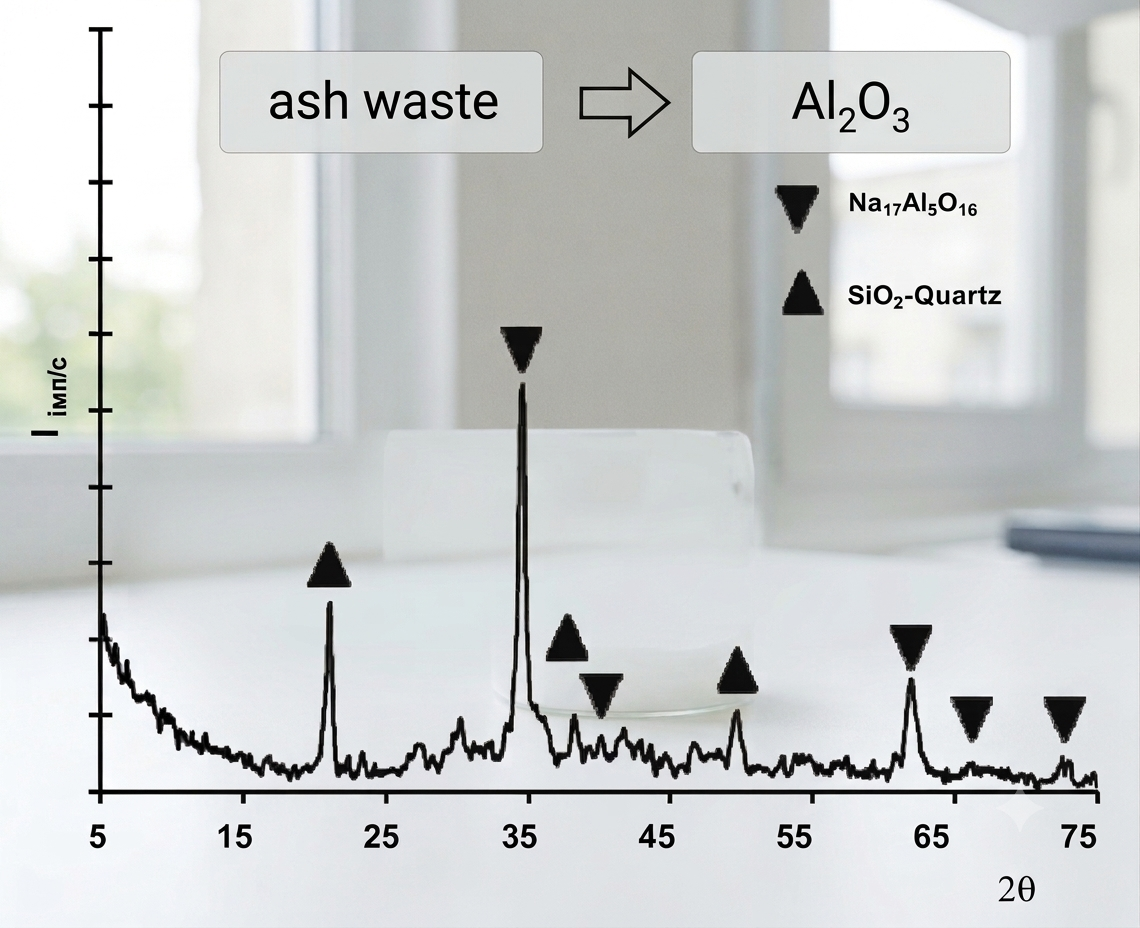
This paper discusses research on the processing of ash waste from thermal power plants and its fractions. The morphological and chemical composition of ash waste and its fractions has been established. A processing method is proposed that allows for the extraction of alumina from the non-magnetic fraction. It has been established that the non-magnetic fraction contains 27.4% alumina, as opposed to 17.4% in the original waste. It was found that the morphology and ratio of reagents have a significant effect on the sintering process at different temperature intervals and durations of the process itself. It was found that an increase in temperature does not significantly affect the process of aluminum oxide transition from aluminosilicates of different chemical compositions to sodium aluminosilicate.
References
Navid, R., Carsten, K. (2017). Cenospheres: A review. Fuel, 207, 1–12. https://doi.org/10.1016/j.fuel.2017.06.059
Bennet, T., Piet, D., Chandan, K., SaiSreeVarsha, V., Singh, R., Sankar, B. (2024). Extraction and separation of rare earth elements from coal and coal fly ash: A review on fundamental understanding and on-going engineering advancements. Journal of Environmental Chemical Engineering, 12(3), 112769. https://doi.org/10.1016/j.jece.2024.112769
Gonchar, V., Sezonenko, O., Gonchar, O., Nazarenko, O., Yaltyshev, A., Aleksyeyenko, V. (2025). Research of the properties of the content of ash and slag heaps of the ladyzhynskaya thermal power plants to develop the process of their rational use. Energy Technologies & Resource Saving, 82(1), 107–117. https://doi.org/10.33070/etars.1.2025.07
Chang, L., Tao, C., Qin-Yi, Z., Lai-Shou, L., Zhou, C., Zhi-Ping, F. (2020). Remediation of lead polluted soil by active silicate material prepared from coal fly ash. Ecotoxicology and Environmental Safety, 206, 111409. https://doi.org/10.1016/j.ecoenv.2020.111409
Zbykovskyy, Y., Kostetsky, Y., Pedchenko, Y., Shvets, I., Zaitsev, V. (2025). Prospects for metallurgical processing of ash and slag waste from coal-fired power plants under electroslag smelting conditions with metals extraction. Metal - International Conference on Metallurgy and Materials, Conference Proceedings, 55–60. DOI: 10.37904/metal.2025.5068
Mahantayya, M., Kiran, A., Durga, P., Jayavardhana, T., Hemanth, R. (2022). A review on fly ash utilization. Materials Today: Proceedings, 50(5), 1535–1540. https://doi.org/10.1016/j.matpr.2021.09.106
Lang, X., Guanghui, L., Jun, L., Hao, J. (2025). From waste to wealth: Separation of alumina from coal fly ash and synergistic preparation of soil amendments. Journal of Environmental Management, 385, 125675. https://doi.org/10.1016/j.jenvman.2025.125675
Abdelrahman, K., Ines, B., Lubna, J., Alaa, A., Ismail, A., Mohammad, A., Muataz, A. (2025). Fly ash as zero cost material for water treatment applications: A state of the art review. Separation and Purification Technology, 354(Part 5), 129104. https://doi.org/10.1016/j.seppur.2024.129104
Yanxia, G., Zesen, Z., Qian, Z., Fangqin, C. (2017). Novel process of alumina extraction from coal fly ash by pre-desilicating – Na2CO3 activation – Acid leaching technique. Hydrometallurgy, 169, 418–425. https://doi.org/10.1016/j.hydromet.2017.02.021
Xiongfei, H., Xunrong, H., Hanghang, Z., Fuhao, L., Lu, W., Xin, Z., Pengcheng, G., Xiuying, L., Puhui, J. (2021). Possibility of using modified fly ash and organic fertilizers for remediation of heavy-metal-contaminated soils. Journal of Cleaner Production, 284, 124713. https://doi.org/10.1016/j.jclepro.2020.124713
Behera, S., Mishra, D., Prashant, S., Mishra, S., Mandal, C., Ghosh, R., Phanil, K. (2021). Utilization of mill tailings, fly ash and slag as mine paste backfill material: Review and future perspective. Construction and Building Materials, 309, 125120. https://doi.org/10.1016/j.conbuildmat.2021.125120
Khlopytskyi, O. O., Kovalenko, I. L., Frolova, L. A., Skiba, M. I., Makarchenko, N. P. (2023). Ash and slag waste of thermal power plants as a promising raw material of the present. Journal of Chemistry and Technologies, 31(3), 635–641. https://doi.org/10.15421/jchemtech.v31i3.286130
Dosmukhamedov, N., Zholdasbay, E. (2022). Technology of Ash and Slag Waste Processing by Сhloridizing Roasting. Metallurgist, 66, 180–189. https://doi.org/10.1007/s11015-022-01315-0
Pengxu, C., Guanghui, L., Hao, J., Xin, Z., Jun, L., Mingjun, R., Tao, J. (2021). Extraction and value-added utilization of alumina from coal fly ash via one-step hydrothermal process followed by carbonation. Journal of Cleaner Production, 323, 129174. https://doi.org/10.1016/j.jclepro.2021.129174
Chao, W., Guogang, X., Xinyue, G., Yuanhui, G., Peng, Z. (2021). High value-added applications of coal fly ash in the form of porous materials: A review. Ceramics International, 47(6), 22302–22315. https://doi.org/10.1016/j.ceramint.2021.05.070
Frolova, L., Khlopytskyi, O., Kashkalda, N., Ivanchenko, H. (2023). IOP Conference Series: Earth and Environmental Science, 1156(1), 012032. DOI 10.1088/1755-1315/1156/1/012032
Bliznjuk, O. N., Masalitina, N. Yu., Savenkov, A. S., Suvorin, A. V., Khlopytskyi, A. A. (2019). Synthesis of a multioxide catalyst for the oxidation of ammonia to nitrogen(II) oxide. Voprosy khimii i khimicheskoi tekhnologii, (3), 98–108. DOI: 10.32434/0321-4095-2019-124-3-98-108
Tong, Z., Siqi, Z., Huifen, Y., Wen, N., Jia, L., Ge, Z., Guoxiang, T., Xuan, L., Song, G., Yichen, Z., Zeping, W. (2023). Leaching and hydrating mechanisms, economic benefits of backfill materials by using coal fly ash – slag-based binder for environmentally sustainable production. Construction and Building Materials, 397, 132360. https://doi.org/10.1016/j.conbuildmat.2023.132360
Pengxu, C., Jun, L., Hao, J., Xin, Z., Mingjun, R., Guanghui, L. (2022). Extraction of alumina from low-grade kaolin in the presence of lime and NaOH via multi-stage hydrothermal process. Applied Clay Science, 229, 106675. https://doi.org/10.1016/j.clay.2022.106675
Khlopytskyi, А., Savenkov, A., Bliznjuk, O., Skiba, M., Vorobiova, V., Masalitina, N. (2022). Leaching of FeO and CaO by nitric acid from ash-slag wastes of thermal power plants. Voprosy khimii i khimicheskoi tekhnologii, (1), 95–99. DOI: 10.32434/0321-4095-2022-140-1-95-99
Mingfei, X., Xiaofang, W., Zixin, L., Fan, Z., Yaping, W., Li, Z. (2023). Rare earth element recovery and aluminum-rich residue production from high alumina fly ash by alkali pre-desilication enhance the mechanochemical extraction process. Process Safety and Environmental Protection, 175, 60–69. https://doi.org/10.1016/j.psep.2023.05.022
Zhou-qing, J., Jing, Y., Hong-wen, M., Le, W., Xi, M. (2015). Reaction behaviour of Al2O3 and SiO2 in high alumina coal fly ash during alkali hydrothermal process. Transactions of Nonferrous Metals Society of China, 25(6), 2065–2072. https://doi.org/10.1016/S1003-6326(15)63816-X
Shchukina, L., Galushka, Ya., Khlopytskyi, A., Savenkov, A. (2020). Prospects of the application of coal ash materials to produce construction heat-insulation ceramics. Voprosy khimii i khimicheskoi tekhnologii, (4), 215–224. DOI: 10.32434/0321-4095-2020-130-3-215-224
Klymova, N., Khlopytskyi, O., Kovalenko, I., Frolova, L., Makarchenko, N. (2025). Study of beneficiation waste processing iron ore. Journal of Chemistry and Technologies, 33(2), 474–482. https://doi.org/10.15421/jchemtech.v33i2.328767
Klymova, N., Khlopytskyi, O., Kovalenko, I., Makarchenko, N. (2024). Research on the extraction of rare earth elements from ash-slag waste. Voprosy Khimii i Khimicheskoi Tekhnologii, (2), 26–31. DOI: 10.32434/0321-4095-2024-153-2-26-31
Downloads
Published
Issue
Section
License
Copyright (c) 2026 Oles Honchar Dnipro National University

This work is licensed under a Creative Commons Attribution 4.0 International License.
- Authors reserve the right of attribution for the submitted manuscript, while transferring to the Journal the right to publish the article under the Creative Commons Attribution License. This license allows free distribution of the published work under the condition of proper attribution of the original authors and the initial publication source (i.e. the Journal)
- Authors have the right to enter into separate agreements for additional non-exclusive distribution of the work in the form it was published in the Journal (such as publishing the article on the institutional website or as a part of a monograph), provided the original publication in this Journal is properly referenced
- The Journal allows and encourages online publication of the manuscripts (such as on personal web pages), even when such a manuscript is still under editorial consideration, since it allows for a productive scientific discussion and better citation dynamics (see The Effect of Open Access).