INVESTIGATION OF THE APPLICATION OF FRUIT RAW MATERIALS IN THE PRODUCTION TECHNOLOGY OF WHEY-BASED BEVERAGES
DOI:
https://doi.org/10.15421/jchemtech.v34i2.353371Keywords:
whey; cranberry; chokeberry; serviceberry; black currant; chemical composition; juice; beverages; quality indicators; microbiological parameters.Abstract
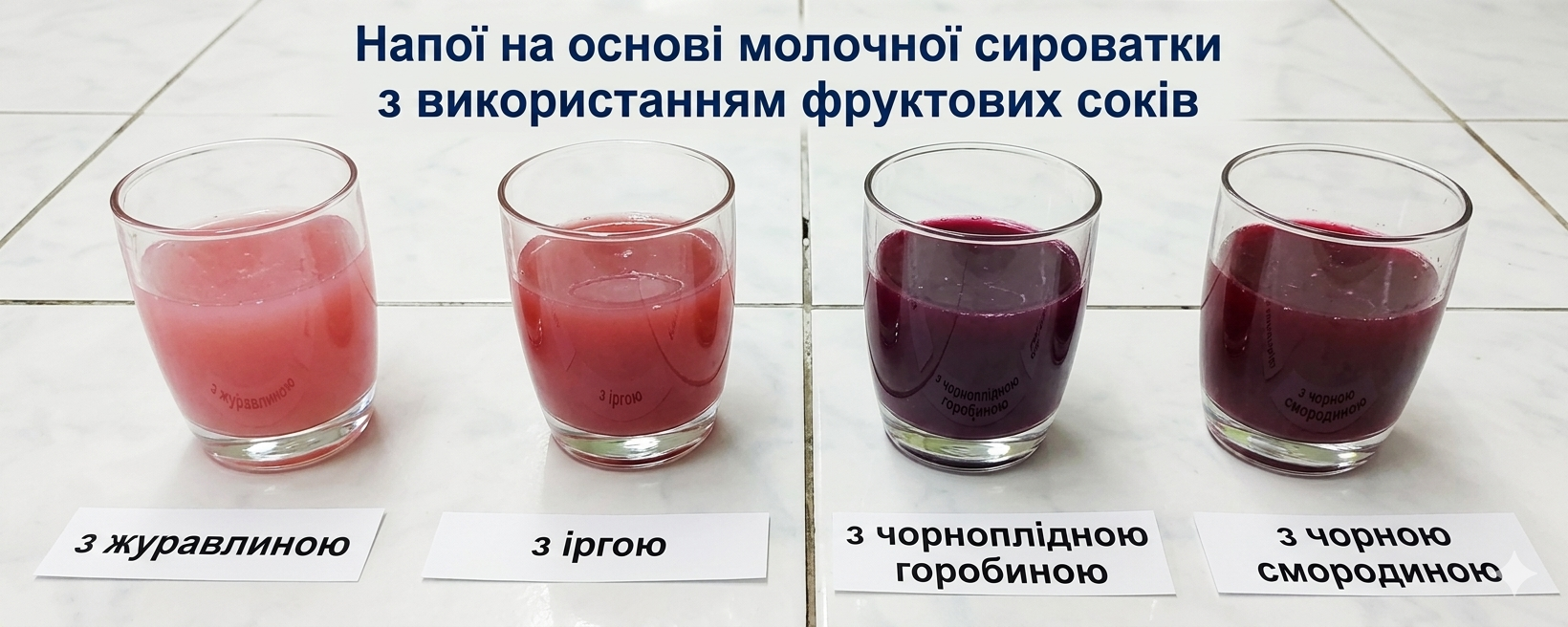
This article is devoted to a comprehensive study of the scientific and practical aspects of using fruit raw materials in the technology of beverages based on dairy whey as a promising secondary resource in the dairy processing industry. The relevance of the work is determined by the need for rational utilization of by-products of milk processing, enhancement of the biological value of beverages, and expansion of the range of functional food products. An analytical review of the current state of whey application in food production, particularly in non-alcoholic beverages, was conducted, highlighting the technological and economic advantages of its use. The aim of the study was to substantiate the feasibility of incorporating cranberry, black chokeberry, serviceberry, and blackcurrant juices into whey-based beverage formulations and to determine their effects on the quality parameters of the final product. It was established that the investigated fruit raw materials are characterized by high contents of biologically active compounds, including phenolic compounds, anthocyanins, organic acids, vitamins, and natural pigments. The fractional composition of organic acids and the polyphenolic profile of the juices were analyzed, confirming the predominance of anthocyanins as the main group of polyphenolic compounds, which provide pronounced antioxidant properties and contribute to the organoleptic quality of the beverages. The physicochemical and microbiological characteristics of dairy whey, selected as the base component of the formulations, as well as of the cranberry, black chokeberry, serviceberry, and blackcurrant juices, were investigated. Microbiological analysis confirmed their compliance with current safety requirements. Based on organoleptic evaluation, an optimal ratio of whey to fruit juices of 80:20 was determined, ensuring a balanced taste, aroma, and color. It was demonstrated that the use of cranberry, black chokeberry, serviceberry, and blackcurrant juices in whey-based beverage technology improves organoleptic, physicochemical, and microbiological parameters, enhances biological value, and promotes the efficient utilization of the resource potential of dairy whey.
References
Bilyk, O. Ya., Dronyk, H. V (2009). [Whey is a valuable dairy by-product used as a raw material for the production of functional food products] Naukovyi visnyk LNUVMBT imeni S. Z. Gzhytskoho - Scientific Herald of Lviv National University of Veterinary Medicine and Biotechnologies named after S. Z. Gzhytskyi 11(2/41), Ч. 5, 422–432. (in Ukrainian)
Deinychenko, H., Huzenko, V., Dmytrevskyi D., Zolotukhina I., Perekrest V. (2022). Introduction of waste-free technologies for processing secondary dairy raw materials. Restorannyi i hotelnyi konsaltynh. Innovatsii – Restaurant and Hotel Consulting. Innovations, 5(1), 82–96. (in Ukrainian)
Hnitsevych V. A., Nykyforov R. P., Fedotova N. A., Kravchenko N. V. (2014). [Technology of Food Products with Specified Properties Based on Secondary Dairy and Plant Raw Materials]. Monograph. Donetsk, Ukraine: Don NUET. (in Ukrainian)
Novhorodska, N. V. (2022). [Functional milk beverage based on whey]. In: Proceedings of the VI International Scientific and Practical Conference “Intehratsiini ta innovatsiini napriamy rozvytku kharchovoi industrii – Integration and Innovative Directions of Food Industry Development” (3–4 November 2022), ChNU, 44–47. (in Ukrainian)
Sydorenko, V. A. (2020). [Biotechnological approaches to the use of whey in beverages]. Biotekhnolohiia – Biotechnology, 8(1), 23–30. (in Ukrainian)
Petrenko, N. V. (2019). [Use of whey for the development of functional beverages]. Kharchova nauka i tekhnolohiia – Food Science and Technology, 14(2), 45–52. (in Ukrainian)
Rybalova, O. V., Pavlenko, V. S. (2024). [Ecological aspect of whey utilization at enterprises in France and Ukraine]. In: Social Communications in the Conditions of Globalization of Society: Challenges and Prospects.Proceedings of the IV International Scientific and Practical Conference (September 23–25, 2024, Lyon), 190–193.
Akhundova, N. A., Babashli, A. (2025).Development of a production technology for functional beverages based on whey enriched with natural juices from plant-based raw materials.Eastern-European Journal of Enterprise Technologies, 5(11 (137)), 86–93. https://doi.org/10.15587/1729-4061.2025.338568
Ahmed, T., Sabuz, A. A., Mohaldar, A., Fardows, H. M. S., Inbaraj, B. S., Sharma, M., Rana, M. R., Sridhar, K. (2023). Development of a novel mixed beverage based on whey and mango: effect of storage on physicochemical, microbiological, and sensory characteristics. Foods, 12(2), 237. https://doi.org/10.3390/foods12020237
Shymkiv, O. S., Kravets, O. I. (2024). [Processing and use of whey as a factor of sustainable development of the dairy industry]. In: Materialy XIII Mizhnarodnoi naukovo-praktychnoi konferentsii molodykh uchenykh ta studentiv “Aktualni zadachi suchasnykh tekhnolohii” (11–12 December 2024), Ternopilskyi natsionalnyi tekhnichnyi universytet imeni Ivana Puliuia - Ternopil National Technical University named after Ivan Puliui, p. 350. (in Ukrainian)
Bandara, T. A., Munasinghe-Arachchige, S. P., Gamlath, S. J. (2023). Fermented whey-based beverages: a review of technological foundations, current developments, and nutritional potential. International Journal of Dairy Technology, 76(4), 737–757. https://doi.org/10.1111/1471-0307.12993
Buchanan, D., Martindale, W., Romey, E., Hebishi, E. (2023). Recent advances in whey processing and valorization: technological and environmental aspects. International Journal of Dairy Technology, 76(2), 291–312. https://doi.org/10.1111/1471-0307.12935
Islam, M. Z., Tabassum, S., Harun-ur-Rashid, M., Vegarud, G. E., Alam, M. S., Islam, M. A. (2021). Development of a probiotic beverage using whey and pineapple (Ananas comosus) juice: sensory, physicochemical properties and probiotic survival during in vitro gastrointestinal digestion. Journal of Agriculture and Food Research, 4, 100144. https://doi.org/10.1016/j.jafr.2021.100144
Kotsaki, P., Aspri, M., Papademas, P. (2025). Novel fermented whey-based beverage enriched with juice concentrates: antimicrobial, antioxidant and ACE-inhibitory activities before and after simulated gastrointestinal digestion. Microorganisms, 13(7), 1490. https://doi.org/10.3390/microorganisms13071490
Leon-Lopez, A., Perez-Marroquin, J. A., Estrada-Fernandez, A. G., Campos-Losada, G., Morales-Penalosa, A., Campos-Montiel, R. G., Aguirre-Alvarez, G. (2022). Whey protein hydrolysates as high value-added natural polymers: functional properties and applications. Polymers, 14(6), 1258. https://doi.org/10.3390/polym14061258
Mirzakulova, A., Sarsembayeva, T., Suleimenova, Z., Kowalski, L., Gajdzik, B., Wolniak, R., Bembenek, M. (2025). Whey: composition, processing, utilization and perspectives in functional and beverage applications – a review. Foods, 14(18), 3245. https://doi.org/10.3390/foods14183245
Naik, B., Kohli, D., Walter, N., Gupta, A. K., Mishra, S., Khan, J. M., Saris, P. E. J., Irfan, M., Rustagi, S., Kumari, V. (2023). Development and storage stability of a functional whey-based carrot beverage. Journal of King Saud University – Science, 35(6), 102775. https://doi.org/10.1016/j.jksus.2023.102775
O’Donoghue, L. T., Murphy, E. G. (2023). Non-dairy utilization routes of whey and whey permeates: direct and indirect applications. Comprehensive Reviews in Food Science and Food Safety, 22(4), 2652–2677. https://doi.org/10.1111/1541-4337.13157
Soumati, B., Atmani, M., Benabderrahmane, A., Benjelloun, M. (2023). Whey valorization: innovative strategies for sustainable development and high value-added products. Journal of Ecological Engineering, 24(10), 86–104. https://doi.org/10.12911/22998993/169505
Sychevskyi, M., Romanchuk, I., Minorova, A. (2019). Whey processing: prospects in Ukraine. Food Science and Technology, 13(4), 58–68. https://doi.org/10.15673/fst.v13i4.1557
Khomych, H. P., Tkach, N. I. (2009). [The use of wild raw materials to provide food products with biologically active substances]. Monograph. Poltava: Poltava University of Economics and Trade (PUSKU). (in Ukrainian)
Khomych, H. P., Kaprelyants, L. V. (2013).[Phenolic compounds of wild fruits and berries: composition, properties, changes during processing]. Monograph. Poltava: PUET. (in Ukrainian)
Borba, K. K. S., Gadêlha, T. S., Sant’Ana, A. M. S., Pacheco, M. T. B., Pinto, L. S., Madruga, M. S., Medeiros, A. N., Bessa, R. J. B., Alves, S. P. A., Magnani, M., Pimentel, T. C. (2022). Fatty acid profile, essential amino acids, minerals and proteins in goat cheese whey: influence of housing system. Small Ruminant Research, 217, 106842. https://doi.org/10.1016/j.smallrumres.2022.106842
Zhakupova, G., Kakimov, M., Tultabaeva, T., Sagandyk, A., Shoman, A. (2023). Study of the effect of juices from wild raw materials of Northern Kazakhstan on the chemical composition of whey-based beverages. Eastern-European Journal of Enterprise Technologies, 6(11/125), 42–50. https://doi.org/10.15587/1729-4061.2023.290095
Borodai, A. B., Khomych, G. P., Horobets, O. M., Nakonechna, Yu. G., Matsuk, Yu. A. (2024).Use of different types of currants as an ingredient structure creators. Journal of Chemistry and Technologies, 32(2), 320–332. https://doi.org/10.15421/jchemtech.v32i2.302520
Brown, J. M., Keller, S. T., Thompson, M. A. (2023). Polyphenolic profiles of a variety of wild berries from the Pacific Northwest region of North America. Current Research in Food Science, 6, 100564. https://doi.org/10.1016/j.crfs.2023.100564
Zhang, Y., Li X., Wang, J. (2023). Studies of value in use, chemical compositions, biological and pharmacological activities, and quality control of Rubus berries: a comprehensive review. Journal of Food Composition and Analysis, 124, 105707. https://doi.org/10.1016/j.jfca.2023.105707
Yamamoto, T., Suzuki, K., Sato, H. (2024). Anthocyanins and the antioxidant capacities of wild berries that grow in Shizuoka, Japan. International Journal of Fruit Science, 24(1), 1–15. https://doi.org/10.1080/15538362.2024.2348716
Salazar, M. C., Ramos, J. P., Gutierrez, L. E. (2024). Study of the physicochemical characteristics, antimicrobial activity, and in vitro multiplication of wild blackberry species from the Peruvian highlands. Scientific Reports, 14, 54058. https://doi.org/10.1038/s41598-024-54058-0
Chen, Y., Li X., Zhang, Y. (2023). Effects and mechanisms of plant bioactive compounds in preventing fungal spoilage and mycotoxin contamination in postharvest fruits: a review. Food Chemistry, 415, 135787. https://doi.org/10.1016/j.foodchem.2023.135787
Downloads
Published
Issue
Section
License
Copyright (c) 2026 Oles Honchar Dnipro National University

This work is licensed under a Creative Commons Attribution 4.0 International License.
- Authors reserve the right of attribution for the submitted manuscript, while transferring to the Journal the right to publish the article under the Creative Commons Attribution License. This license allows free distribution of the published work under the condition of proper attribution of the original authors and the initial publication source (i.e. the Journal)
- Authors have the right to enter into separate agreements for additional non-exclusive distribution of the work in the form it was published in the Journal (such as publishing the article on the institutional website or as a part of a monograph), provided the original publication in this Journal is properly referenced
- The Journal allows and encourages online publication of the manuscripts (such as on personal web pages), even when such a manuscript is still under editorial consideration, since it allows for a productive scientific discussion and better citation dynamics (see The Effect of Open Access).