THERMAL ANALYSIS AND IR SPECTROSCOPY OF COFFFEE GROUNDS AND COFFEE-GROUND-DERIVED BIOCHARS
DOI:
https://doi.org/10.15421/jchemtech.v34i2.353798Keywords:
complex thermal analysis, spent coffee grounds, biochar, physical and chemical properties, infrared spectroscopy, surface structure characteristicsAbstract
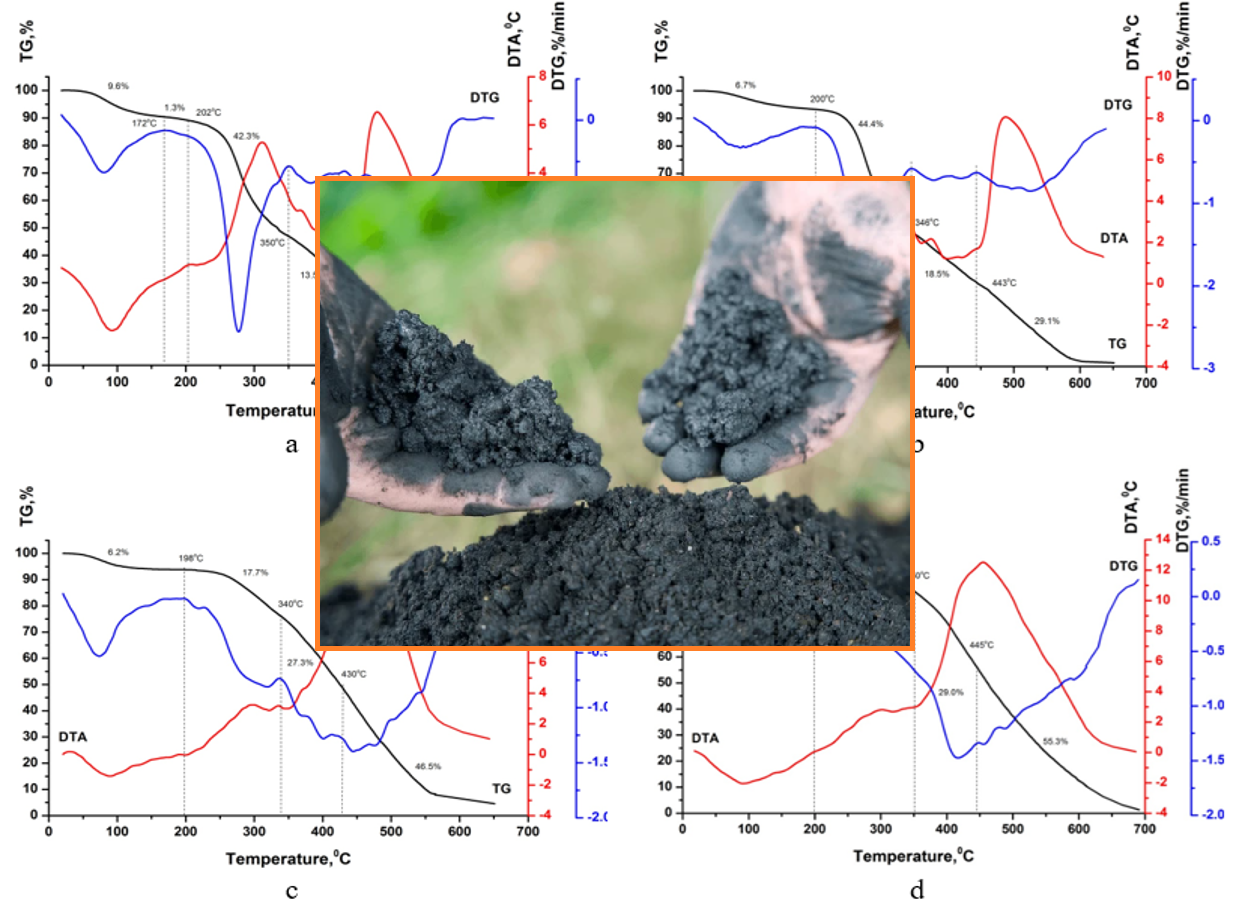
The worsening environmental, food and energy crisis necessitates new approaches to recycling food waste into targeted products, one of which is coffee grounds. The produced biochars, featuring a high specific surface area and suitable pore dimensions, are considered relevant and promising for addressing environmental challenges in the waste management sector. The aim of the objective of this research is to produce biochar, which can be used efficiently and effectively in the future during the process of anaerobic digestion of food waste from a hotel and restaurant complex to produce biogas, to study its structural surface characteristics and its physicochemical characteristics using integral and differential infrared spectroscopy and complex thermal analysis. The differential infrared spectrum of the comparison of biochar and feedstocks is characterised by a decrease in the absorption intensity of the feedstock in the 3400 cm-1 region, which corresponds to the valence vibrations of the free OH- group, indicating an increase in hydrogen bonds in biochar. To evaluate the effect of temperature on the thermal decomposition of the samples, a comprehensive thermal analysis was used, including differential thermogravimetry (DTG), thermogravimetric analysis (ТG) and differential thermal (DТА) analyses. Тhe less intense mass loss of biochar-300 and biochar-500 samples compared to the samples of the feedstock and biochar-MX confirms the presence of fewer thermally unstable components in them. Compared to the raw material sample, the samples of all the studied biochars contain fewer components capable of thermal oxidation. Structural characteristics of the biochar surface have a significant impact on the functional properties of biochar, the specific surface of biochar is much higher than the specific surface of raw materials, which indicates the feasibility of the selected methods of modifying raw materials to increase their functional properties.
References
Björner Brauer, H., Hasselqvist, H., Måkansson, M., Willermark, S., Hiller, C. (2024). Re-configuring practices in times of energy crisis – A case study of Swedish households. Energy Research & Social Science, 114, 103578. https://doi.org/10.1016/j.erss.2024.103578
Faggian, L., Agostini, S., Müller, B., Gupte, A. P., Favaro, L. (2025). Efficient production of hydrogen through bioaugmentation of the organic fraction of municipal solid waste by the newly isolated Clostridium sartagoforme SA1. Bioresource Technology, 415, 131658. https://doi.org/10.1016/j.biortech.2024.131658
Sokolova, T., Krusir, G., Shunko, H., Korkach, H., Makarova, O., Tolstykh, V., Sokolova, V. (2024). Preparation and study of acid-base and ion-exchange properties of biochar from waste coffee grounds. Ecological Engineering & Environmental Technology, 25(11), 399–409. https://doi.org/10.12912/27197050/193052
Torboli, A., Foladori, P., Lu, M., Gialanella, S., Maines, L. (2024). Spent coffee ground biochar for phosphate adsorption in water: Influence of pyrolysis temperature and iron-coating activation method. Cleaner Engineering and Technology, 23, 100839. https://doi.org/10.1016/j.clet.2024.100839
Sharma, T., Hakeem, I. G., Gupta, B. A., Joshi, J., Shah, K., Vuppaladadiyam, A. K., Sharma, A. (2024). Parametric influence of process conditions on thermochemical techniques for biochar production: A state-of-the-art review. Journal of the Energy Institute, 113, Article 101559. https://doi.org/10.1016/j.joei.2024.101559
Premchand, P., Demichelis, F., Chiaramonti, D., Bensaid, S., Fino, D. (2022). Study on the effects of carbon dioxide atmosphere on the production of biochar derived from slow pyrolysis of organic agro-urban waste. Waste Management, 172, 308–319. https://doi.org/10.1016/j.wasman.2023.10.035
Skliar V., Krusir G., Zakharchuk V., Kuznecova I., Malovanyy M. (2020). Study of the physical and chemical characteristics of an immobilized lipase in the hydrolysis of fat waste. Ecological Questions, 31(3), 1644-7298. http://dx.doi.org/10.12775/EQ.2020.019
Pambudi, S., Jongyingcharoen, J. S., Saechua, W. (2024). Thermochemical treatment of spent coffee grounds via torrefaction: A statistical evidence of biochar properties similarity between inert and oxidative conditions. Results in Engineering, 21, 102012. https://doi.org/10.1016/j.rineng.2024.102012
Kochito, J., Gure, A., Abdisa, N., Tadesse, B. T., Femi, O. E. (2024). Magnetic biochar nanocomposites of coffee husk and khat (Catha edulis) leftover for removal of Cr (VI) from wastewater. Current Research in Green and Sustainable Chemistry, 8, Article 100403. https://doi.org/10.1016/j.crgsc.2024.100403
Kupriyashkina H., Pylypenko L., Sevastyanova E., Mazurenko K, Hugi Ch., Breitenmoser L., Krusir G., Malovanyy M. (2024). Microbiological landscape of oil-contaminated soil and its bioremediation by microorganisms. Ecological Engineering & Environmental Technology, 25(2), 31–40. https://doi.org/10.12912/27197050/175139
Gwenzi, W., Chaukura, N., Noubactep, C., Mukome, F. N. D. (2017). Biochar-based water treatment systems as a potential low-cost and sustainable technology for clean water provision. Journal of Environmental Management, 197, 732–749. https://doi.org/10.1016/j.jenvman.2017.03.087
Khomych G., Krusir G., Horobets O., Levchenko Y., Gaivoronska Z. (2020). Development of Resource Effective and Cleaner Technologies Using the Waste of Plant Raw Materials. Journal of Ecological Engineering, 21(4), 178–184.
https://doi:10.12911/22998993/119814
Soloviy, Ch., Malovanyy, M., Bordun, I., Ivashchyshyn, F., Borysiuk, A., Kulyk, Y. (2020). Structural, magnetic and adsorption characteristics of magnetically susceptible carbon sorbents based on natural raw materials. Journal of Water and Land Development, 47(X–XII), 160–168. https://doi.org/10.24425/jwld.2020.135043
Krusir, G., Zakharchuk, V., Sevastyanova, E., Pylypenko, L., Mazurenko, K. (2021). Isolation of lysozyme of Black Sea Mussel Mutilus galloprovincialis. Journal of Chemistry and Technologies, 28(3), 269–277. https://doi.org/10.15421/jchemtech.v29i3.223378
Krusir, G., Hugi, Ch., Breitenmoser, L., Sevastyanova, E., Pylypenko, L., Mazurenko, K. (2022). Isolation and characterization of a pancreatic amylase inhibitor. Journal of Chemistry and Technologies, 30(4), 558–567. https://doi.org/10.15421/jchemtech.v30i4.263201
Krusir G., Zakharchuk V., Sevastyanova E., Pylypenko L., Moshtakov S. (2020). Isolation of Alfalfa Seed Trypsin Inhibitor using Affinity Chromatography. Journal of Chemistry and Technologies, 28(3), 269-277. https://doi.org/10.15421/08202803
Sharma, A., Pareek, V., Zhang, D. (2015). Biomass Pyrolysis - A Review of Modelling, Process Parameters and Catalytic Studies. Renewable and Sustainable Energy Reviews, 50(9), 1081–1096. https://doi.org/10.1016/j.rser.2015.04.193
Cha, J., Park, S., Jung, S. C., Ryu, C., Jeon, J. K., Shin, M. C., Park, Y. K. (2016). Production and Utilization of Biochar: A Review. Journal of Industrial and Engineering Chemistry, 40, 1–15. https://doi.org/10.1016/j.jiec.2016.06.002
Yaashikaa, P. R., Kumar, P., Varjani, S., Anbalagan, S. (2019). Advances in production and application of biochar from lignocellulosic feedstocks for remediation of environmental pollutants. Bioresource Technology, 292, 122030. https://doi.org/10.1016/j.biortech.2019.122030
Yalechko, V., Kochubey, V., Hnatyshyn, Y., Pavlovskyi, Y. (2016). Thermal analysis of willow wood (Salix Viminalis). Scientific Bulletin of UNFU, 26(4), 247–251. https://doi.org/10.15421/40260438
Yang, H., Yan, R., Chen, H., Lee, D. H., Zheng, C. (2007). Characteristics of hemicellulose, cellulose and lignin pyrolysis. Fuel, 86(12-13), 1781–1788. https://doi.org/10.1016/j.fuel.2006.12.013
Krusir, G., Pylypenko, L., Sevastyanova, E., Mazurenko, K., Moshtakov, S., Shunko, H., Vitiuk, A., Shpyrko, T., Zdoryk, O. (2023). Isolation and characterization of pancreatic lipase inhibitor from rapeseed seeds. Journal of Chemistry and Technologies, 31(2), 255–270. https://doi.org/10.15421/jchemtech.v31i2.279214
Downloads
Published
Issue
Section
License
Copyright (c) 2026 Oles Honchar Dnipro National University

This work is licensed under a Creative Commons Attribution 4.0 International License.
- Authors reserve the right of attribution for the submitted manuscript, while transferring to the Journal the right to publish the article under the Creative Commons Attribution License. This license allows free distribution of the published work under the condition of proper attribution of the original authors and the initial publication source (i.e. the Journal)
- Authors have the right to enter into separate agreements for additional non-exclusive distribution of the work in the form it was published in the Journal (such as publishing the article on the institutional website or as a part of a monograph), provided the original publication in this Journal is properly referenced
- The Journal allows and encourages online publication of the manuscripts (such as on personal web pages), even when such a manuscript is still under editorial consideration, since it allows for a productive scientific discussion and better citation dynamics (see The Effect of Open Access).