IMPACT OF FORMULA OPTIMIZATION ON ENHANCING BIOLOGICAL VALUE AND MICROBIOLOGICAL SAFETY INDICATORS OF LACTOSE-FREE YOGURT PRODUCTS
DOI:
https://doi.org/10.15421/jchemtech.v34i2.355566Keywords:
lactose-free yogurt products, dry plant milk, Jerusalem artichoke powder, optimization; response surfaces, Pareto method, microbiological safetyAbstract
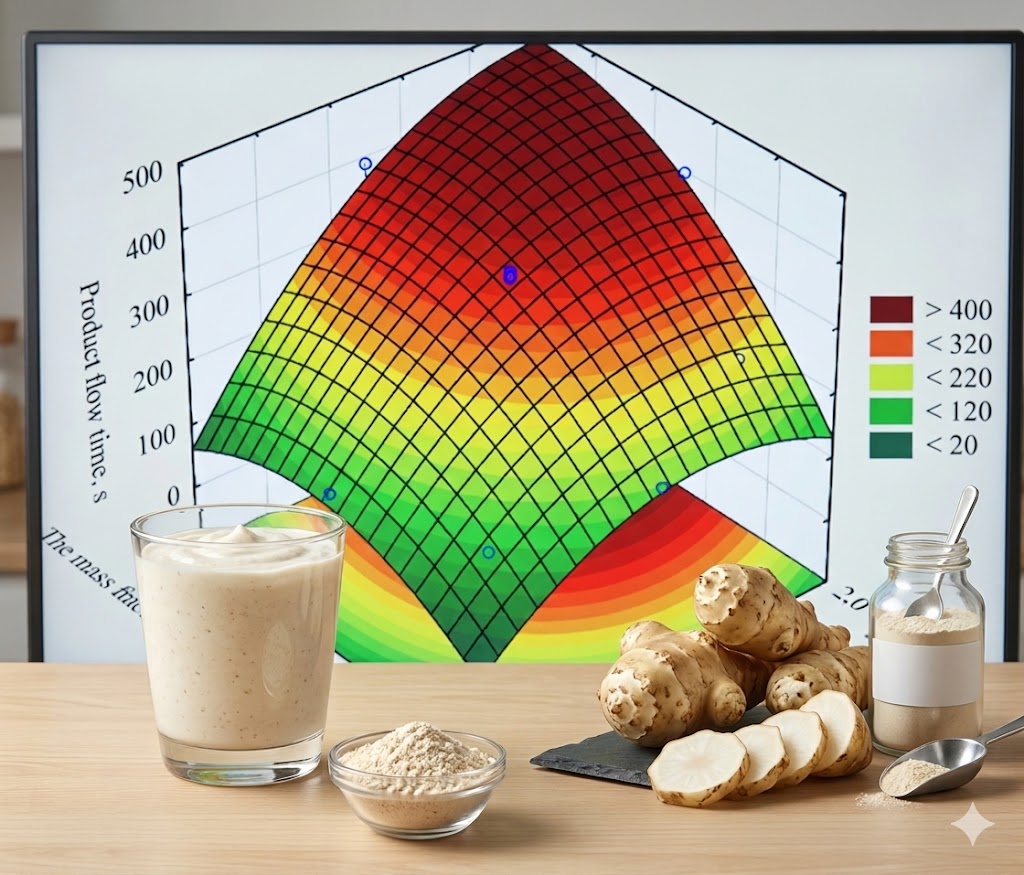
The influence of formula optimization on the microbiological safety indicators of lactose-free yogurt products enriched with plant-based biologically active components was investigated. The purpose of the study was to optimize the formula using dry oat and corn milks and Jerusalem artichoke powder in order to increase nutritional and biological values and ensure regulatory quality and microbiological safety indicators. Lactose-free pasteurized milk with 2.6 % fat and Danisco Yo-Mix 495 starter culture were used as raw materials; additional ingredients were dry oat/corn milk and Jerusalem artichoke powder. The formulation was optimized using the Statistica 10 software and the response surface method. Conditional viscosity and sensory evaluation of the product were selected as the optimization criteria. The optimal mass fractions of the raw ingredients were determined: for the formulation containing dry oat milk and Jerusalem artichoke powder – 1.43 % and 1.11 %, respectively; for the formulation containing dry corn milk and Jerusalem artichoke powder – 1.45 % and 1.07 %, respectively. It was shown that after 14 days of storage, the developed samples met the requirements of DSTU 4343:2004 in terms of physical and chemical indicators and had good microbiological safety indicators: absence of coliforms, E. coli, S. aureus, B. cereus, and Salmonella spp. The number of lactic acid bacteria was 9.0·107–1.1·108 CFU/ml. The results obtained confirm the technological feasibility of using the studied plant components in lactose-free yogurt health-enhancing products and creation of prerequisites for expanding the range of functional fermented milk products.
References
Wang, X., Wang, L., Wei, X., Xu, C., Cavender, G., Lin, W., Sun, S. (2025). Invited review: Advances in yogurt development-Microbiological safety, quality, functionality, sensory evaluation, and consumer perceptions across different dairy and plant-based alternative sources. Journal of dairy science, 108(1), 33–58. https://doi.org/10.3168/jds.2024-25322
Wajs, J., Brodziak, A., Król, J. (2023). Shaping the Physicochemical, Functional, Microbiological and Sensory Properties of Yoghurts Using Plant Additives. Foods, 12(6), 1275. https://doi.org/10.3390/foods12061275
Zhai, J., Zhuang, Y., Sun, L., Gu, Y., Fan, X. (2025). Nutritional health aspects and functional properties of nut yogurt: Future perspectives. Food Chemistry: X, 25, 102102. https://doi.org/10.1016/j.fochx.2024.102102
Montemurro, M., Pontonio, E., Coda, R., Rizzello, C.G. (2021). Plant-Based Alternatives to Yogurt: State-of-the-Art and Perspectives of New Biotechnological Challenges. Foods, 10(2), 316. https://doi.org/10.3390/foods10020316
Drositi, I., Barone G., Bang-Berthelsen C.H., Ahrné L. (2026). Processability and physicochemical properties of plant-based dispersions formulated with oat, pea, and potato concentrates intended for the production of yoghurt analogues. Journal of Food Engineering, 402, 112673. https://doi.org/10.1016/j.jfoodeng.2025.112673
Craig, W.J., Brothers, C.J. (2021). Nutritional Content and Health Profile of Non-Dairy Plant-Based Yogurt Alternatives. Nutrients, 13(11), 4069. https://doi.org/10.3390/nu13114069
Qadir, R., Nasir, W.N.A.W.M., Azmi, A.B., Fatima, S., Mehmood, N., Hussin, A.S.M. (2025). An insight into plant-based yogurts: Physicochemical, organoleptic properties and functional food aspects. Journal of Food Composition and Analysis, 143, 107578. https://doi.org/10.1016/j.jfca.2025.107578
Trajkovska, B., Djurovic, V., Radovanović, M., Nakov, G. (2025). Effect of semi-defatted walnut and pumpkin flour fortification on the physicochemical, microbiological, and sensory properties of yogurt. LWT, 228, 118114. https://doi.org/10.1016/j.lwt.2025.118114
Leal, M.R.S., Albuquerque, P.B.S., Rodrigues, N.E.R., Silva, P.M.S., Oliveira, W.F., Correia, M.T.S., Kennedy, J.F., Coelho, L.C.B.B. (2024). A review on the use of polysaccharides as thickeners in yogurts. Carbohydrate Polymer Technologies and Applications, 8, 100547. https://doi.org/10.1016/j.carpta.2024.100547
Jayaweera, Y., Silva, M., Chandrapala, J., Liyanage, R., Jayathunge, K.G.L.R., Alahakoon, A.U. (2025). Potential Applications of Zingiber officinale, Clitoria ternatea, and Coccinia grandis for Enhancing the Functionality of Set Yogurts. Food science & nutrition, 13(7), e70475. https://doi.org/10.1002/fsn3.70475
Jaeger, S. Cardello, A., Jin, D. Ryan, G., Giacalone, D. (2023). Consumer perception of plant-based yoghurt: Sensory drivers of liking and emotional, holistic and conceptual associations. Food Research International. 167. 112666. https://doi.org/10.1016/j.foodres.2023.112666
García-Barón, S.E., Carmona-Escutia, R.P., Herrera-López, E.J., Leyva-Trinidad, D.A., Gschaedler-Mathis, A. (2025). Consumers’ Drivers of Perception and Preference of Fermented Food Products and Beverages: A Systematic Review. Foods, 14(5), 713. https://doi.org/10.3390/foods14050713
Capcanari, T. Chirsanova, A., Covaliov, E., Rodica, S. (2021). Development of Lactose Free Yogurt Technology for Personalized Nutrition. Food and Nutrition Sciences. 12. 1116–1135. https://doi.org/10.4236/fns.2021.1211082
Sharma, N., Yeasmen, N., Dubé, L., Orsat, V. (2024). A review on current scenario and key challenges of plant-based functional beverages, Food Bioscience, 60, 104320. https://doi.org/10.1016/j.fbio.2024.104320
Benmeziane, F., Belleili, I. (2023). An innovative approach: Formulation and evaluation of fermented oat milk using native yoghurt cultures. Measurement: Food, 12, 100113. https://doi.org/10.1016/j.meafoo.2023.100113
Adeyanju, A., Ogunsimiro, O., Adejuyitan, J., Akinsa-nola, B.A., Bamidele, O., Adebo, O. (2025). Formulation and Quality Evaluation of Yoghurts From Tigernut, Soybean and Cow Milk Blends. Legume Science, 7(3), e70042. https://doi.org/10.1002/leg3.70042
Adesulu-Dahunsi, A., Oluwatoyin, B., James, F. (2023). Physicochemical, microbiological and sensorial qualities of dairy yoghurt supplemented with coconut and tiger nut milk extract during storage. IOP Conference Series: Earth and Environmental Science. 1219(1), 012009. https://doi.org/10.1088/1755-1315/1219/1/012009
Miskmolzavod No. 1. (2019). [Pasteurized lactose-free milk 2.6%. Technical Specifications of Ukraine TU U 10.5–35757383–001:2019]. Odesa, Ukraine. (In Ukrainian). https://gormolzavod-odessa.com.ua/production/moloko-pasterizovane-bezlaktozne-2-6-zhiru-2/
Zdorovo. (n.d.). [Natural Jerusalem artichoke powder (60% inulin)]. (In Ukrainian). https://zdorovoshop.com/ru/superfud/poroshok-topinambura-naturaliy-zdorovo
MANTeca. (n.d.). [Oat milk (powdered)]. (In Ukrainian). https://mantecapb.com/shop/vivsiane-moloko-sukhe/
MANTeca. (n.d.). [Corn milk (powdered)]. (In Ukrainian). https://mantecapb.com/shop/kukurudziane-moloko-sukhe/
Yu, Y., Li, X., Zhang, J., Li, X., Wang, J., Sun, B. (2023). Oat milk analogue versus traditional milk: Comprehensive evaluation of scientific evidence for processing techniques and health effects. Food chemistry: X, 19, 100859. https://doi.org/10.1016/j.fochx.2023.100859
Rahbari, M., Aalami, M., Kashaninejad, M., Maghsoudlou, Y., Aghdaei S. (2015). A mixture design approach to optimizing low cholesterol mayonnaise formulation prepared with wheat germ protein isolate. J Food Sci Technol., 52(6), 3383–3393. http://dx.doi.org/10.1007/s13197-014-1389-4
Kishk, Y., Elsheshetawy, H. (2013). Effect of ginger powder on the mayonnaise oxidative stability, rheological measurements, and sensory characteristics. Annals Of Agricultural Sciences. 58(2). 213–220. http://dx.doi.org/10.1016/j.aoas.2013.07.016
Myers, R., Montgomery, D., Anderson-Cook, C. (2016). Response surface methodology: process and product optimization using designed experiments. Hoboken, New Jersey: John Wiley & Sons.
State Standard of Ukraine. (2004). [Yoghurts. General specifications] (DSTU 4343:2004). State Consumer Standard of Ukraine. (In Ukrainian).
National Standard of Ukraine. (2015). [Milk products. Determination of lactose and galactose content by spectrometric method] (DSTU 8059:2015). Ukrainian Research and Training Center for Standardization, Certification and Quality (UkrNDNTs). (In Ukrainian).
National Standard of Ukraine. (2015). [Food products. Methods for determination of the number of mesophilic aerobic and facultative anaerobic microorganisms] (DSTU 8446:2015). Ukrainian Research and Training Center for Standardization, Certification and Quality (UkrNDNTs). (In Ukrainian).
National Standard of Ukraine. (2015). [Food products. Methods for determination of lactic acid bacteria] (DSTU 7999:2015). Ukrainian Research and Training Center for Standardization, Certification and Quality (UkrNDNTs). (In Ukrainian).
International Organization for Standardization. (2008). [Microbiology of food and animal feeding stuffs – Horizontal method for the enumeration of yeasts and moulds – Part 1: Colony count technique in products with water activity greater than 0,95] (ISO Standard No. 21527-1:2008). (In Ukrainian).
National Standard of Ukraine. (2014). [Microbiology of food and animal feeding stuffs. Horizontal method for the enumeration of β-glucuronidase-positive Escherichia coli. Part 2: Colony-count technique at 44 ºC using 5-bromo-4-chloro-3-indolyl-β-D-glucuronide] (DSTU ISO 16649-2:2014; ISO 16649-2:2001, IDT). Ukrainian Research and Training Center for Standardization, Certification and Quality (UkrNDNTs). (In Ukrainian).
National Standard of Ukraine. (2022). [Microbiology of the food chain. Horizontal method for the enumeration of coagulase-positive staphylococci (Staphylococcus aureus and other species). Part 1: Method using Baird-Parker agar medium] (DSTU EN ISO 6888-1:2022; EN ISO 6888-1:2021, IDT; ISO 6888-1:2021, IDT). Ukrainian Research and Training Center for Standardization, Certification and Quality (UkrNDNTs). (In Ukrainian).
National Standard of Ukraine. (2015). [Food products. Method for detection and determination of Bacillus cereus] (DSTU 8040:2015). Ukrainian Research and Training Center for Standardization, Certification and Quality (UkrNDNTs). (In Ukrainian).
National Standard of Ukraine. (2022). [Microbiology of the food chain. Horizontal method for the detection, enumeration and serotyping of Salmonella. Part 1: Detection of Salmonella spp.] (DSTU EN ISO 6579-1:2022; EN ISO 6579-1:2017, IDT; ISO 6579-1:2017, IDT). Ukrainian Research and Training Center for Standardization, Certification and Quality (UkrNDNTs). (In Ukrainian).
Downloads
Published
Issue
Section
License
Copyright (c) 2026 Oles Honchar Dnipro National University

This work is licensed under a Creative Commons Attribution 4.0 International License.
- Authors reserve the right of attribution for the submitted manuscript, while transferring to the Journal the right to publish the article under the Creative Commons Attribution License. This license allows free distribution of the published work under the condition of proper attribution of the original authors and the initial publication source (i.e. the Journal)
- Authors have the right to enter into separate agreements for additional non-exclusive distribution of the work in the form it was published in the Journal (such as publishing the article on the institutional website or as a part of a monograph), provided the original publication in this Journal is properly referenced
- The Journal allows and encourages online publication of the manuscripts (such as on personal web pages), even when such a manuscript is still under editorial consideration, since it allows for a productive scientific discussion and better citation dynamics (see The Effect of Open Access).