STUDY OF THERMODYNAMIC INDICATORS OF THE MOISTURE STATE IN EXPERIMENTAL CUPCAKE FORMULATIONS WITH THE ADDITION OF NON-TRADITIONAL RAW MATERIALS USING THE THERMOGRAVIMETRIC ANALYSIS
DOI:
https://doi.org/10.15421/jchemtech.v34i2.355831Keywords:
confectionery, cupcakes, non-traditional raw materials, bound moisture, free moisture, thermogravimetric analysis, derivatograms, freshnessAbstract
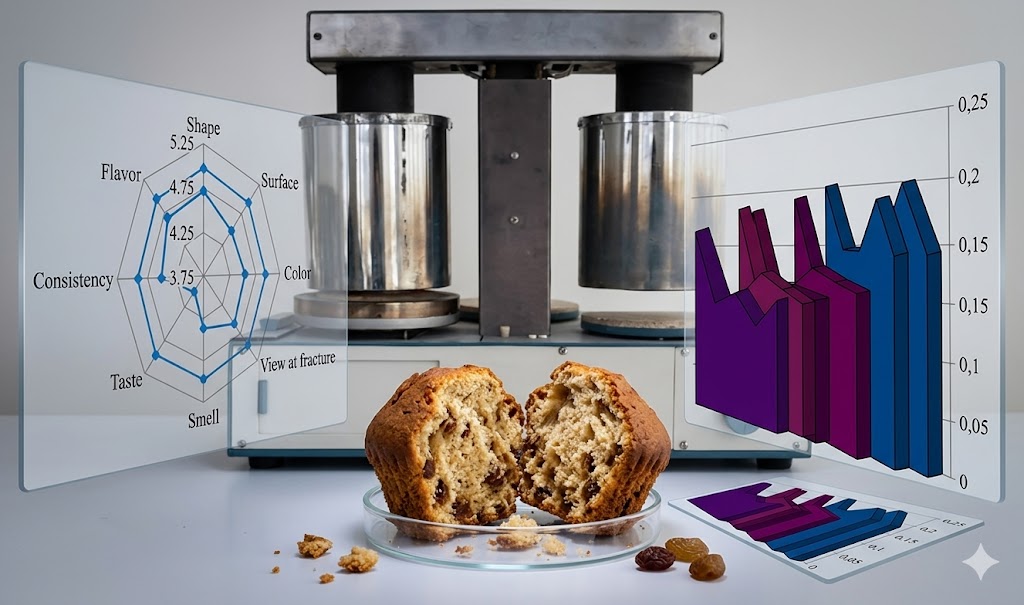
The object of research was the technology of cupcake production using non-traditional raw materials. The study focused on investigating the forms of moisture binding in experimental cupcake samples in comparison with the control sample, the “Stolichny” cupcake. The experimental cupcake samples included buckwheat, oat, rye, and corn flours, powders of non-traditional plant raw materials, whey and skimmed milk powder, and beekeeping products, which replaced part of the wheat flour. The inclusion of these ingredients contributed to an increase in the content of vitamins, minerals, and essential amino acids in the experimental cupcake samples. Margarine was also partially replaced with vegetable oils (sesame, pumpkin seed, and walnut oil) to reduce the content of trans-isomers of fatty acids and increase the content of polyunsaturated fatty acids of the ω-3 and ω-6 families. At each stage of the production of experimental cupcake samples, an analysis of biological, chemical, and physical hazardous factors was carried out. A derivatographic study of experimental cupcake samples was carried out using the Q-1000 derivatograph device in the range from 25 to 220 °С. Based on the results of thermogravimetric analysis, it was established that the amount of free moisture in the control sample of the “Stolichnyi” cupcake accounted for 63.0 % of the total amount of moisture. In the experimental cupcake samples, a decrease in the proportion of free moisture was found: “Kunzhutnyi” cupcake – by 1.0, “Moryachok” – by 2.8, “Osinniy Aromat” – by 3.1, “Chornychnyi” – by 3.3, “Mitsnyi Horishok” – by 9.3, “Elitnyi” – by 15.9 and “Medok” – by 17.4 % compared to the control sample.
References
Baldych, L. V., Konarivska, O. B., Shenaur, O. V. (2025). [Research and analysis of the assortment of confectionery products: modern approaches and development prospects]. Tavria Scientific Bulletin. Series: Technical Sciences, 2(4), 15–25. (in Ukrainian). https://doi.org/10.32782/tnv-tech.2025.4.2.2
Sorokina, A. M. (2023). [Problems of development of confectionery industry of Ukraine in modern conditions]. Scientific Bulletin of Kherson State University, 47, 27–32. (in Ukrainian). https://doi.org/10.32999/ksu2307-8030/2023-47-4
Sorokina, A. M. (2023). [Development trends of the modern confectionery industry of Ukraine]. Problems of modern transformations. Series economics and management, 7, (in Ukrainian). https://doi.org/10.54929/2786-5738-2023-7-04-15
Sheludko, V. M. (2021). [Expanding the range of modern flour confectionery products of increased nutritional value]. Bulletin of the Lviv Technological University. Technical Sciences, 26, 71–77. (in Ukrainian). https://doi.org/10.36477/2522-1221-2021-26-10
Peñalver, R., Ros, G., Nieto, G. (2023). Development of Gluten-Free Functional Bread Adapted to the Nutritional Requirements of Celiac Patients. Fermentation, 9(7), 631. https://doi.org/10.3390/fermentation9070631
Bernyk, I. M., Novgorodska, N. V., Solomon, A. M., Ovsienko, S. M., Bondar, M. M. (2022). [Innovative technologies of food production: monograph]. Vinnytsia, Publisher FOP Kushnir Yu. V. (in Ukrainian).
Samokhvalova, O.V., Kasabova, K.R., Oliynyk, S.G. (2015) [Technology of muffins for health purposes: monograph]. Kharkiv: Technological Center. (in Ukrainian).
Ryapolova, I. O., Mykulinska, A. V. (2021). Experience in the use of non-traditional raw materials of functional purpose in flour confectionery products. Tavria Scientific Bulletin. Series: Technical Sciences, 1, 36–41. (in Ukrainian). https://doi.org/10.32851/tnv-tech.2021.1.6
Christ-Ribeiro, A., Chiattoni, L. M., Mafaldo, C. R. F., Badiale-Furlong, E., Souza-Soares, L. A. (2021). Fermented rice-bran by Saccharomyces cerevisiae: Nutritious ingredient in the formulation of gluten-free cookies. Food Bioscience, 40, 100859. https://doi.org/10.1016/j.fbio.2020.100859
Kravchenko, M. F., Romanovska, O. L. (2023). [Innovative technologies of flour confectionery products from flour mixtures. Sustainable food chain and safety through science, knowledge and business, scientific monograph], 99–116. Riga, Latvia, Baltija Publishing. (in Ukrainian). https://doi.org/10.30525/978-9934-26-328-6-5
Romanovska, O. L. (2022). [Modeling the recipe composition of biscuits with “Health” flour]. Bulletin of the Lviv University of Trade and Economics. Technical Sciences, 29, 66–69. (in Ukrainian). https://doi.org/10.36477/2522-1221-2022-29-09
Cetin Babaoğlu, H. (2025). The effects of heat-moisture modified tapioca starch on dough rheology and bread quality. Afyon Kocatepe University. Journal of Science and Engineering, 25(1), 114–122. https://doi.org/10.35414/akufemubid.1512781
Havrylyshyn, V. V., Lebedynetsʹ A. I. (2025). [Development and optimization of the recipe composition of cupcakes with the addition of sweet potato flour]. Scientific Bulletin of the Poltava University of Economics and Trade. Series "Technical Sciences", 1, 79–86. (in Ukrainian). https://doi.org/10.37734/2518-7171-2025-1-13
Park, J., Kim, H-S. (2023) Rice-Based Gluten-Free Foods and Technologies: A review. Foods, 12(22), 4110. https://doi.org/10.3390/foods12224110
Brykova, T. (2025) Developing a recipe and technology for making gluten-free desserts for patients with celiac disease. Zernovi produkty i kombikormy, 25(2), 4–10. https://doi.org/10.15673/gpmf.v25i2.3123
Kravchenko, M., Romanovska, O., Marusiak, T. (2021). Rheological properties of biscuits dough with spelt flour. Commodities and markets. 2, 94–102. https://doi.org/10.31617/tr.knute.2021(38)09
Sova, N. A., Svysenko, O. V. (2024). The use of niche culture flour in the technology of biscuit semi-finished products. Tavria Scientific Bulletin. Series: Technical Sciences, 6, 176–185. (in Ukrainian). https://doi.org/10.32782/tnv-tech.2023.6.20
Sidhu, J. S., Zafar, T., Almusallam, A., Ali M. Al-Othman, A. (2024). Effect of substitution of wheat flour with chickpea flour on their physico-chemical characteristics. Agricultural & Food Science Research, 42(2), 290–305. https://doi.org/10.1108/AGJSR-09-2022-0178
Shevchenko A., Ivanišová E., Kováčiková Е., Benešová L., Mykhonik L. (2024). Effect of complex plant supplement on shelf life of wheat bread. Ukrainian Food Journal, 13(2), 274–286. https://doi.org/10.24263/2304-974X-2024-13-2-6
Bilyk O., Khalikova, E. Shevchenko A., Kochubei-Lytvynenko O., Bondarenko Y., & Fain A. (2020). Effect of the complex improver on consumer properties of bakery products. Ukrainian Food Journal, 9(1), 148 – 158. https://doi.org/10.24263/2304-974X-2020-9-1-13
Tanasiychuk B.M., & Meshkov Y.E. (2020). Ways to extend the shelf life of bread. Bulletin of KhNTU, 1(72), 135–140. https://doi.org/10.35546/kntu2078-4481.2020.1.1.16 (in Ukrainian).
Bilyk, O., Bondarenko, Y., Hryshchenko, А., Drobot, V., Kovbasa, V., Shutyuk, V. (2018). Investigation of the cinnamon influence on the wheat bread quality enriched with flax seeds oil meal. EUREKA: Life Sciences, 3, 13–18. https://doi.org/10.21303/2504-5695.2018.00658
Gong, C., Lee, M. C., Godec, M., Zhang, Z., Abbaspourrad, A. (2020). Ultrasonic encapsulation of cinnamon flavor to impart heat stability for baking applications. Food Hydrocolloids, 99, 105316. https://doi.org/10.1016/j.foodhyd.2019.105316
Boudrag, S., Arendt, E. K., Godoy, C. S., Sahin, A. W., Nyhan, L., Cashman, K. D., Zannini, E. (2025). Optimising white wheat bread fortification with vitamin D3 and dietary fibre: balancing nutritional enhancement and technological quality. Foods, 14(12), 2055. https://doi.org/10.3390/foods14122055
Liubych, V., Novikov, V., Zheliezna, V., Koval, H., Tryhub, O., Belinska, S., Pykalo, S. (2023). Devising a recipe for muffins with pumpkin paste. Eastern-European Journal of Enterprise Technologies, 2(11), 38–48. https://doi.org/10.15587/1729-4061.2023.276975
Golovko, T. M., Pasichnyi, V. M., Golovko, M. P., Stepanova, T. M., Lapytska, N. V., Nazarenko, I. O., Shmidt, B. V. (2023). Vegetarian shortbread enriched with sweet potato (ipomoea batatas var. portu beterraba). Journal of Chemistry and Technologies, 31(2), 325–333. https:// doi.org/10.15421/jchemtech.v31i2.279127
Bilyk, O., Kochubei-Lytvynenko, O., Bondarenko, Y., Burchenko, L., Fain A. (2021). Determining the effect of a multicomponent mixture on the quality of pastry products containing a mixture of germinated grains. Technology and Equipment of Food Production, 6(11), 32–42. https://doi.org/10.15587/1729-4061.2021.246273
Sylchuk, T., Bilyk, O., Kovbasa, V., Zuiko, V. (2017). Investigation of the effect of multicomponent acidulants on the preservation of freshness and aroma of rye-wheat bread. Eastern-European Journal of Enterprise Technologies, 5(11), 4–9. https:// doi.org/10.15587/1729-4061.2017.110154
Wu, G., Hui, X., Wang, R., Dilrukshi, H. N. N., Zhang, Y., Brennan, M. A., Brennan C. S. (2021). Sodium caseinate-blackcurrant concentrate powder obtained by spray-drying or freeze-drying for delivering structural and health benefits of cookies. Journal of Food Engineering, 299, 110466. https://doi.org/10.1016/j.jfoodeng.2020.110466
Aditya, S., Stephen J., Radhakrishnan, M. (2021). Utilization of eggshell waste in calcium-fortified foods and other industrial applications: A review. Trends in Food Science & Technology, 115, 422–432. https://doi.org/10.1016/j.tifs.2021.06.047
Kholobtseva, I. P., Serik, M. L., Samokhvalova, O. V. (2021). [The effect of protein-mineral additives on the properties of wheat flour gluten]. Scientific works of the National University of Food Technologies, 27(2), 129–139. (in Ukrainian). https://doi.org/10.24263/2225-2924-2021-27-2-15
Kholobtseva, I., Serik, M., Samokhvalova, O. (2021). Research of qualitative indicators of butter cookies using protein-mineral supplements. EUREKA: Life Sciences, 4, 27–33. https://doi.org/10.21303/2504-5695.2021.001968
Derzhspozhyvstandart of Ukraine. (2005). [Muffins. General technical conditions]. (DSTU 4505:2005). Kyiv, Ukraine: Derzhspozhyvstandart Ukrayiny. (in Ukrainian).
Derzhspozhyvstandart of Ukraine. (2010). [Sensory research. Guidelines for the application of quantitative reaction scales]. (DSTU ISO 4121:2010). Kyiv, Ukraine: Derzhspozhyvstandart Ukrayiny. (in Ukrainian).
Derzhspozhyvstandart of Ukraine. (2006). [Sensory research. Methodology. Methods for creating a flavor spectrum] (DSTU ISO 6564:2005). Kyiv, Ukraine: Derzhspozhyvstandart Ukrayiny. (in Ukrainian).
Romanovsʹka, O. (2021). [A comprehensive assessment of the quality of sponge cakes]. Technical sciences and technologies, 4(26), 121–126. (in Ukrainian).
Romanovska, O. (2021). Comprehensive assessment of biscuit quality. Technical sciences and technologies, 4(26), 121–126. (in Ukrainian). https://doi.org/10.25140/2411-5363-2021-4(26)-121-128
Onyshchenko, V. M. (2008). Computer implementation of complex assessment of product quality. Technical Sciences "Scientific Bulletin of Donbas", 2(6). (in Ukrainian). https://nvd.luguniv.edu.ua/archiv/NN6/08ovmoyt.pdf
Matejtschuk, P., Duru, C., Malik, K., Ezeajughi, E., Gray, E., Raut, S., Mawas F. (2016). Use of thermogravimetric analysis for moisture determination in difficult lyophilized biological samples. American Journal of Analytical Chemistry, 7(3), 260–265. https:// doi.org/10.4236/ajac.2016.73023
Saadatkhah, N., Garsia, A., Leclerc, P., Latifi, M., Samih, S., Patience, G., Chaouki, J. (2020). Experimental methods in chemical engineering: Thermogravimetric analysis – TGA. The Canadian Journal of Chemical Engineering, 98(1), 34–43. https://doi.org/10.1002/cjce.23673
Byrn, S., George Z. D, Xiaoming (Sean) Chen (2017). Differential Scanning Calorimetry and Thermogravimetric Analysis. Solid State Properties of Pharmaceutical Materials, 10, 124–141. https://doi.org/10.1002/9781119264408.ch10
Kovalchuk, K., Ozimok, H., Mariychuk, R., Gyrka, O., Bodak, M., Palko, N., Huba L. (2019). Determination of safety indi-cators in the developed muffins with non-traditional raw materials. EUREKA: Life Sciences, 4, 28–35. http://doi.org/10.21303/2504-5695.2019.00972
Kovalchuk, K., Katruk, M., Tkachenko, A., Guba, L., Zakharchyn, R. (2019). Research of destruction of starch crystal structure in cupcakes with improved recipe. Technology Audit and Production Reserves, 6(3), 40–44. https://doi.org/10.15587/2312-8372.2019.18728.
Downloads
Published
Issue
Section
License
Copyright (c) 2026 Oles Honchar Dnipro National University

This work is licensed under a Creative Commons Attribution 4.0 International License.
- Authors reserve the right of attribution for the submitted manuscript, while transferring to the Journal the right to publish the article under the Creative Commons Attribution License. This license allows free distribution of the published work under the condition of proper attribution of the original authors and the initial publication source (i.e. the Journal)
- Authors have the right to enter into separate agreements for additional non-exclusive distribution of the work in the form it was published in the Journal (such as publishing the article on the institutional website or as a part of a monograph), provided the original publication in this Journal is properly referenced
- The Journal allows and encourages online publication of the manuscripts (such as on personal web pages), even when such a manuscript is still under editorial consideration, since it allows for a productive scientific discussion and better citation dynamics (see The Effect of Open Access).