SYNTHESIS AND CRYSTAL STRUCTURE OF COPPER(I) CHLORIDE π-COMPLEX BASED ON 3-ALLYLTHIO-4-ALLYL-5-(2-PYRIDYL)-4H-1,2,4-TRIAZOLE
DOI:
https://doi.org/10.15421/jchemtech.v34i2.356785Keywords:
copper(I); 1,2,4-triazole; allyl derivative; crystal structureAbstract
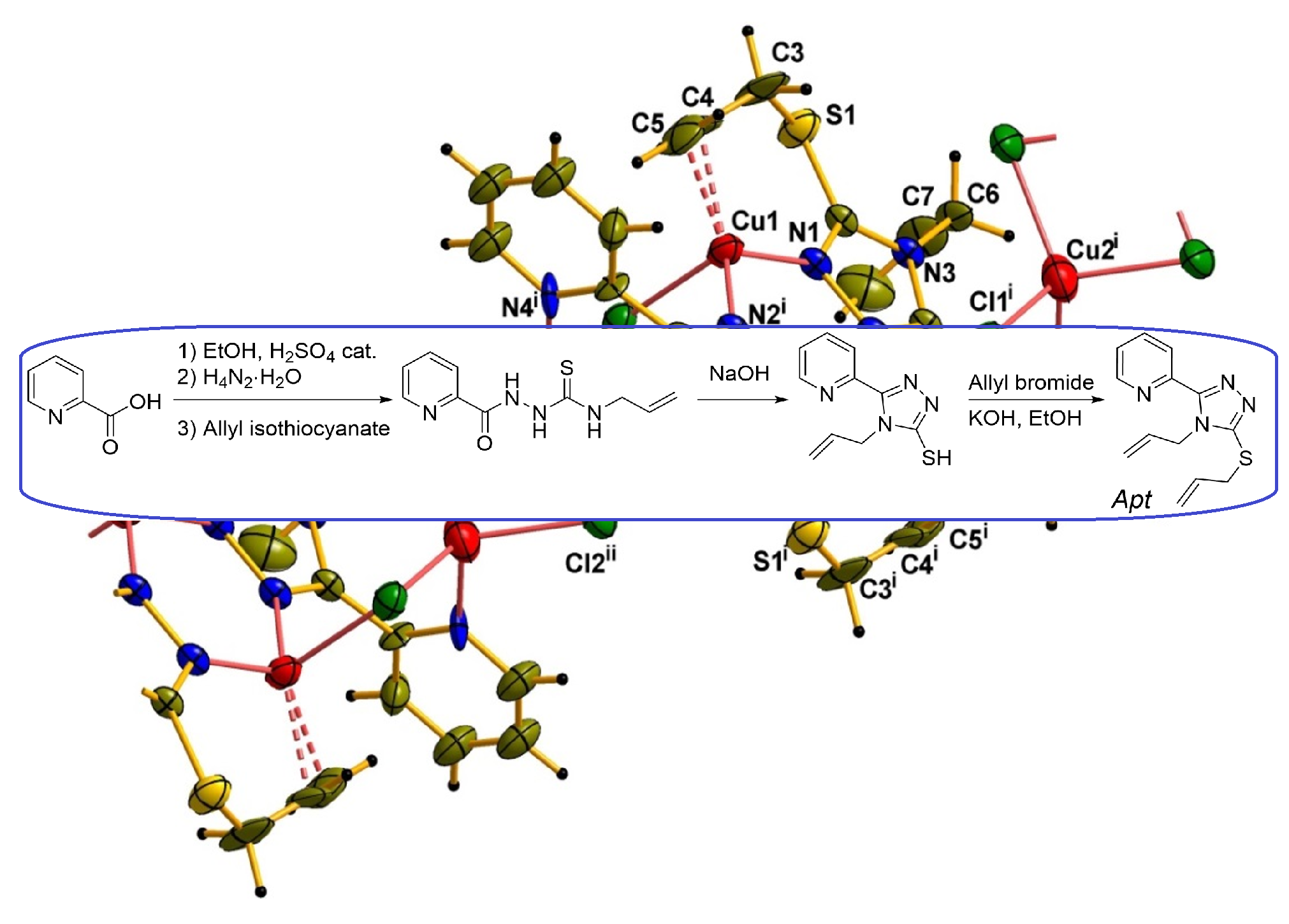
This work is devoted to the synthesis and structure characterization of a new copper(I) η2-π-complex [Cu4(Apt)2Cl4] (1) based on 3-allylthio-4-allyl-5-(2-pyridyl)-4H-1,2,4-triazole (Apt). Crystals of the compound were obtained by means of alternating current-electrochemical technique and studied by X-ray single crystal diffraction. The
π-complex crystallizes in the monoclinic centrosymmetric space group P21/n (a = 10.884(3), b = 10.944(3), c = 13.860(4) Å, β = 93.96(3) °, V = 1647.0(8) Å3, Z = 2) and is built of polymeric chains. In its crystal structure, two crystallographically independent copper(I) atoms have different coordination arrangements: Cu1 forms a close to trigonal-pyramidal coordination environment composed of two triazole N atoms, an allylic C=C bond, and one halogen atom, while distorted tetrahedral surrounding of Cu2 is formed by pyridyl N atom and tree bridging Cl atoms. The pyridyl-substituted 1,2,4-triazole defines the formation of an infinite coordination polymer in 1.
References
Ji Ram, V., Sethi, A., Nath M., Pratap, R. (2019). Five-Membered Heterocycles. In: The Chemistry of Heterocycles. Elsevier. https://doi.org/10.1016/B978-0-08-101033-4.00005-X
Sandoval, K.E., Witt, K.A., Crider, A.M., Kontoyianni, M. (2014). Somatostatin receptor-4 agonists as candidates for treatment of Alzheimer’s disease. In: Drug Design and Discovery in Alzheimer’s Disease. Elsevier, pp 566–597. https://doi.org/10.1016/B978-0-12-803959-5.50012-X
Opsomer T., Dehaen W. (2020). 1,2,4-Triazoles. In: Reference Module in Chemistry, Molecular Sciences and Chemical Engineering. Elsevier. https://doi.org/10.1016/B978-0-12-409547-2.14854-1
Kumar, S., Misra, S.K., Kashaw, S.K., Kashaw, V., Kumar, A. (2026). A comprehensive review on 1,2,4-Triazole: Synthesis, properties and therapeutic potential. Talanta, 305, 129543. https://doi.org/10.1016/j.talanta.2026.129543
Zakopailo, D., Blashchak, Y., Тupychak, M., Finiuk, N., Pokhodylo, N. (2025). Design and synthesis of novel 1H-1,2,3-triazolecarbohydrazides and 1,2,4-triazoloazines based on them for anticancer drug discovery. Med. Chem. Res., 34, 1321–1331. https://doi.org/10.1007/s00044-025-03419-z
Fedko, A. M., Slyvka, Y.I., Goreshnik, E.A., Jȩdryka, J., Rakus, P., Morozov, D. (2025). Crystal structure, computational study and nonlinear optical properties of the novel copper(I) π,σ-complexes based on 3,4-diphenyl-5-allylsulfanyl-4H-1,2,4-triazole. J. Mol. Struct., 1319, 139552. https://doi.org/10.1016/j.molstruc.2024.139552
Hordiichuk, O.R., Slyvka, Y.I., Kinzhybalo, V.V., Goreshnik, E.A., Bednarchuk, T.J., Bednarchuk, O., Jedryka, J., Kityk, I., Mys’kiv, M.G. (2019). Construction of heterometallic and mixed-valence copper(I/II) chloride π-complexes with 1,2,4-triazole allyl-derivative. Inorganica Chim. Acta, 495, 119012. https://doi.org/10.1016/j.ica.2019.119012
Wang, G-X., Xing, Z., Chen, L-Z., Han, G-F. (2015). A ferroelectric olefin–copper(I) organometallic polymer with flexible organic ligand (R)-MbVBP. J. Mol. Struct., 1091, 16–19. https://doi.org/10.1016/j.molstruc.2015.02.043
Cariati, E., Lucenti, E., Botta, C., Giovanella, U., Marinotto, D., Righetto S. (2016). Cu(I) hybrid inorganic–organic materials with intriguing stimuli responsive and optoelectronic properties. Coord. Chem. Rev. 306, 566–614. https://doi.org/10.1016/j.ccr.2015.03.004
Wang, X-S., Zhao, H., Li, Y-H., Xiong, R.-G., You, X.-Z. (2005). Olefin-copper(I) complexes and their properties. Top Catal. 35., 43–61. https://doi.org/10.1007/s11244-005-3812-6
Santini, C., Pellei, M., Gandin, V., Porchia, M., Tisato, F., Marzano, C. (2014). Advances in copper complexes as anticancer agents. Chem. Rev., 114, 815–862. https://doi.org/10.1021/cr400135x
Chen, L., Hu, R., Xu, J., Wang, S., Li, X., Li, S., Yang, G. (2013). Third-order nonlinear optical properties of a series of porphyrin-appended europium(III) bis(phthalocyaninato) complexes. Spectrochim. Acta Part A Mol. Biomol. Spectrosc, 105, 577–581. https://doi.org/10.1016/j.saa.2012.12.063
Le Bozec, H., Guerchais, V. (2013). Photochromic bipyridyl metal complexes: Photoregulation of the nonlinear optical and/or luminescent properties. Comptes Rendus Chim., 16, 1172–1182. https://doi.org/10.1016/j.crci.2013.06.001
Grelaud, G., Cifuentes, M.P., Paul, F., Humphrey, M.G. (2014). Group 8 metal alkynyl complexes for nonlinear optics. J. Organomet. Chem., 751, 181–200. https://doi.org/10.1016/j.jorganchem.2013.10.008
Henchiri, R., Ennaceur, N., Cordier, M., Ledoux-Rak, I., Elaloui, E. (2017). Synthesis, X-ray crystal structure and highly non-linear optical properties of inorganic-organic hybrid compound: 1,4-Diazbicyclo-octane oxonium tri- nitrates single crystal. J. Phys. Chem. Solids., 106, 58–64. https://doi.org/10.1016/j.jpcs.2017.02.011
Green, K.A., Cifuentes, M.P., Samoc, M., Humphrey, M.G. (2011). Syntheses and NLO properties of metal alkynyl dendrimers. Coord. Chem. Rev., 255, 2025–2038. https://doi.org/10.1016/j.ccr.2011.05.017
Green, K.A., Cifuentes, M.P., Samoc, M., Humphrey, M.G. (2011). Metal alkynyl complexes as switchable NLO systems. Coord. Chem. Rev., 255, 2530–2541. https://doi.org/10.1016/j.ccr.2011.02.021
Slyvka, Yu, Fedorchuk, A.A., Goreshnik, E., Pokhodylo, N., Jedryka, J., Ozga K., Mys’kiv, M. (2022). Crystal structure, DFT-study and NLO properties of the novel copper(I) nitrate π,σ-coordination compound based on 1-allyl-3-norbornan-thiourea. Polyhedron, 211, 115545. https://doi.org/10.1016/j.poly.2021.115545
Slyvka, Yu., Goreshnik, E., Pavlyuk, O., Mys’kiv, M. (2013). Copper(I) π-complexes with allyl derivatives of heterocyclic compounds: structural survey of their crystal engineering. Open Chem., 11, 1875–1901. https://doi.org/10.2478/s11532-013-0323-3
Rourke, J. (2006). Christoph Elschenbroich. Organometallics. Wiley-VCH, 2006, 3rd edn, 818 pp. ISBN 3-527-29390-6 (paperback). Appl. Organomet. Chem. 20, 811–811. https://doi.org/10.1002/aoc.1136
Slyvka, Yu., Goreshnik, E., Pokhodylo, N., Morozov, D., Tupychak, M., Mys’kiv, M. (2022). Allylcytisine as a convenient scaffold for the construction of the π,σ-coordination compound {Acyt(H+)}[Cu8{Acyt(H+)}Cl10] with the unusual anionic 1D-coordination polymer. Polyhedron, 224, 116022. https://doi.org/10.1016/j.poly.2022.116022
Goreshnik, E.A., Veryasov, G., Morozov, D., Slyvka, Yu., Ardan, B., Mys’kiv, M.G. (2016). Solvated copper(I) hexafluorosilicate π-complexes based on [Cu2(amtd)2]2+ (amtd = 2-allylamino-5-methyl-1,3,4-thiadiazole) dimer. J. Organomet. Chem., 810, 1–11. https://doi.org/10.1016/j.jorganchem.2016.03.001
Yang, L., Powell, D.R., Houser, R.P. (2007). Structural variation in copper(I) complexes with pyridylmethylamide ligands: structural analysis with a new four-coordinate geometry index, τ4. Dalt. Trans. 955–964. https://doi.org/10.1039/B617136B
Sheldrick, G.M. (2015). SHELXT – Integrated space-group and crystal-structure determination, Acta Crystallogr. Sect. A Found. Adv., 71, 3–8. https://doi.org/10.1107/S2053273314026370
Sheldrick G.M. (2015). Crystal structure refinement with SHELXL, Acta Crystallogr. Sect. C Struct. Chem., 71 3–8. https://doi.org/10.1107/S2053229614024218
Dolomanov, O. V., Bourhis, L.J., Gildea, R.J., Howard, J.A.K., Puschmann, H. (2009). OLEX2 : a complete structure solution, refinement and analysis program, J. Appl. Crystallogr. 42, 339–341. https://doi.org/10.1107/S0021889808042726
Downloads
Published
Issue
Section
License
Copyright (c) 2026 Oles Honchar Dnipro National University

This work is licensed under a Creative Commons Attribution 4.0 International License.
- Authors reserve the right of attribution for the submitted manuscript, while transferring to the Journal the right to publish the article under the Creative Commons Attribution License. This license allows free distribution of the published work under the condition of proper attribution of the original authors and the initial publication source (i.e. the Journal)
- Authors have the right to enter into separate agreements for additional non-exclusive distribution of the work in the form it was published in the Journal (such as publishing the article on the institutional website or as a part of a monograph), provided the original publication in this Journal is properly referenced
- The Journal allows and encourages online publication of the manuscripts (such as on personal web pages), even when such a manuscript is still under editorial consideration, since it allows for a productive scientific discussion and better citation dynamics (see The Effect of Open Access).