ELECTROCHEMICAL EXTRACTION OF NICKEL FROM METHANESULFONATE SOLUTION IN THE PRESENCE OF SODIUM CUMENESULFONATE
DOI:
https://doi.org/10.15421/jchemtech.v34i2.356926Keywords:
electroextraction, nickel, sodium cumenesulfonate, structure, internal stressesAbstract
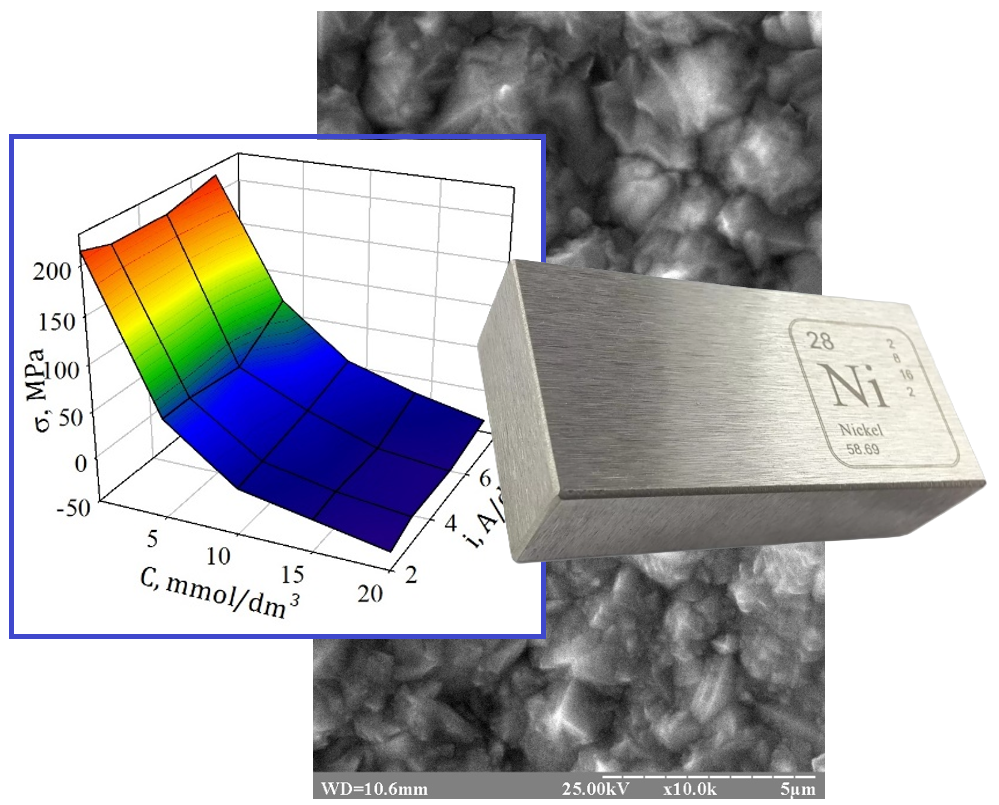
The work is devoted to solving an urgent scientific and practical problem involving the processing of nickel-containing heat-resistant alloys, with the extraction of nickel via electroextraction from leaching solutions. Nickel is one of the strategically important metals that are widely used in the defense-industrial complex, and its secondary use is of priority importance due to the limited natural resources and the high cost of primary production. The high purity of the nickel obtained from the processing of heat-resistant alloy waste is achieved through the use of electrochemical methods to extract the metal from leaching solutions. In the work, a new methanesulfonate solution was used as the leaching medium. Electrochemically deposited nickel is characterized by significant internal tensile stresses, which can cause its delamination from the cathode surface. The work established that the formation of nickel deposits with a reduced level of internal stresses requires the use of sulfur-containing organic modifiers. During their electrochemical decomposition on the surface of the nickel electrode, sulfur is incorporated into the deposit in concentrations close to the maximum permissible, which ensures an effective reduction in internal stresses due to the formation of a solid solution of sulfur in nickel. At the same time, the content of hydrocarbon decomposition products of additives in the coating should be minimized. It has been shown that the addition of sodium cumenesulfonate to a methanesulfonate solution in an amount of 10 mmol/l reduces the internal stresses of nickel to almost zero. It was found that in the methanesulfonate solution there is a wider range of current densities in which nickel can be deposited with constant internal stress values compared to the sulfate solution.
References
Sun, H., Wu, X., Wang, X., Liu, J., He, G. (2024). End-of-life nickel recycling: Energy security and circular economy development. Resources Policy, 98, 105308. https://doi.org/10.1016/j.resourpol.2024.105308
Henckens, M.L.C.M., Worrell, E. (2020). Reviewing the availability of copper and nickel for future generations. The balance between production growth, sustainability and recycling rates. Journal of Cleaner Production, 264, 121460. https://doi.org/10.1016/j.jclepro.2020.121460
Tian, Q., Gan, X., Cui, F.,Yu, D., Guo, X. (2021). Selective Extraction of Ni from Superalloy Scraps by Molten Mg-Zn. Metals, 11, 993. https://doi.org/10.3390/met11060993
Meshram, P., Abhilash, Pandey, B. D. (2018). Advanced review on extraction of nickel from primary and secondary sources. Mineral Processing and Extractive Metallurgy Review, 40(3), 157–193. doi: 10.1080/08827508.2018.1514300
Zhang, Z., Huang, H., Zhang, Z., Wang, Y., Zhu, B., Zhao, H. (2024). A review of the microstructure and properties of superalloys regulated by magnetic field. Journal of Materials Research and Technology, 30, 9285-9317. https://doi.org/10.1016/j.jmrt.2024.05.189
Srivastava, R. R., Kim, M., Lee, J., Jha, M. K., Kim, B. (2014). Resource recycling of superalloys and hydrometallurgical challenges. Journal of Materials Science, 49, 4671–4686. doi 10.1007/s10853-014-8219-y
Xia, W., Zhao, X., Yue, L., Zhang, Z. (2020). A review of composition evolution in Ni-based single crystal superalloys. Journal of Materials Science & Technology, 44, 76–95 https://doi.org/10.1016/j.jmst.2020.01.026.
Horst, O., Adler, D., Adler, P., Wang, H., Streitberger, J., Streitberger, M., Jöns, N., Singer, R.F., Körner, C., Eggeler, G. (2020). Exploring the fundamentals of Ni-based superalloy single crystal (SX) alloy design: Chemical composition vs. Microstructure. Materials & Design, 195, 108976. https://doi.org/10.1016/j.matdes.2020.108976.
Szczucka-Lasota, B., Szymczak, T., Wegrzyn, T., Tarasiuk, W. (2023). Superalloy–Steel Joint in Microstructural and Mechanical Characterisation for Manufacturing Rotor Components. Materials, 16, 2862. https://doi.org/10.3390/ma16072862
Yu, D.W., Gan, X.D., Cui, F.H., Guo, X.Y., Tian, Q.H. (2021). Dissolution behavior of nickel-based superalloy in molten zinc: Its mechanism and kinetics. J. Alloys Compd, 878, 160338.
Junior, A.B.B., Kim, J. (2026). Recycling of superalloys: circular strategies for critical mineral supply chain resilience. Resources, Conservation and Recycling, 229, 108859. https://doi.org/10.1016/j.resconrec.2026.108859
Kim, M.S., Lee, J.C., Park, H.S., Jun M.J., Kim B.S. (2018). A multistep leaching of nickel-based superalloy scrap for selective dissolution of its constituent metals in hydrochloric acid solutions. Hydrometallurgy, 176, 235-242. https://doi.org/10.1016/j.hydromet.2018.02.002
Liu, J., Tang, J., Sun, Y., Zhou, Y., Shi, F. (2024). Recovery of Ni and Co Elements from Superalloy Leaching Solution by Sodium Roasting and Water Leaching. Journal of Materials Science & Technology, 76, 3393–3401. https://doi.org/10.1007/s11837-024-06441-5
Cui, F., Wang, G., Yu, D., Gan, X., Tian, Q., Guo X. (2020). Towards “zero waste” extraction of nickel from scrap nickel-based superalloy using magnesium. Journal of Cleaner Production, 262(20), 121275. https://doi.org/10.1016/j.jclepro.2020.121275
Alvial-Hein, G., Mahandra, H., Ghahreman, A. (2021). Separation and recovery of cobalt and nickel from end of life products via solvent extraction technique: A review. Journal of Cleaner Production, 297, 126592. https://doi.org/10.1016/j.jclepro.2021.126592
Kollová, A., Pauerová, K. (2022). Superalloys – characterization, usage and recycling. Manufacturing technology, 22 (5). doi: 10.21062/mft.2022.070
Kim, K., Raymond, D., Candeago, R. Su, X. (2021). Selective cobalt and nickel electrodeposition for lithium-ion battery recycling through integrated electrolyte and interface control. Nat Commun, 12, 6554. https://doi.org/10.1038/s41467-021-26814-7
Kim, K., Candeago, R., Rim, G., Raymond, D., Park, A.A., Su, X. (2021). Electrochemical approaches for selective recovery of critical elements in hydrometallurgical processes of complex feedstocks. iScience, 24(5), 102374. doi: 10.1016/j.isci.2021.102374
Choi, W.-S., Cho, S.-H., Lee, Y.-J., Kim, Y.-S., Lee, J.-H. (2015). Separation behavior of nickel and cobalt in a LiCl-KCl-NiCl2 molten salt by electrorefining process. J. Electroanal. Chem. 866, 114175. https://doi.org/10.1016/j.jelechem.2020.114175
Sknar, Yu.E., Savchuk, O.O., Sknar, I.V., Danilov, F.I. (2018). Electrolytic Codeposition of Nickel and Phosphorus from Methanesulfonate Electrolyte. Surface Engineering and Applied Electrochemistry, 54, 125–130. doi: 10.3103/S1068375518020138
Danilov, F.I.,Tkach, I.G., Sknar, I.V., Sknar, Y.E. (2014). Ni-Co alloy coatings obtained from methanesulfonate electrolytes. Protection of Metals and Physical Chemistry of Surfaces, 50, 639–642. https://doi.org/10.1134/S2070205114050062
Mieszkowska, M., Grdeń, M. (2021). Electrochemical deposition of nickel targets from aqueous electrolytes for medical radioisotope production in accelerators: a review. Journal of Solid State Electrochemistry, 25, 1699–1725. https://doi.org/10.1007/s10008-021-04950-w
Mohanty, U.S., Tripathy, B.C., Singh, P., Keshavarz, A., Iglauer, S. (2019). Roles of organic and inorganic additives on the surface quality, morphology, and polarization behavior during nickel electrodeposition from various baths: a review. Journal of Applied Electrochemistr, 49, 847–870. https://doi.org/10.1007/s10800-019-01335-w
Baraniak, M., Lota, G., Wojciechowski, J., Walkiewicz, F., Regel-Rosocka, M. (2023). Effect of Versenium Hydrogensulfate on Properties of Nickel Coatings. Materials, 16, 4101. https://doi.org/10.3390/ma16114101
Mbugua, N.S., Kang, M., Zhang, Y., Ndiithi, N.J., Bertrand, G.V., Yao, L. (2020). Electrochemical Deposition of Ni, NiCo Alloy and NiCo-Ceramic Composite Coatings-A Critical Review. Materials, 13(16), 3475. doi: 10.3390/ma13163475
Sknar, Y.E., Sknar, I.V., Butyrina, T.E. (2025). Electrochemical discharge of nickel with low internal stresses. Journal of Chemistry and Technologies, 33(1), 117–122.
Kotok, V., Sknar, Y., Butyrina, T., Sknar, I., Sukha, I., Demchyshyna, O. (2025). Determination of the efficiency and selectivity of anodic dissolution of a heat-resistant rhenium-containing superalloy in chloride-containing media with sulfuric or methanesulfonic acids. Eastern-European Journal of Enterprise Technologies, 5(6-137), 32–40. https://doi.org/10.15587/1729-4061.2025.342421
Sknar, Y., Sknar, I., Cheremysinova, A., Yermolenko, I., Karakurkchi, A., Mizin, V., Proskurina, V., Sachanova, Y. (2017). Research into composition and properties of the Ni-Fe electrolytic alloy. Eastern-European Journal of Enterprise Technologies, 4(12-88), 4–10. doi: 10.15587/1729-4061.2017.106864
Mikhailov, I.F., Baturin, A.A., Mikhailov, A.I., Fomina, L.P. (2016). Perspectives of development of X-ray analysis for material composition. Functional Materials, 23, 5-14. http://dx.doi.org/10.15407/fm23.01.005
Oriňáková, R., Turoňová, A., Kladeková, D., Gálová, M., Smith, R.M. (2006). Recent developments in the electrodeposition of nickel and some nickel-based alloys. Journal of Applied Electrochemistry, 36, 957–972. doi:10.1007/s10800-006-9162-7.
Epelboin, I., Joussellin, M., Wiart, R. (1981). Impedance measurements for nickel deposition in sulfate and chloride electrolytes. Journal of Electroanalytical Chemistry, 119, 61–71. https://doi.org/10.1016/S0022-0728(81)80124-6
Sknar, Y.E., Sknar, I.V., Savchuk, O.O., Hrydnieva, T.V., Butyrina, O.D. (2023). Electrodeposition of Ni-zirconia or Ni-titania composite coatings from a methanesulfonic acid bath. Surface & Coatings Technology, 452, 129120. https://doi.org/10.1016/j.surfcoat.2022.129120
Downloads
Published
Issue
Section
License
Copyright (c) 2026 Oles Honchar Dnipro National University

This work is licensed under a Creative Commons Attribution 4.0 International License.
- Authors reserve the right of attribution for the submitted manuscript, while transferring to the Journal the right to publish the article under the Creative Commons Attribution License. This license allows free distribution of the published work under the condition of proper attribution of the original authors and the initial publication source (i.e. the Journal)
- Authors have the right to enter into separate agreements for additional non-exclusive distribution of the work in the form it was published in the Journal (such as publishing the article on the institutional website or as a part of a monograph), provided the original publication in this Journal is properly referenced
- The Journal allows and encourages online publication of the manuscripts (such as on personal web pages), even when such a manuscript is still under editorial consideration, since it allows for a productive scientific discussion and better citation dynamics (see The Effect of Open Access).