HYBRID PROCESSES AND TECHNOLOGICAL SOLUTIONS AS A FACTOR IN THE INTENSIFICATION AND TRANSFORMATION OF CHEMICAL AND FOOD ENGINEERING: A SYSTEMATIC REVIEW
DOI:
https://doi.org/10.15421/jchemtech.v34i2.359137Keywords:
chemical engineering, food engineering, chemical technology, food technology, heat transfer, mass transfer, hybrid processes, synergistic effect, synergy, process intensification, project design, artificial intelligenceAbstract
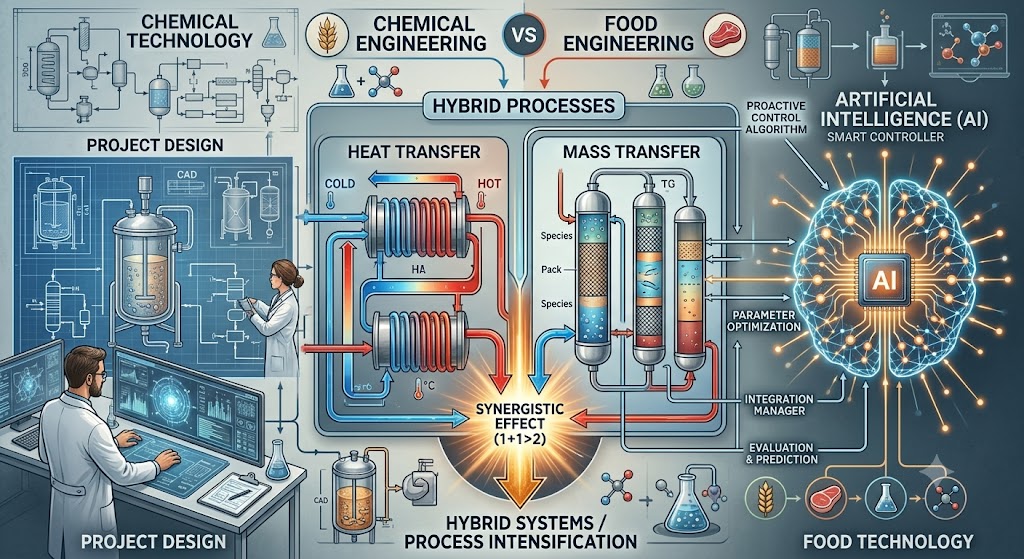
This article provides a systematic review of current trends in intensifying technological processes in chemical and food engineering. It focuses on hybrid methods of drying, separation, and extraction, which have been extensively studied in recent publications (2021–2026). These studies reveal interest in using nanofluids as heat transfer fluids, employing combined drying systems, using membrane-integrated reactors, and employing extraction technologies based on deep eutectic solvents. Combining physical effects (e.g., ultrasound, microwaves, radio frequencies, and magnetic fields) with traditional processes creates synergistic effects, including increased heat and mass transfer coefficients, reduced operation times, and preserved bioactive components. For instance, energy consumption in combined drying units is reduced by tens of percent compared to conventional units, while product quality is preserved. Membrane-integrated reactors and process systems using deep eutectic solvents show promise, though long-term stability and safety must be confirmed. After summarizing the discussed material, the author proposed a simple classification of hybrid heat and mass transfer processes, which improves understanding of the subject.
References
Scott, T. O., Ewim, D. R. E., Eloka-Eboka, A. C. (2022). Hybrid nanofluids flow and heat transfer in cavities: A technological review. International Journal of Low-Carbon Technologies, 17, 1104–1123. https://doi.org/10.1093/ijlct/ctac093
Arya, S. S., More, P. R., Ladole, M. R., Pegu, K., Pandit, A. B. (2023). Non-thermal, energy efficient hydrodynamic cavitation for food processing, process intensification and extraction of natural bioactives: A review. Ultrasonics Sonochemistry, 98, 106504. https://doi.org/10.1016/j.ultsonch.2023.106504.
Mujumdar, A. S., Devahastin, S., Shirkole, S. S. (2025). Impact of drying technology on stimulating academic and industrial R&D on a global scale. Drying Technology, 44(1), 1–3. https://doi.org/10.1080/07373937.2025.2600254.
Haase, S., Tolvanen, P., Russo, V. (2022). Process intensification in chemical reaction engineering. Processes, 10(1), 99. https://doi.org/10.3390/pr10010099.
Arteaga-Cabrera, E., Ramírez-Márquez, C., Sánchez-Ramírez, E., Segovia-Hernández, J. G., Osorio-Mora, O., Gómez-Salazar, J. R. (2025). Advancing optimization strategies in the food industry: From traditional approaches to multi-objective and technology-integrated solutions. Applied Sciences, 15(7), 3846. https://doi.org/10.3390/app15073846.
Hoff, K. L., Eisenacher, M. (2025). Process intensification strategies for esterification: Kinetic modeling, reactor design, and sustainable applications. International Journal of Molecular Sciences, 26(15), 7214. https://doi.org/10.3390/ijms26157214.
Liu, C., Zhao, Q., Ma, X., He, C., Zou, X., Gong, F., Liu, Y., Lei, J., Xiong, Z., Liu, J. (2026). Novel green solvent–in situ ultrasound synergistic extraction of phenolic acids from Lonicera japonica Thunb. Ultrasonics Sonochemistry, 127, 107779. https://doi.org/10.1016/j.ultsonch.2026.107779
Vallejo, J. P., Prado, J. I., Lugo, L. (2021). Hybrid or mono nanofluids for convective heat transfer applications: A critical review of experimental research. Applied Thermal Engineering, 203, 117926. https://doi.org/10.1016/j.applthermaleng.2021.117926.
Nagaraja, K. V., Khan, U., Madhukesh, J. K., Hassan, A. M., Prasannakumara, B. C., Kahla, N. B., Elattar, S., Chohan, J. S. (2023). Heat and mass transfer analysis of assisting and opposing radiative flow conveying ternary hybrid nanofluid over an exponentially stretching surface. Scientific Reports, 13, 14795. https://doi.org/10.1038/s41598-023-41916-6. .
Asmadi, M. S., Siri, Z., Kasmani, R. M., Saleh, H. (2022). Nanoparticle shape effect on the natural-convection heat transfer of hybrid nanofluid inside a U-shaped enclosure. Thermal Science, 26(1 Part B), 463–475. https://doi.org/10.2298/TSCI200818139A.
Kumar, A., Singh, S., Tailor, T. (2025). Heat and mass transfer in hybrid nanofluids with MHD and entropy effects. International Journal of Environmental Sciences, 11(23), 3821–3830. https://doi.org/10.64252/9qm3n935.
Sniezhkin, Y., Petrova, Z., Bessarab, J., Samoilenko, K., Grakov, D., Petrov, P. (2023). Intensification of drying process of shiitake mushroom (Lentinula edodes). Ukrainian Food Journal, 12(3), 444–457. https://doi.org/10.24263/2304-974X-2023-12-3-10.
Bulantekin, Ö., Kuşçu, A. (2024). Evaluation of microwave vacuum drying combined with explosion puffing drying and compared with microwave vacuum drying and hot-air drying by the quality of the dried apple slices. Cogent Food & Agriculture, 10(1), 2404699. https://doi.org/10.1080/23311932.2024.2404699.
Duc, L. A., Kien, P. V., Tan, N. T., Son, D. T., Nguyen, N. V., & Nguyen, N. X. (2023). Heat and mass transfer in drying of carrot by radio frequency assisted heat pump drying. Frontiers in Heat and Mass Transfer, 20, 1–6. https://doi.org/10.5098/hmt.20.25. .
Kuzminchuk, N., Atamanyuk, V. (2025). Heat transfer process during filtration drying of match splints. Environmental Problems, 10(1), 72–78. https://doi.org/10.23939/ep2025.01.072.
Kotov, B., Voitiuk, V., Kalinichenko, R., Stepanenko, S., Kuzmych, A. (2025). Mathematical modelling and investigation of the grain drying process in bunker units with radial supply of drying agent. Machinery and Energetics, 16(3), 33–47. https://doi.org/10.31548/machinery/3.2025.33.
Liu, S., Li, H., Kruber, B., Skiborowski, V., Gao, X. (2022). Process intensification by integration of distillation and vapor permeation or pervaporation: An academic and industrial perspective. Results in Engineering, 15, 100527. https://doi.org/10.1016/j.rineng.2022.100527.
Li, J., Wang, T. (2025). Environment-oriented assessment of hybrid methods for separation of N-propanol–water mixtures: Combination of distillation and hydrophilic pervaporation processes. Membranes, 15(2), 48. https://doi.org/10.3390/membranes15020048.
Kabawa, B., Sampers, I., Raes, K. (2026). Unveiling synergy in ultrasound-assisted enzymatic extraction: Role of treatment sequence and biomass complexity. Ultrasonics Sonochemistry, 125, 107749. https://doi.org/10.1016/j.ultsonch.2026.107749.
Liu, Y., Zhe, W., Zhang, R., Peng, Z., Wang, Y., Gao, H., Guo, Z., Xiao, J. (2022). Ultrasonic-assisted extraction of polyphenolic compounds from Paederia scandens (Lour.) Merr. Using deep eutectic solvent: Optimization, identification, and comparison with traditional methods. Ultrasonics Sonochemistry, 86, 106005. https://doi.org/10.1016/j.ultsonch.2022.106005.
Kuzyk, O. O., Atamanyuk, V. M., Gumnitsky, Y. M., Ivashchuk, O. S. (2025). Mass transfer during the dissolution of sodium tetraborate in water intensified by mechanical stirring. Journal of Chemistry and Technologies, 33(3), 901–910. https://doi.org/10.15421/jchemtech.v33i3.331092.
Kuzyk, O., Atamaniuk, V., Gumnitsky, Y. (2024). Mass transfer during boric acid dissolution. Chemistry Chemical Technology, 18(3), 393–400. https://doi.org/10.23939/chcht18.03.393.
Pavlenko, A. (2025). Analysis of methods for intensifying heat and mass transfer in liquid media. Energies, 18(6), 1419. https://doi.org/10.3390/en18061419.
Založnik, M., Zadravec, M. (2025). Analysis of gas flow distribution in a fluidized bed using two-fluid model with kinetic theory of granular flow and coupled CFD-DEM: A numerical study. Strojniški vestnik – Journal of Mechanical Engineering, 71(9–10), 349–356. https://doi.org/10.5545/sv-jme.2025.1365.
Szpicer, A., Bińkowska, W., Stelmasiak, A., Zalewska, M., Wojtasik-Kalinowska, I., Piwowarski, K., Piepiórka-Stepuk, J., Półtorak, P. (2025). Computational fluid dynamics simulation of thermal processes in food technology and their applications in the food industry. Applied Sciences, 15(1), 424. https://doi.org/10.3390/app15010424.
Kornienko, Y., Haidai, S., Sameliuk, O. (2023). Increasing the efficiency of transfer processes when using inhomogeneous fluidization. Bulletin of National Technical University of Ukraine “Igor Sikorsky Kyiv Polytechnic Institute” Series “Chemical Engineering, Ecology and Resource Saving, 22(1), 9–19. https://doi.org/10.20535/2617-9741.1.2023.276443.
Elwakeel, A. E., Ali, G., Eldin, A. Z., Alsebiey, M. M., Tantawy, A.A., Al-Harbi, M.S., Ahmed, A.F., Metwally, K.A. (2025). Influence of physical shape and salting on tomato drying performance using mixed mode solar and open-air methods in semi-cloudy weather. Scientific Reports, 15, 26340. https://doi.org/10.1038/s41598-025-11194-5.
Shen, L., Pang, S., Zhong, M., Sun, Y., Qayum, A., Liu, Y., Rashid, A., Xu, B., Liang, Q., Ma, H., Ren, X. (2023). A comprehensive review of ultrasonic assisted extraction (UAE) for bioactive components: Principles, advantages, equipment, and combined technologies. Ultrasonics Sonochemistry, 101, 106646. https://doi.org/10.1016/j.ultsonch.2023.106646.
Yu, P., Zhu, W., Shen, C., Qiao, Y., Zhang, W., Zhu, Y., Gong, J., Cai, J. (2025). Current status of grain drying technology and equipment development: A review. Foods, 14(14), 2426. https://doi.org/10.3390/foods14142426.
Grillo, J., Cintas, P., Colia, M., Gaudino, E. C., Gravotto, G. (2022). Process intensification in continuous flow organic synthesis with enabling technologies. Frontiers in Chemical Engineering, 4, 1–23. https://doi.org/10.3389/fceng.2022.966451.
Khan, M. N., Boorsma, E., Vandezande, P., Lammerink, I., de Lange, R., Buekenhoudt, A., Van Dael, V. (2025). Unlocking the benefits of hybrid and standalone pervaporation for IPA dehydration. Membranes, 15(8), 224. https://doi.org/10.3390/membranes15080224.
Do Thi, H. T., Tóth, A. J. (2024). Environmental evaluation and comparison of hybrid separation methods based on distillation and pervaporation for dehydration of binary alcohol mixtures with life cycle, PESTLE, and multi-criteria decision analyses. Separation and Purification Technology, 348, 127684. https://doi.org/10.1016/j.seppur.2024.127684.
Downloads
Published
Issue
Section
License
Copyright (c) 2026 Oles Honchar Dnipro National University

This work is licensed under a Creative Commons Attribution 4.0 International License.
- Authors reserve the right of attribution for the submitted manuscript, while transferring to the Journal the right to publish the article under the Creative Commons Attribution License. This license allows free distribution of the published work under the condition of proper attribution of the original authors and the initial publication source (i.e. the Journal)
- Authors have the right to enter into separate agreements for additional non-exclusive distribution of the work in the form it was published in the Journal (such as publishing the article on the institutional website or as a part of a monograph), provided the original publication in this Journal is properly referenced
- The Journal allows and encourages online publication of the manuscripts (such as on personal web pages), even when such a manuscript is still under editorial consideration, since it allows for a productive scientific discussion and better citation dynamics (see The Effect of Open Access).