DENSITY FUNCTIONAL THEORY INVESTIGATION AND MOLECULAR DOCKING ANALYSIS OF HYDROGEN-BONDED COMPLEXES OF CYANURIC ACID WITH ORTHOPHOSPHORIC ACID: STRUCTURAL, ELECTRONIC, AND SPECTROSCOPIC CHARACTERIZATION
DOI:
https://doi.org/10.15421/jchemtech.v34i2.361596Keywords:
cyanuric acid, orthophosphoric acid, DFT; B3LYP/3-21G, hydrogen bond, molecular docking, ArgusLab, HOMO–LUMO, Mulliken charges, electrophilicity, infrared spectroscopy, supramolecular complexAbstract
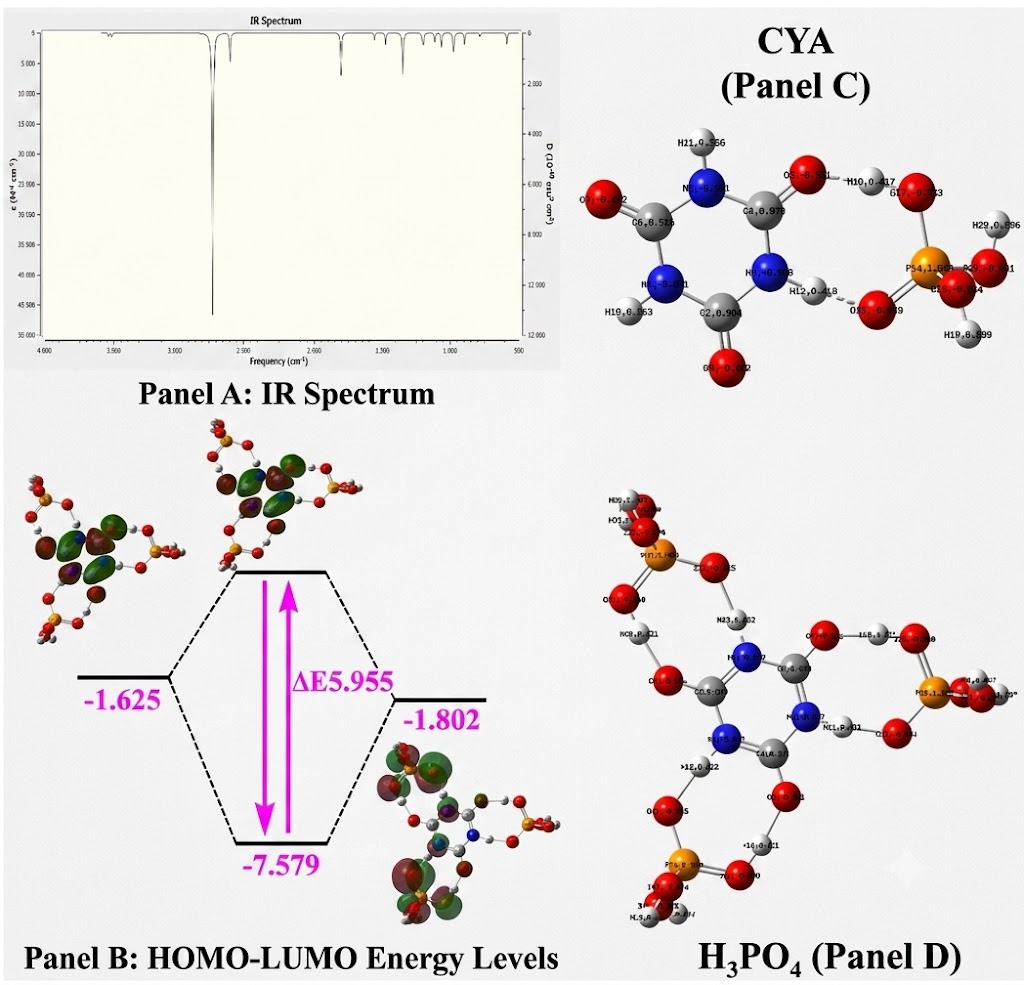
Two hydrogen-bonded molecular complexes of cyanuric acid (C₃H₃N₃O₃, CYA) with orthophosphoric acid (H₃PO₄) in 1 : 1 and 1 : 3 molar ratios were investigated by a combination of density functional theory (DFT) calculations, molecular docking (ArgusLab), and Fourier-transform infrared (FTIR) spectroscopy. Full geometry optimizations and harmonic frequency calculations were performed at the B3LYP/3-21G level using Gaussian 16. Both complexes were confirmed as true energy minima. The 1:1 complex features two intermolecular hydrogen bonds — N3–H···O(P) (H···O = 1.564 Å; N···O = 2.628 Å) and O(C=O)···H–O(P) (H···O = 1.528 Å) — while the 1:3 complex displays a symmetric, C₃-like arrangement in which each of the three carbonyl/N–H pairs of the triazine ring engages one H₃PO₄ molecule through equivalent dual hydrogen bonds. The HOMO–LUMO energy gaps of 5.672 eV and 5.955 eV for the 1:1 and 1 : 3 complexes, respectively, indicate moderate reactivity and enhanced kinetic stability upon progressive phosphorylation. Global reactivity descriptors — ionization potential, electron affinity, chemical hardness, chemical potential, and electrophilicity index — reveal quantitative differences between the two assemblies. Mulliken population analysis shows significant polarization at N, C=O, and P=O sites. Molecular docking calculations in ArgusLab yielded binding energies of −11.3 kcal/mol (1 : 1) and −27.6 kcal/mol (1 : 3), consistent with the formation of stable supramolecular adducts. Calculated vibrational frequencies reproduce the experimentally observed red-shifts of ν(N–H), ν(C=O), and ν(P=O) bands with good fidelity, supporting the proposed interaction mode. These results advance quantitative understanding of triazine–phosphate supramolecular chemistry relevant to flame-retardant design, crystal engineering, and biomedical materials.
References
Petelski, A. N., Peruchena, N., Pamies, S. C., Sosa, G. L. (2017). Insights into the self-assembly steps of cyanuric acid toward rosette motifs: a DFT study. Journal of Molecular Modeling, 23, 1–13. https://doi.org/10.1007/s00894-017-3428-3
Desiraju, G.R. (2002). Crystal engineering: a holistic view. Accounts of Chemical Research, 35(7), 565–573.
Roy, B., Bairi, P., Nandi, A. K. (2014). Supramolecular assembly of melamine and its derivatives: nanostructures to functional materials. RSC advances, 4(4), 1708–1734.
Perkins, J., Kim, B., Whitesides, G.M. (1991). Complementary hydrogen bonding and the regularity of co-crystallization. Journal of the American Chemical Society, 113(22), 8560–8561.
Larson, S.B., Simonsen, S.H. (1976). The crystal structure of cyanuric acid. Acta Crystallographica Section B, 32(2), 1048–1052.
Zhang, Z., Ye, Y., Xiang, S., Chen, B. (2022). Exploring multifunctional hydrogen-bonded organic framework materials. Accounts of Chemical Research, 55(24), 3752–3766. https://doi.org/10.1021/acs.accounts.2c00686
Lin, R. B., Chen, B. (2022). Hydrogen-bonded organic frameworks: Chemistry and functions. Chem, 8(8), 2114–2135. https://doi.org/10.1016/j.chempr.2022.06.015
Gašparič, L., Poberžnik, M., Kokalj, A. (2022). DFT study of hydrogen bonding between metal hydroxides and organic molecules containing N, O, S, and P heteroatoms: clusters vs. surfaces. Chemical Physics, 559, 111539. https://doi.org/10.1016/j.chemphys.2022.111539
Gao C., Hu M., Wang L., Wang L. (2020). Synthesis and properties of phosphoric acid-doped polybenzimida-zole with hyperbranched cross-linking imidazole groups as high-temperature proton exchange membranes. Polymers, 12(3), 515. https://doi.org/10.3390/polym12030515
Horacek, H. (2024). Common features and the unique role of phosphorus in bioproducts ATP, DNA, and in intumescent flame retardants. Open Access Library Journal, 11(7), 1–29.
Koch, W., Holthausen, M.C. (2001). A Chemist's Guide to Density Functional Theory (2nd ed.). Wiley-VCH, Weinheim.
Stone, A. M., Golden, A. R., Daniel, S. M., Rheingold, A. L., Protasiewicz, J. D. (2024). Hydrogen Bonding vs Dihydrogen Bonding in the Air Stable Primary Phosphine ortho‐Phosphinophenol. European Journal of Inorganic Chemistry, 27(25), e202400260. https://doi.org/10.1002/ejic.202400260
Kanmazalp, S. D., Dege, N., Baildya, N., Adhikari, S. (2024). Exploring the supramolecular features, computational studies, and molecular docking studies of a carbamate Schiff base. Letters in Organic Chemistry, 21(7), 568–574. https://doi.org/10.2174/0115701786283444231128061732
Thompson, M.A. (2004). ArgusLab 4.0: a molecular modeling, graphics, and drug design program. Planaria Software LLC, Seattle, WA. www.arguslab.com
Soofi, A., Rezaei-Tavirani, M., Safari-Alighiarloo, N. (2023). In silico screening of inhibitors against human dihydrofolate reductase to identify potential anticancer compounds. Journal of Biomolecular Structure and Dynamics, 41(23), 14497–14509. https://doi.org/10.1080/07391102.2023.2183038
Ganiev, B.Sh., Aslonova, F.S. (2023). Investigation of global descriptors and reactivity of cyanuric acid semicarbazone using DFT. Journal of Science, Research and Teaching, 2(5), 124–133.
Amrullaev, A., Boltaeva, S., Rashitova, S., Ganiev, B. (2024). Synthesis and study of sorption properties of oligo(poly)mer sorbents based on urea-formaldehyde and cyanuric acid. BIO Web of Conferences, 130, 06004.
Aslonova, F.S., Mardonov, U.M., Ganiev, B.Sh., Kholikova, G.K. (2025). Synthesis and IR spectroscopy analysis of the adduct of cyanuric acid and metaphosphoric acid. Proceedings of the International Scientific-Practical Conference “Problems of Chemical Science, Its Application in Industry and Green Technologies”, 680–682.
Mardonov, U.M., Aslonova, F.S., Kholikova, G.K. (2026). Study of the reaction products of cyanuric acid with meta- and orthophosphoric acids by infrared spectroscopy. Universum: Chemistry and Biology, 1(139), 65–69.
Frisch M.J., Schlegel H.B., Scuseria G.E., Robb M.A., Cheeseman J.R., Scalmani G., Fox D.J. (2019). Gaussian 16, Revision C.01. Gaussian, Inc., Wallingford CT.
Becke, A. D. (1993). Density-functional thermochemistry. III. The role of exact exchange. The Journal of Chemical Physics, 98(7), 5648–5652.
Lee, C., Yang, W., Parr, R.G. (1988). Development of the Colle-Salvetti correlation-energy formula into a functional of the electron density. Physical Review B, 37(2), 785–789.
Binkley, J. S., Pople, J. A., Hehre, W. J. (1980). Self-consistent molecular orbital methods. 21. Small split-valence basis sets for first-row elements. Journal of the American Chemical Society, 102(3), 939–947.
Chemcraft 1.8 (2015). Molecular visualization program. http://www.chemcraftprog.com
Thompson, M.A., Glendening, E.D. (2004). ArgusLab docking engine. Planaria Software LLC. http://www.arguslab.com
Chakraborty, S., Ray, S., Banerjee, S. (2024). Drug Repurposing in Quest for Newer Therapeutic Options Against Cancer. Computational Biology in Drug Discovery and Repurposing, 251–322.
Šmydke, J. (2023). Using Koopmans’ theorem for constructing basis sets: approaching high Rydberg excited states of lithium with a compact Gaussian basis. Physical Chemistry Chemical Physics, 25(30), 20250–20258. https://doi.org/10.1039/D2CP04633D
Parr, R.G., Yang, W. (1989). Density-Functional Theory of Atoms and Molecules. Oxford University Press, New York.
Parr, R.G., Szentpály, L.V., Liu, S. (1999). Electrophilicity index. Journal of the American Chemical Society, 121(9), 1922–1924.
Yu, J., Yang, W. (2024). Chemical concepts from molecular orbital theory. Exploring Chemical Concepts Through Theory and Computation, 1–22.
Jeffrey, G.A. (1997). An Introduction to Hydrogen Bonding. Oxford University Press, New York.
Steiner, T. (2002). The hydrogen bond in the solid state. Angewandte Chemie International Edition, 41(1), 48–76.
Taga, T., Sato, T., Kobayashi, M. (2008). Hydrogen-bonded structures in molecular crystals. Journal of Molecular Structure, 875(1–3), 102–110.
Souto, M., Strutyński, K., Melle‐Franco, M., Rocha, J. (2020). Electroactive organic building blocks for the chemical design of functional porous frameworks (MOFs and COFs) in electronics. Chemistry–A European Journal, 26(48), 10912–10935. https://doi.org/10.1002/chem.202001211
Nishikiori, H., Kobayashi, M., Fujii, T. (2014). Hydrogen-bonding and vibrational features of molecular complexes. Vibrational Spectroscopy, 70, 68–74.
Silverstein, R.M., Webster, F.X., Kiemle, D.J., Bryce, D.L. (2014). Spectrometric Identification of Organic Compounds (8th ed.). Wiley, Hoboken.
Amaral, L. Q. D. (2021). Supramolecular Aggregates: Hardness Plus Softness. Molecules, 26(14), 4233. https://doi.org/10.3390/molecules26144233
Chermette, H. (1999). Chemical reactivity indexes in density functional theory. Journal of Computational Chemistry, 20(1), 129–154.
Gilli, G., Gilli, P. (2000). Towards an unified hydrogen-bond theory. Journal of Molecular Structure, 552(1–3), 1–15.
Zulkefeli, M., Suzuki, A., Shiro, M., Hisamatsu, Y., Kimura, E., & Aoki, S. (2011). Selective hydrolysis of a phosphate monoester by a supramolecular phosphatase formed by self-assembly of a bis(Zn²⁺-cyclen) complex, cyanuric acid, and copper. Inorganic Chemistry, 50(20), 10113–10123.
Corbridge, D.E.C. (2013). Phosphorus: Chemistry, Biochemistry and Technology (6th ed.). CRC Press, Boca Raton.
Sherrill, C.D. (2013). Energy component analysis of π interactions. Accounts of Chemical Research, 46(4), 1020–1028.
Grabowski, S.J. (2011). What is the covalency of hydrogen bonding? Chemical Reviews, 111(4), 2597–2625.
Scott, A.P., Radom, L. (1996). Harmonic vibrational frequencies: an evaluation of Hartree-Fock, Møller-Plesset, quadratic configuration interaction, density functional theory, and semiempirical scale factors. The Journal of Physical Chemistry, 100(41), 16502–16513.
Merrick, J.P., Moran, D., Radom, L. (2007). An evaluation of harmonic vibrational frequency scale factors. The Journal of Physical Chemistry A, 111(45), 11683–11700.
Kholikova, G.K., Mardonov, U.M., Ganiyev, B.Sh., Khazratova, D.A., Aliyeva, S.H., & Sharipov, M.S. (2025). Flame-retardant behavior of urea–metaphosphoric acid complexes on cellulose-based materials. Journal of Chemistry and Technologies, 33(4), 1136–1148. https://doi.org/10.15421/jchemtech.v33i4.336986
Downloads
Published
Issue
Section
License
Copyright (c) 2026 Oles Honchar Dnipro National University

This work is licensed under a Creative Commons Attribution 4.0 International License.
- Authors reserve the right of attribution for the submitted manuscript, while transferring to the Journal the right to publish the article under the Creative Commons Attribution License. This license allows free distribution of the published work under the condition of proper attribution of the original authors and the initial publication source (i.e. the Journal)
- Authors have the right to enter into separate agreements for additional non-exclusive distribution of the work in the form it was published in the Journal (such as publishing the article on the institutional website or as a part of a monograph), provided the original publication in this Journal is properly referenced
- The Journal allows and encourages online publication of the manuscripts (such as on personal web pages), even when such a manuscript is still under editorial consideration, since it allows for a productive scientific discussion and better citation dynamics (see The Effect of Open Access).