STABILIZATION OF CAMELINA OIL-BASED EMULSION SYSTEMS WITH ROSMARINIC ACID: OXIDATION KINETICS AND INTERFACIAL EFFECTS
DOI:
https://doi.org/10.15421/jchemtech.v34i2.361671Keywords:
олія рижію, Camelina sativa, розмаринова кислота, емульсійна система, міжфазна взаємодія, кінетика окиснення, первинні продукти окиснення, лецитинAbstract
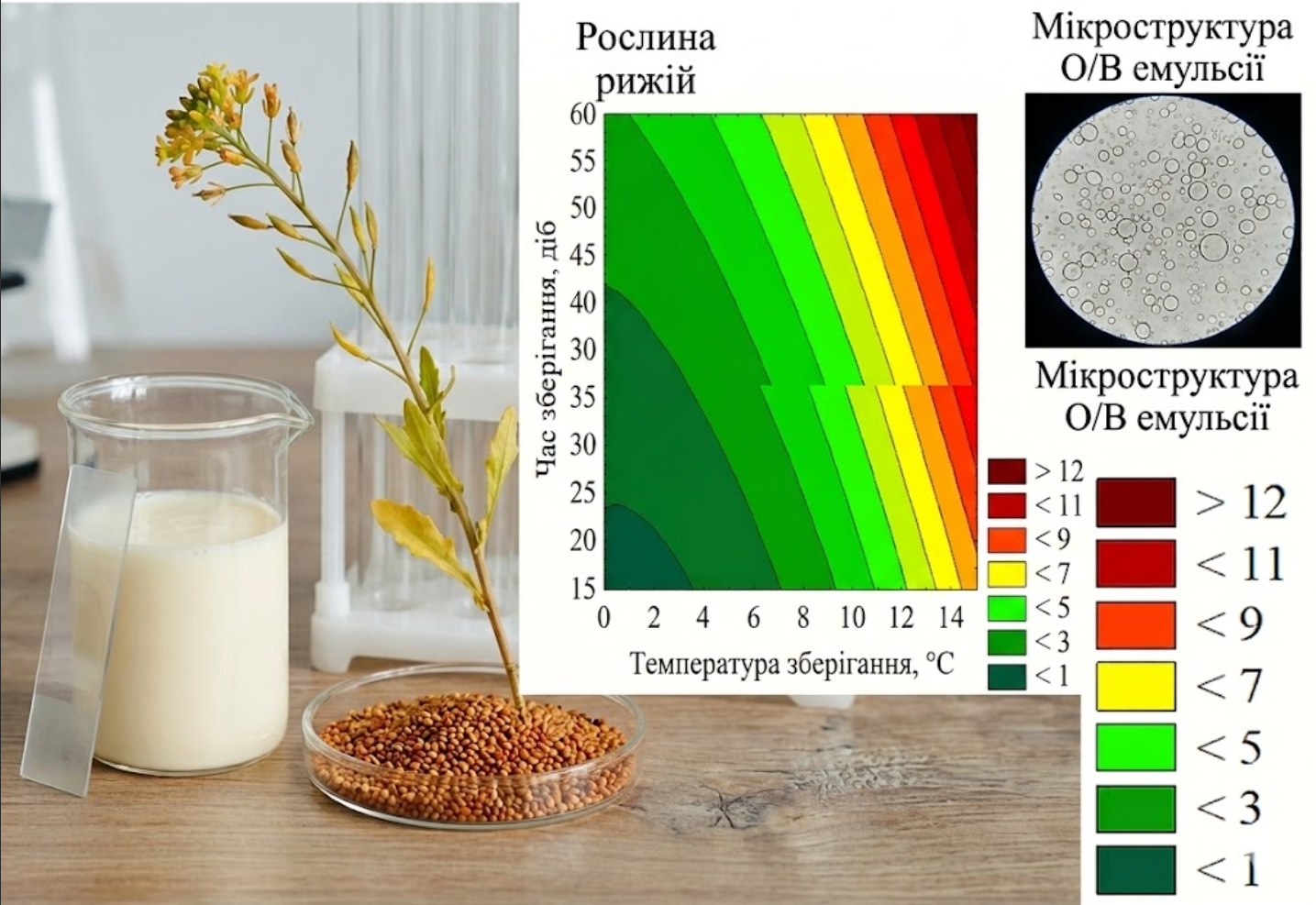
The work is devoted to solving the problem of oxidative stabilization of emulsion systems based on camelina oil (Camelina sativa) – a valuable and sustainable source of ω-3 polyunsaturated fatty acids – by incorporating a natural polar antioxidant, rosmarinic acid. The research is highly relevant in the context of green economy trends focused on developing functional food innovations and extending their shelf life. The distinct feature of this study is the determination of rosmarinic acid’s effect on oxidation kinetics and interfacial phenomena in oil-in-water emulsions during storage. The object of the study is the accumulation dynamics of oxidation products and the induction period of accelerated lipid oxidation under modeled conditions. An effective content of structural stabilizers (lecithin – 0.8–1.0 %; xanthan gum – 0.0–0.1 %) is proposed to ensure the physical integrity of the system. The optimal concentration range of rosmarinic acid (0.02–0.04 %) is outlined, the addition of which leads to a synergistic effect with lecithin phospholipids at the interface, thereby increasing the induction period of accelerated lipid oxidation by 2.2–2.8 times. The dynamics of the peroxide value in the lipid fraction were investigated under various temperature conditions (0–15 °C) over 15–60 days of storage. The results confirm the high efficacy of rosmarinic acid in retarding the degradation of polyunsaturated fatty acids. The applied aspect of the obtained results lies in the possibility of targeted modeling of stable functional agro-food, pharmaceutical, and cosmetic formulations based on highly nutritious camelina oil.
References
Abdullahi, A., Khairulmazmi, A., Yasmeen, S., Ismail, I. S., Norhayu, A., Sulaiman, M. R., Ahmed, O. H., Ismail, M. R. (2020). Phytochemical profiling and antimicrobial activity of ginger (Zingiber officinale) essential oils against important phytopathogens. Arabian Journal of Chemistry, 13, 8012–8025. https://doi.org/10.1016/j.arabjc.2020.09.031
Aguirre-Joya, J. A., De Leon-Zapata, M. A., Alvarez-Perez, O. B., Torres-León, C., Nieto-Oropeza, D. E., Ventura-Sobrevilla, J. M., Aguilar, M. A., Ruelas-Chacón, X., Rojas, R., Ramos-Aguiñaga, M. E., Aguilar, C. N. (2018). Basic and applied concepts of edible packaging for foods. In Food Packaging and Preservation. Elsevier. https://doi.org/10.1016/B978-0-12-811516-9.00001-4
Ahari, H., Naeimabadi, M. (2021). Employing nanoemulsions in food packaging: Shelf life enhancement. Food Engineering Reviews, 13, 858–883. https://doi.org/10.1007/s12393-021-09282-z
Alamri, S. A. M., Hashem, M., Alqahtani, M. S. A., Alshehri, A. M. A., Mohamed, Z. A., Ziedan, E. S. H. (2020). Formulation of mint and thyme essential oils with Arabic gum and Tween to enhance their efficiency in the control of postharvest rots of peach fruit. J. Indian Dent. Assoc., 42, 330–343. https://doi.org/10.1080/07060661.2019.1686654
Alliod, O., Almouazen, E., Nemer, G., Fessi, H., Charcosset, C. (2019). Comparison of three processes for parenteral nanoemulsion production: Ultrasounds, microfluidizer, and premix membrane emulsification. Journal of Pharmaceutical Sciences, 108, 2708–2717. https://doi.org/10.1016/j.xphs.2019.03.026
Almasi, H., Azizi, S., Amjadi, S. (2020). Development and characterization of pectin films activated by nanoemulsion and Pickering emulsion stabilized marjoram (Origanum majorana L.) essential oil. Food Hydrocolloids, 99, 105338. https://doi.org/10.1016/j.foodhyd.2019.105338
Álvarez-Martínez, F. J., Barrajón-Catalán, E., Herranz-López, M., Micol, V. (2021). Antibacterial plant compounds, extracts and essential oils: An updated review on their effects and putative mechanisms of action. Phytomedicine, 90, 153626. https://doi.org/10.1016/j.phymed.2021.153626
Alvarez-Perez, O. B., León-Zapata, M. Á. De, Molina, R. R., Ventura-Sobrevilla, J., Aguilar-González, M. A., Aguilar, C. N. (2019). Functionality features of candelilla wax in edible nanocoatings. In Research Methods and Applications in Chemical and Biological Engineering. Apple Academic Press. https://doi.org/10.1201/9780429424137-16
Arabpoor, B., Yousefi, S., Weisany, W., Ghasemlou, M. (2021). Multifunctional coating composed of Eryngium campestre L. essential oil encapsulated in nano-chitosan to prolong the shelf-life of fresh cherry fruits. Food Hydrocolloids, 111, 106394. https://doi.org/10.1016/j.foodhyd.2020.106394
Assadpour, E., Mahdi Jafari, S. (2019). A systematic review on nanoencapsulation of food bioactive ingredients and nutraceuticals by various nanocarriers. Critical Reviews in Food Science and Nutrition, 59, 3129–3151. https://doi.org/10.1080/10408398.2018.1484687
Baig, N., Kammakakam, I., Falath, W. (2021). Nanomaterials: A review of synthesis methods, properties, recent progress, and challenges. Materials Advances, 2, 1821–1871. https://doi.org/10.1039/D0MA00807A
Ban, Z., Zhang, J., Li, L., Luo, Z., Wang, Y., Yuan, Q., Zhou, B., Liu, H. (2020). Ginger essential oil-based microencapsulation as an efficient delivery system for the improvement of Jujube (Ziziphus jujuba Mill.) fruit quality. Food Chemistry, 306, 125628. https://doi.org/10.1016/j.foodchem.2019.125628
Bazargani, M. M., Rohloff, J. (2016). Antibiofilm activity of essential oils and plant extracts against Staphylococcus aureus and Escherichia coli biofilms. Food Control, 61, 156–164. https://doi.org/10.1016/j.foodcont.2015.09.036
Helikh, A., Filon, A. (2025). Biochemical variability of vegetable juice ety profile of vegan fermented sausages. Technology Audit and Production Reserves, 4(3(84)), 52–59. https://doi.org/10.15587/2706-5448.2025.334830
Helikh, A., Filon, A. (2025). Nanocomposite biopolymer coating with β-nanochitosan for preserving snail fillets: A synergistic antimicrobial system with Monarda punctata oil. 2025 IEEE 15th International Conference Nanomaterials: Applications & Properties (NAP). https://doi.org/10.1109/NAP68437.2025.11216270
Liu, Y., Helikh, A., Filon, A., & Duan, Z. (2023). Sausage technology for food sustainability: Recipe, color, nutrition, structure. Eastern-European Journal of Enterprise Technologies, 4(11(124)), 47–58. https://doi.org/10.15587/1729-4061.2023.286323
Bodirsky, B. L., Dietrich, J. P., Martinelli, E., Stenstad, A., Pradhan, P., Gabrysch, S., Mishra, A., Weindl, I., Le Mouël, C., Rolinski, S., Baumstark, L., Wang, X., Waid, J. L., Lotze-Campen, H., Popp, A. (2020). The ongoing nutrition transition thwarts long-term targets for food security, public health and environmental protection. Scientific Reports, 10, 19778. https://doi.org/10.1038/s41598-020-75213-3
Bouyahya, A., Abrini, J., Dakka, N., Bakri, Y. (2019). Essential oils of Origanum compactum increase membrane permeability, disturb cell membrane integrity, and suppress quorum-sensing phenotype in bacteria. Journal of Pharmaceutical Analysis, 9, 301–311. https://doi.org/10.1016/j.jpha.2019.03.001
Campolo, O., Giunti, G., Laigle, M., Michel, T., Palmeri, V. (2020). Essential oil-based nano-emulsions: Effect of different surfactants, sonication and plant species on physicochemical characteristics. Industrial Crops and Products, 157, 112935. https://doi.org/10.1016/j.indcrop.2020.112935
Chaudhari, A. K., Singh, V. K., Das, S., Deepika, Prasad, J., Dwivedy, A. K., Dubey, N. K. (2020). Improvement of in vitro and in situ antifungal, AFB1 inhibitory and antioxidant activity of Origanum majorana L. essential oil through nanoemulsion and recommending as novel food preservative. Food and Chemical Toxicology, 143, 111536. https://doi.org/10.1016/j.fct.2020.111536
Chaudhary, S., Kumar, S., Kumar, V., Sharma, R. (2020). Chitosan nanoemulsions as advanced edible coatings for fruits and vegetables: Composition, fabrication and developments in last decade. International Journal of Biological Macromolecules, 152, 154–170. https://doi.org/10.1016/j.ijbiomac.2020.02.276
Downloads
Published
Issue
Section
License
Copyright (c) 2026 Oles Honchar Dnipro National University

This work is licensed under a Creative Commons Attribution 4.0 International License.
- Authors reserve the right of attribution for the submitted manuscript, while transferring to the Journal the right to publish the article under the Creative Commons Attribution License. This license allows free distribution of the published work under the condition of proper attribution of the original authors and the initial publication source (i.e. the Journal)
- Authors have the right to enter into separate agreements for additional non-exclusive distribution of the work in the form it was published in the Journal (such as publishing the article on the institutional website or as a part of a monograph), provided the original publication in this Journal is properly referenced
- The Journal allows and encourages online publication of the manuscripts (such as on personal web pages), even when such a manuscript is still under editorial consideration, since it allows for a productive scientific discussion and better citation dynamics (see The Effect of Open Access).